

Watching a dog lose strength in its hind legs is hard, but losing walks entirely doesn’t have to be part of it. A well-fitted rear-support cart lets a dog with healthy front legs walk, sniff, and play again, often within days of getting used to it. This shortlist covers small-breed carts, a mid-size option from a well-known brand, and a lighter support brace for dogs who need help rather than wheels. Every entry here suits a specific weight range and body type, so measuring your dog before choosing matters more than anything else on this page.
The Shortlist At A Glance

LetPetRun Adjustable Dog Wheelchair White XS
LetPetRun Adjustable Dog Wheelchair White 3XS
LetPetRun Adjustable Dog Wheelchair White 2XS
LetPetRun Adjustable Dog Wheelchair Pink S
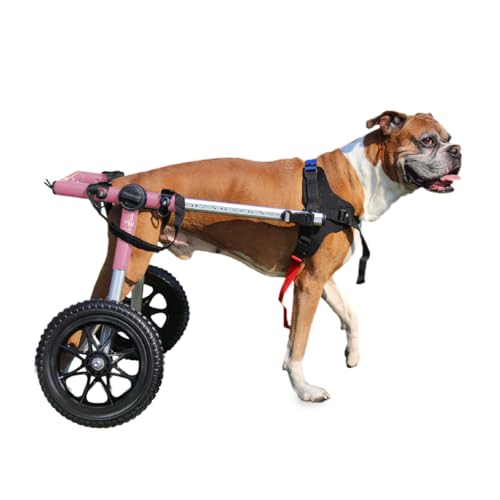
Walkin’ Wheels Dog Wheelchair Med/Large Dogs 50-69 lbs
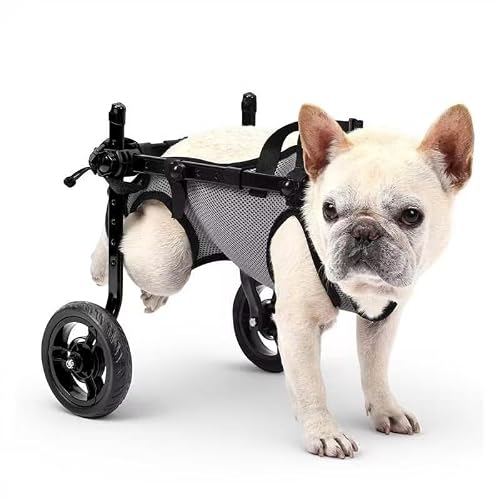
BECROWM Lightweight Adjustable Dog Wheelchair Cart

NeoAlly Cat and Dog Ankle Brace Pair Hock Support (S)
More Details On Our Top Picks
This extra-small LetPetRun cart targets dogs between 11 and 17.6 pounds, a range that covers beagles, smaller cocker mixes, and stocky terriers whose hind legs have weakened but whose front legs still carry them confidently. The frame adjusts in height, width, and length, which is what you want in a first cart since swelling, weight changes, and muscle tone all shift over a recovery period.
In daily use around a house with rugs and doorways, an adjustable frame earns its keep: you can loosen the fit for indoor lounging and tighten it slightly for backyard sprints. The white finish also makes it easy to spot dirt before it transfers to your furniture.
Strong Points
- Height, width, and length adjustments let one cart track your dog’s changing condition instead of being replaced.
- The XS sizing band fits a genuinely common small-dog weight range, so most owners in this bracket get a close match.
- Rear-wheel support keeps walking natural for dogs with healthy front legs, preserving their gait rather than replacing it.
- Bright white frame shows grime early, so cleaning stays ahead of messes indoors.
Things To Consider
- Owners commonly report that measuring carefully before ordering matters more than with fixed-size carts, since the adjustment window has limits at both ends.
- This design assumes working front legs; a dog weak on all four sides needs a different support style.
Key Specs
Who It Suits Best
Dogs in the 11 to 17.6 pound range recovering hind-leg strength whose front legs remain strong, especially in homes mixing indoor floors with yard time.
A Better Fit Elsewhere
Smaller pups under 11 pounds will sit better in the LetPetRun White 2XS or 3XS versions later on this list, which share the same adjustable design in tighter frames.
Few carts exist for dogs under seven pounds, and that gap is exactly where this 3XS version sits. Chihuahuas, Yorkies, toy poodles, and senior cats-sized dogs weighing 3 to 6.6 pounds get a frame scaled down to their actual proportions rather than a shrunken adult cart that swallows them. The same adjustability philosophy carries over from the XS reviewed above, so height, width, and length can all be tuned.
At this weight class, every ounce of frame matters. A cart that’s even slightly too tall forces a tiny dog to lean forward, so plan on a slow introduction with treats and short sessions while you dial the settings in.
What We Like
- Genuine 3XS coverage from 3 to 6.6 lb serves the tiniest breeds that most cart makers skip entirely.
- Adjustable geometry means one purchase can outlast weight fluctuations common in senior toy breeds.
- Light overall footprint stores easily in apartments where floor space is scarce.
Minor Gripes
- The narrow adjustment window demands precise measurements of leg length and chest width before ordering.
- Toy-breed owners widely note that patience during the first week of acclimation makes or breaks acceptance.
Made For
Owners of Chihuahuas, Yorkies, Maltese, and similar toys weighing under 7 pounds whose back legs have failed but front legs remain dependable.
Where A Sibling Pick Shines
Dogs edging past 6.6 pounds will find the LetPetRun White 2XS a steadier match, offering the same layout with a bit more clearance.
The awkward middle zone between 6.6 and 11 pounds trips up a lot of shoppers, because many cart lines jump straight from toy sizing to true small. This 2XS fills that slot with the same adjustable frame family as its siblings, tuned for dogs like papillons, Havanese, and petite Frenchies. Compared with the 3XS above, there’s simply more room to grow into it, which matters for younger dogs still filling out.
Day to day, this size tends to handle mixed terrain best within the LetPetRun range: slightly larger wheels clear sidewalk cracks and grass better than the smallest frames manage.
Highlights
- Covers the frequently overlooked 6.6 to 11 lb band where other brands leave a sizing hole.
- Shared adjustable design lets you fine-tune fit across height, width, and length as rehab progresses.
- Proportioned for small breeds specifically, avoiding the oversized-frame problem of generic “small” carts.
- Works for both permanent mobility loss and temporary post-surgery support.
Softer Spots
- Like the rest of this line, it requires healthy front legs; full-body weakness calls for a four-wheel solution instead.
- Straps and contact points need regular checking for wear, a routine chore owners of any fabric-contact cart should expect.
Quick Facts
Right Fit For
Papillon, Havanese, and small Frenchie households needing a mid-toy-size cart that won’t be outgrown within months.
Swap It Out When
Dogs heavier than 11 pounds belong in the LetPetRun White XS at the top of this list, which shares the design with a wider stance.
This is the largest configuration in the LetPetRun lineup covered here, built for dogs from 26.5 up to 44.1 pounds. That span reaches corgis, beagles, border collies, and sturdy spaniels, dogs heavy enough that frame stiffness starts to matter more than it does at toy scale. The pink colorway is purely cosmetic, but visibility is real: a bright cart is easier for drivers and cyclists to notice on shared paths.
Structurally, the same three-way adjustability applies, though at this weight you’ll want to double-check strap tension weekly since bigger dogs generate more force against harness points.
Upsides
- Extends the brand’s adjustable design into medium-dog territory up to 44.1 lb.
- High-visibility pink improves safety on neighborhood walks near traffic.
- Supports both long-term mobility loss and shorter rehabilitation stretches after injury.
Honest Caveats
- Heavier dogs put more stress on harness stitching, so periodic inspection is a sensible habit.
- For dogs above roughly 50 pounds, the Walkin’ Wheels further down this list is the sturdier route.
Whose Shelf It Belongs On
Corgi, beagle, and collie owners wanting an affordable adjustable cart sized squarely for the 26.5 to 44.1 pound range.
Consider Something Else When
Dogs approaching 50 pounds or more should move to the Walkin’ Wheels Med/Large model, engineered for that weight class with folding convenience added.
Walkin’ Wheels is the name most vets mention first in this category, and this med/large build covers dogs from 50 to 69 pounds with three leg-length options: 14 to 16 inches, 17 to 20 inches, and 21 to 22 inches. That second measurement axis is the detail worth pausing on. Weight alone doesn’t determine fit; a stocky bulldog and a lanky shepherd at the same weight need different frames, and Walkin’ Wheels handles that explicitly.
The practical standout is portability. The whole cart folds flat, so it slides into a car trunk for road trips, and every part including the foam-rubber wheels is washable. For families who travel with their dog, that combination is hard to argue with.
Reasons To Buy
- Three leg-length variants let you match frame height to your dog’s actual proportions, not just weight.
- Folds flat for car loading and compact storage between uses.
- All components, foam-rubber wheels included, are washable, which keeps hygiene manageable for a dog spending hours in the rig.
- Designed to let dogs run and play, not just shuffle, preserving quality of life for active large breeds.
- Established brand presence means replacement parts and sizing guidance are easy to find.
Points To Note
- You must measure rear leg length accurately before choosing among the three variants; guessing leads to returns.
- Large-breed carts take up more storage space than the small frames earlier in this list, folded or not.
Details At A Glance
Who Will Love This
Families with 50 to 69 pound dogs, especially those who travel by car and want a washable, foldable rig from a category-leading maker.
Not Your Match When
Dogs under 45 pounds are overserved here; the LetPetRun Pink S handles that range at a friendlier footprint and cost.
BECROWM takes a different angle than the LetPetRun line: breadth. One product page spans X-Small (4.4 to 6.6 lb), Small (5.5 to 18 lb), Medium (12.1 to 22 lb), and Medium-Large (22 to 40 lb), with harness-only add-ons available for each size. Multi-dog households, foster homes, and rescue volunteers benefit most from that spread, since one familiar design can serve several animals of different builds.
The U-shaped rear frame is the thoughtful touch here. Because it leaves the underside open, it doesn’t interfere with bathroom breaks, which cuts down on the strap-adjusting routine that closed-frame designs demand several times a day.
Bright Spots
- Four distinct size tiers cover roughly 4 to 40 pounds, unusual range for a single cart design.
- Open U-shaped rear frame permits natural bowel movements without removing the rig.
- Lightweight construction suits smaller dogs and older owners lifting it in and out of cars.
- Simple assembly reported by most owners, with no specialized tools involved.
Small Caveats
- The overlapping Small and Medium ranges mean careful measurement decides the right tier; two sizes can look plausible on paper.
- As a lighter build, it’s aimed at moderate activity rather than rough outdoor terrain.
Feature Snapshot
Best Suited To
Foster homes, rescues, and multi-dog families wanting one adaptable cart platform across several weight classes.
Look Elsewhere When
Single-dog owners above 50 pounds should go straight to the Walkin’ Wheels Med/Large, whose heavier-duty frame matches that class better.
Not every wobbly back end needs wheels. This NeoAlly pair supports the hock, the joint on a dog’s hind leg equivalent to a human ankle, and it’s sized for cats and small dogs: the S fits chest sizes of 15 to 17.7 inches, body lengths of 5.5 to 11.8 inches, and weights of 5.5 to 11 pounds. Think Bichon Frise, pugs, teddy-cut small breeds, and cats dealing with sprains or joint soreness.
Reflective straps are the quiet bonus. Evening leash walks around dim streets become noticeably safer when the moving legs carry reflective material. Talk with your vet before using any brace on a healing wound, since fit and wear time matter there.
Plus Points
- Supports hock joints for sprains, arthritis-related soreness, and post-injury stability without committing to a full cart.
- Reflective straps improve visibility on dusk and nighttime walks.
- Sold as a pair, so both hind legs get matched support rather than one-sided bracing.
- Sized for both cats and small dogs, rare flexibility in this niche.
Worth Noting
- Only the S size appears here, so larger dogs need to check the brand’s other listings.
- Braces require accurate chest, length, and weight measurements upfront; a loose brace shifts and rubs.
Core Details
Perfect Match For
Owners of Bichons, pugs, and senior cats needing light joint support during short recovery phases rather than full-time wheeled mobility.
Another Choice May Suit
Dogs with complete hind-leg paralysis need actual wheels, and the BECROWM Lightweight Cart in the matching size tier is the logical step up.
What Matters Most Before Choosing Dog Wheelchairs
Measure Twice, Order Once
Weight is only half the equation. Rear leg length, chest width, and body length all determine whether a cart sits correctly, and most sizing complaints trace back to skipped measurements. Use a soft tape measure while your dog stands naturally, and record numbers before browsing. A cart that’s half an inch off can rub, shift, or force an unnatural posture.
Match The Cart To The Condition
Rear-support carts assume strong front legs. Degenerative myelopathy, hip dysplasia, and post-surgical weakness all fit that profile; generalized weakness across all four limbs does not. Severe injuries deserve a vet conversation first, both to confirm a cart is appropriate and to set realistic rehab expectations alongside it.
Adjustability Beats Precision
A frame that tunes in height, width, and length absorbs the changes that come with recovery: muscle loss, weight shifts, swelling. Fixed-size carts cost less upfront but often get outgrown mid-rehab. Over a dog’s remaining active years, the adjustable route usually wins on value.
Think About Your Own Routine
Cleaning, storage, and car loading are the unglamorous parts of ownership. Washable parts, fold-flat frames, and open rear designs that allow bathroom breaks all reduce daily friction. Choose for the whole routine, not just the walk.
Key Considerations Across These Picks
Traps First Timers Fall Into
The most common error is buying on weight alone and ignoring leg length, then discovering the harness sits wrong. The second is skipping the acclimation period: most dogs need a week or more of short, treat-filled sessions before they accept a cart willingly. Expecting instant enthusiasm sets both of you up for frustration.
What Separates Premium From Basic
Higher-tier carts buy engineering, not decoration. Brand-name frames offer validated sizing systems, washable components, fold-flat storage, and available replacement parts. Budget carts cover basic mobility fine for light use, but households logging daily miles, traveling often, or supporting a large breed generally find the upgrade pays for itself in durability and fit.
Closing Thoughts
The right choice comes down to honest measurements and a clear picture of your dog’s condition. Tiny breeds have solid options in the LetPetRun 3XS and 2XS, mid-size dogs fit the Pink S or BECROWM, and larger companions belong in the Walkin’ Wheels. For lighter joint trouble, the NeoAlly braces may be all that’s needed. Whichever direction you go, give your dog time to adapt, and the walks you thought were over tend to come back.
