

Anyone juggling early shifts, late meetings, or weekend trips knows the guilt of a cat staring at an empty bowl. An electric feeder handles the schedule so you don’t have to, dispensing measured portions on time whether you’re home or not. The seven models below cover everything from basic battery-powered units to camera-equipped smart feeders, so there’s a fit for nearly every household and budget.
The Shortlist At A Glance

Sarpaws FW1 Automatic Cat Feeder and Water Dispenser

oneisall 2.4 GHz Wi-Fi Automatic Cat Feeder 3.5L

Faroro Automatic Cat Feeder 4L Dispenser (Black)

oneisall 2.4G Cordless Automatic Cat Feeder 20 Cups/5L
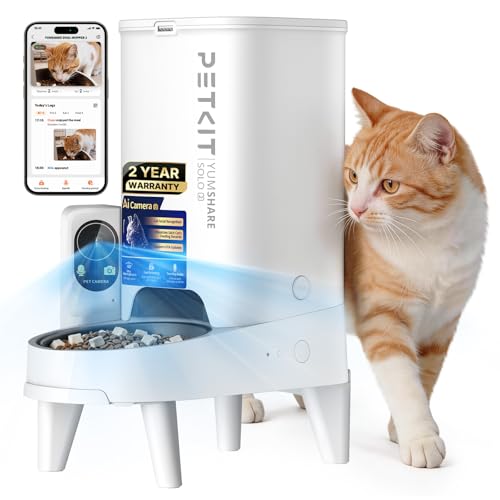
PETKIT Automatic Cat Feeder with Camera 1080P

PETKIT Dual Hopper Feeder with Camera 1080P

oneisall Automatic Cat Feeder for Large Kibble 12 Cups/3L
More Details On Our Top Picks
Most feeders solve half the problem: food yes, water no. The Sarpaws FW1 pairs a programmable dry-food dispenser with a water reservoir, which means one corner of the kitchen covers both essentials. It runs on wall power or batteries, so you can park it wherever the cat actually eats rather than wherever an outlet happens to be.
The locking lid matters more than it sounds. Anyone who has owned a clever cat knows hoppers get raided at 3 a.m., and a secure top keeps portions honest. A desiccant bag inside helps keep kibble from going stale between refills.
Strong Points
- Combined feeder and water station cuts down on separate bowls cluttering the floor.
- Dual power options let you place it anywhere, no outlet hunting required.
- Locking lid stops determined paws from self-serving extra meals.
- Built-in desiccant bag keeps dry food fresher between top-ups.
- Four daily meal slots suit most standard feeding routines.
Things To Consider
- No app connectivity, so schedule changes happen at the unit itself.
- Owners commonly report needing to clean the water section regularly to avoid film buildup.
Key Specs
Who Should Grab It
Single-cat households that want food and water handled by one tidy unit will find this the simplest all-in-one setup here.
Where A Sibling Pick Shines
Multi-cat homes juggling different diets should look at the PETKIT dual-hopper model instead, since two separate hoppers beat one shared supply.
Where the Sarpaws FW1 keeps things analog, this oneisall leans fully into app control over 2.4 GHz Wi-Fi. You adjust schedules, trigger a Feed Now session, and review feeding logs straight from your phone, which is genuinely useful when travel plans shift midweek. The stainless steel bowl is a quiet upgrade too: it resists the chin-acne irritation some cats develop around plastic dishes.
Portion precision is the headline spec. With up to ten daily meals available through the app, slow-feed pacing, and fine-grained portion sizing, it suits cats on strict vet-guided diets better than button-only units. Family sharing lets everyone in the house manage meals from their own device.
Upsides
- Full remote control means schedule tweaks take seconds from anywhere.
- Feeding logs help you spot skipped meals or overeating patterns early.
- Stainless steel bowl is more hygienic and easier to sanitize than plastic.
- Dual power backup keeps scheduled meals running through outages.
Minor Gripes
- Wi-Fi setup only works on 2.4 GHz networks, which trips up some mesh routers; expect a little fiddling during pairing.
- App dependence may frustrate anyone who prefers simple physical buttons.
Made For
Comfortable smartphone users managing a diet-conscious cat, especially those who travel and want remote control over every meal.
Swap It Out When
If your network situation is unreliable, the Faroro 4L feeder delivers similar scheduling discipline without any app requirement at all.
This is the workhorse of the list. The 4-liter hopper holds roughly 3.5 to 4.8 pounds of dry food, enough to keep a cat fed for about two weeks or a small dog for a week, according to the manufacturer’s figures. For weekend trips, that capacity alone removes the biggest worry.
Unlike the app-driven oneisall models, everything is programmed at the unit, and the trade-off works in its favor for reliability. Six meals per day with 10-gram portion steps give you real control, and the Slow Feed mode dribbles food out gradually, which helps gulping-prone pets avoid bloating and digestive upset.
Reasons To Buy
- Large 4L capacity stretches refills to roughly two weeks for one cat.
- Slow Feed mode slows down fast eaters, a genuine health convenience.
- Dual power supply keeps the schedule alive if household power cuts out.
- Handles cats and small dogs, adding flexibility for mixed pet homes.
- Button-based programming means no apps, accounts, or network fuss.
Small Caveats
- No remote access, so a last-minute schedule change requires standing at the machine.
- The hopper seals well enough, though owners commonly report wiping out kibble dust during monthly deep cleans.
At A Glance
Right Fit For
Practical owners who want maximum capacity and portion control without touching a smartphone will be happiest here.
Consider Something Else When
Remote scheduling is non-negotiable for you? The oneisall 2.4 GHz Wi-Fi feeder covers that gap while keeping similar portion flexibility.
Corded feeders live where your outlets are, not where your cat wants to eat. This cordless version breaks that constraint entirely, running on battery power while still connecting over 2.4 GHz Wi-Fi for full app control. You can move it between rooms, tuck it into a laundry corner, or reposition it seasonally without dragging a cable across the floor.
The 5-liter hopper is the largest in the oneisall lineup here, holding around 20 cups. Remote scheduling supports up to ten daily meals with twelve portions each, and real-time meal tracking in the app makes overfeeding easier to catch before it becomes a weight problem.
What We Like
- Cordless design frees you to place the feeder anywhere in the home.
- Biggest hopper among these picks, ideal for long absences.
- App-based meal tracking builds a clear record of eating habits.
- Up to ten remotely scheduled meals suits grazing-style feeders.
Points To Note
- Battery operation means checking charge levels before extended trips becomes part of your routine.
- Like its sibling above, it needs a 2.4 GHz network for remote features.
Quick Facts
Who Will Love This
Renters and anyone whose kitchen layout lacks a convenient outlet will appreciate the placement freedom more than any other feature.
Not Your Match When
You want visual check-ins on your cat while away? Step up to either PETKIT camera model, which adds monitoring this unit deliberately skips.
Feeding is only half the anxiety of leaving a cat alone; knowing they’re actually eating is the other half. This PETKIT folds a 1080P camera with a wide viewing angle directly into the feeder, complete with infrared night vision for after-dark check-ins. Two-way audio lets you talk to your cat, and motion capture flags activity worth reviewing.
In practice, this replaces a separate pet camera for many households, consolidating two devices into one footprint. The desiccant bag keeps stored kibble fresh, and the Meal Call feature plays a recorded prompt to draw your cat toward the bowl at feeding time.
Bright Spots
- Integrated 1080P camera eliminates the need for a standalone pet cam.
- Night vision captures movement even in dark rooms.
- Two-way audio lets you soothe an anxious cat remotely.
- Motion capturing surfaces notable activity without constant watching.
- Desiccant bag protects kibble freshness inside the hopper.
Softer Spots
- Camera features depend on a stable 2.4 GHz connection; weak Wi-Fi degrades the experience noticeably.
- More electronics mean more surface area to dust and wipe compared with simpler mechanical feeders.
Details At A Glance
Whose Shelf It Belongs On
Frequent travelers who currently run a feeder and a separate camera will find this consolidation genuinely simplifies their setup.
Another Choice May Suit
Households with two cats on different foods should pick the PETKIT dual-hopper version below instead, gaining a second chamber without losing any camera capability.
Two cats rarely agree on one food, and this is the only feeder here built around that reality. The dual-hopper design dispenses from two separate chambers, letting you serve different diets, mix wet-preference kibble with dental formulas, or split rations between pets without labeling jars. Everything else carries over from the single-hopper PETKIT above: the same 1080P camera, wide viewing angle, infrared night vision, and AI-powered motion detection.
Two-way audio and cloud video storage round out the monitoring side. The honest caveat is size; with two hoppers stacked under a camera module, this occupies more counter space than anything else in the lineup, so measure your spot first.
Plus Points
- Dual hoppers serve two different foods from one programmed unit.
- Same strong camera suite as the single-hopper model, including night vision.
- AI motion capturing highlights meaningful moments automatically.
- Desiccant protection in both chambers keeps each food fresh.
Trade Offs
- Larger footprint demands dedicated floor or counter space.
- More moving parts than single-hopper designs, so periodic cleaning takes a few minutes longer.
The Right Fit
Multi-cat homes managing separate prescriptions or preferences get the most practical value from this configuration.
Look Elsewhere When
A single cat with one food needs none of this; the standard PETKIT camera feeder delivers identical monitoring in a slimmer body.
Most automatic feeders choke on oversized kibble, jamming on pieces wider than their auger channel. This oneisall variant is engineered specifically for large kibble and treats up to 0.7 inches, solving a frustration many owners discover only after buying the wrong unit. Dental diets and chunky indoor formulas pass through cleanly.
Programming stays refreshingly straightforward: six meals per day with twelve portions per meal, each portion a precise 6 grams. That granularity supports careful weight management, and the corded design means no battery checks, just plug it in and set the schedule.
Standout Traits
- Accepts kibble up to 0.7 inches, covering large-piece and dental diets.
- Precise 6g portions make calorie-controlled feeding realistic.
- Six daily slots accommodate grazing routines.
- Corded power removes battery maintenance from the equation.
Areas To Watch
- Placement is tied to an outlet, unlike the cordless oneisall earlier in this list.
- Owners commonly report rinsing the bowl and hopper mouth weekly to prevent oil residue from building up.
Core Details
Who It Suits Best
Cats on dental or large-kibble formulas finally have a purpose-built option, and their owners will notice the difference immediately.
Reach For A Different Pick When
Standard small-kibble diets are better served by the Faroro 4L, which adds slow-feed pacing and bigger capacity at a friendlier commitment level.
What Matters Most Before Choosing Electric Cat Feeders
Capacity And Your Absence Pattern
Match hopper size to how long you’re actually away. A 3L tank covers a long weekend comfortably, while a 5L unit stretches past two weeks for a single cat. Oversizing wastes counter space; undersizing defeats the purpose entirely.
Power: Corded, Battery, Or Both
Corded models never need charging but anchor you to an outlet. Battery-powered units offer placement freedom yet demand pre-trip charge checks. Dual-power designs split the difference and are worth prioritizing for anyone traveling often.
Smart Features Versus Simplicity
App control earns its keep for remote schedule changes and feeding logs, but it requires a 2.4 GHz network and occasional troubleshooting. Button-only feeders trade convenience for fewer failure points. Decide honestly which trade-off fits your patience level.
Portion Precision And Diet Needs
Weight-managed cats need small, consistent portions, so look for granular sizing like 6g or 10g increments. Large-kibble households must verify compatibility explicitly, since most standard augers jam above roughly half an inch.
Key Considerations Across These Picks
Where Shoppers Go Wrong
The most common mistake is ignoring kibble size until the feeder jams. Check the maximum piece dimension against your current food before ordering. The second slip is assuming every smart feeder joins a 5 GHz network; nearly all of these require 2.4 GHz, and mismatched routers cause most setup complaints.
Why Top Tier Costs More
Camera models command higher prices because they bundle sensors, infrared emitters, microphones, and software development into one device. You’re paying for consolidated hardware, not just a motor. Households already owning a pet camera gain less from upgrading, while travelers replacing two devices often come out ahead.
Bottom Line
Every feeder here solves the core problem: reliable, measured meals without you standing over the bowl. Start with your constraints, outlet access, kibble size, number of cats, and appetite for apps, then narrow fast. The right choice is usually obvious once those three answers are honest. Whichever you land on, your cat’s routine gets steadier, and your mornings get quieter.
