

Leaving a dog home alone is harder than it sounds. Boredom turns into barking, chewing, and a very guilty greeting at the door. The right electronic treat dispenser keeps your dog occupied, rewards good behavior, and lets you stay connected from anywhere. Below are seven options that cover both ends of the spectrum: app-controlled camera dispensers for remote interaction, and hands-on puzzle feeders that build your dog’s problem-solving skills.
The Shortlist At A Glance

TKENPRO 2K Pet Camera Treat Dispenser with 360° View

TKENPRO 2K Pet Camera Treat Dispenser with AI Photo Album

TKENPRO 5MP Ultra HD Pet Camera with Treat Dispenser

PETGEEK Automatic Dog Treat Dispenser with Button (Blue)

PETGEEK Automatic Dog Treat Dispenser with Button (Green)

PetSafe Busy Buddy Kibble Nibble Treat Dispensing Dog Toy
Potaroma Dog Puzzle Feeder Toy, Interactive IQ Training
More Details On Our Top Picks
This unit combines two jobs into one footprint: an indoor security-style camera and a treat launcher you control from your phone. The 360-degree rotating head means one device can watch an entire living room, so your dog can’t hide behind the sofa during a work call. The built-in hopper holds roughly half a liter of snacks sized between 7 and 15mm, which covers most standard training treats.
For anyone working long office days, the appeal is simple: toss a reward mid-afternoon, talk through the two-way speaker, and check motion alerts without leaving your desk. Dual-band WiFi support (both 5G and 2.4GHz networks) helps the connection stay stable in crowded apartment buildings.
Strong Points
- Full-room coverage from a single rotating camera head
- Remote treat tossing turns a boring afternoon into a small event for your dog
- Two-way audio lets you calm a whining pup before it escalates
- Motion alerts ping your phone when activity starts
- Works on both 5G and 2.4GHz networks for flexible router setups
Things To Consider
- Treat size matters: sticks outside the 7-15mm range can jam the mechanism, so measure your snacks first
- The hopper needs regular emptying and wiping to keep old crumbs from gumming up the launcher
Key Specs
Who It Suits Best
Remote workers and frequent travelers who want monitoring and interaction in one device rather than buying a separate camera and feeder.
Where A Sibling Pick Shines
If crisp nighttime footage tops your list, the TKENPRO 5MP Ultra HD model later in this list offers upgraded low-light performance for the same core workflow.
Think of this as the sibling of pick one with a memory. The hardware story is familiar: 2K video, a 360-degree auto-tracking head, dual-band WiFi, two-way talk, and that same half-liter treat hopper fed by the phone app. The difference sits in the software layer, where onboard AI compiles your pet’s day into short highlight videos stored for about a month.
That album feature changes how the device fits into daily life. Instead of scrubbing through hours of footage after work, you get a ready-made reel of your dog napping, pacing, or catching a tossed treat. Owners who already share pet clips with family tend to find this the deciding factor, though the subscription-based storage is worth factoring into the total cost before committing.
What We Like
- AI-curated daily highlight reels save serious review time
- Auto-tracking follows your dog around the room without manual panning
- Same proven treat-tossing workflow as the base TKENPRO model
- Motion alerts keep you posted on unusual activity
Worth Noting
- The cloud album relies on a subscription, which adds a recurring cost some households won’t want
- AI editing occasionally picks odd moments, so expect a few dud clips mixed in
Made For
Pet parents who treat their dog’s daily antics as shareable content and want the highlights assembled automatically rather than manually.
Consider Something Else When
Households that only need live viewing and treat tossing will be equally served by the cheaper-feeling TKENPRO 2K base model at number one, minus the recurring storage fee.
Resolution is where this third TKENPRO variant pulls ahead. The 5-megapixel sensor captures noticeably finer detail than the 2K models above it, and the infrared night vision keeps footage usable after lights-out. In a dim hallway or a bedroom where your dog sleeps, that extra clarity is the difference between guessing what’s happening and actually seeing it.
The rest of the formula carries over: 355-degree rotation, automatic tracking, bark and motion detection with instant alerts, dual-band WiFi, and the same 0.5L treat chamber accepting 7-15mm snacks. Compared with the AI Photo Album version, you trade the curated reels for raw image quality, which suits owners whose priority is monitoring rather than memory-making. One practical note: higher-resolution streams demand more bandwidth, so homes with congested networks may see slower load times on cellular data.
Highlights
- 5MP sensor delivers the sharpest daytime detail in this lineup
- Infrared night vision keeps overnight checks genuinely useful
- Bark detection distinguishes vocal activity from ordinary movement
- Auto tracking plus treat tossing works identically to its siblings
Trade Offs
- Higher-resolution streaming eats more bandwidth, which can lag on weak connections
- You give up the AI photo album feature found on pick two
Quick Facts
Right Fit For
Overnight shift workers and light-sleeper households that check on their dog after dark and value image clarity over bonus software features.
Not Your Match When
Shoppers who want the richest feature set rather than pure video quality should look back at the TKENPRO AI Photo Album model instead.
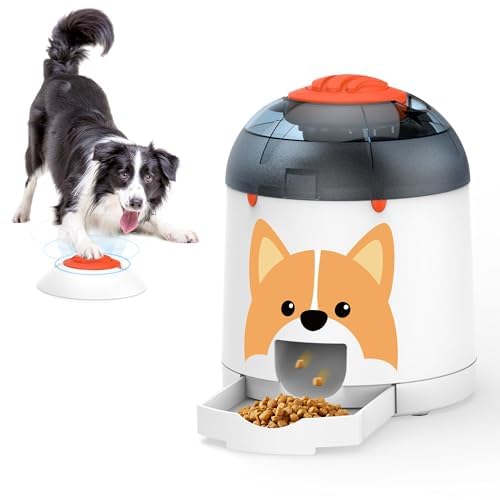
A complete change of pace from the camera units above. There’s no app, no WiFi, no video: just a sturdy plastic base, a food chamber that rotates to release rewards, and a big button your dog learns to press. The concept borrows from operant conditioning, the training principle where a correct action earns an immediate payoff, and it works because dogs figure out cause and effect quickly once treats follow every press.
Training sessions run best in short bursts, five minutes at a time, with you nearby to guide paw placement at first. Most determined learners crack the pattern within a few sessions according to widely reported owner experiences, though pushy dogs may try brute force before finesse. Once learned, it becomes self-directed entertainment that burns mental energy on rainy days.
Upsides
- Teaches genuine problem-solving rather than passive snacking
- No setup, pairing, or network dependency: fill it and start
- Reward timing reinforces memory and impulse control
- Encourages physical movement alongside mental effort
Minor Gripes
- Requires hands-on training time upfront, unlike the set-and-forget camera dispensers
- Kibble dust collects inside the rotating chamber, so plan a quick rinse weekly
Who Will Love This
Owners of smart, energetic breeds such as border collies or poodles who want structured brain work they can supervise directly.
Look Elsewhere When
Away-from-home interaction is the goal, in which case any of the three TKENPRO camera models handles remote rewarding far better than a button toy can.
Functionally, this is the blue PETGEEK trainer wearing a different coat. Same press-to-release button, same rotating inner chamber that drops kibble into the tray, same two selectable sound effects designed to draw your dog’s attention toward the button. The sound switch matters more than it sounds: some dogs respond better to a chirp, others to a click, and being able to toggle between them gives you a second chance with hesitant learners.
The honest question is why choose one color over the other, and the answer mostly comes down to availability and price at checkout. Both versions suit multi-dog homes too, since running two units side by side prevents resource guarding over a single machine. For first-time puzzle-toy shoppers testing whether their dog engages with this style of play, starting here costs little and teaches plenty.
Bright Spots
- Two switchable sound effects help hook different temperaments
- Identical training mechanics to the blue version at typically friendlier pricing
- Rotating chamber dispenses treats or regular kibble interchangeably
Small Caveats
- Color choice is cosmetic, so don’t expect any functional edge over pick four
- Flat-nosed breeds sometimes struggle with button reach, based on commonly reported owner feedback
The Right Fit
Budget-conscious trainers introducing puzzle play for the first time, or households adding a second unit for a multi-dog setup.
Skip It When
Your dog already masters button toys quickly; the Potaroma puzzle feeder at number seven offers a fresh challenge shape once this one is solved.
No electronics here either, but the Kibble Nibble earns its place by solving a different problem: speed eating. Fill the ball-shaped toy with up to 3.5 cups of kibble, and your dog must roll it around the floor to shake food out through the openings. Meals that used to vanish in thirty seconds stretch across twenty minutes of chasing and nudging, which is easier on digestion and far more engaging.
The random delivery pattern is the clever part. Because kibble exits unpredictably, the toy stays interesting long after a fixed puzzle has been memorized. PetSafe has made this design for years, and the hard plastic shell holds up to enthusiastic rolling on hardwood and tile alike. The small size shown here fits compact jaws; larger breeds need the bigger variant to avoid a choking-scale mismatch, so size carefully against your dog’s muzzle.
Reasons To Buy
- Slows down fast eaters at every meal, not just playtime
- 3.5-cup capacity can replace a bowl entirely for small dogs
- Random kibble release keeps the challenge fresh for months
- Simple rinse-and-dry cleaning with no electronics to protect
Points To Note
- Rolling on hard floors gets loud during mealtime, which light sleepers may mind
- Size selection is critical: too large frustrates small dogs, too small risks gulping
At A Glance
Whose Shelf It Belongs On
Owners of gulpers and weight-conscious dogs who want mealtime itself to become exercise, with zero tech involved.
Another Choice May Suit
Dogs needing mental challenge beyond mealtime will get more mileage from the PETGEEK button trainer, which targets problem-solving rather than eating pace.
Where the PETGEEK trainers rely on a single button, this Potaroma puzzle spreads the challenge across multiple interactive elements, giving your dog several problems to work through in one session. The manufacturer positions it for every breed from puppies to large dogs, and the adjustable difficulty is what makes that claim credible: beginners nose at the easy parts while experienced solvers dig into the trickier mechanisms.
It slots naturally into a rotation alongside earlier picks. After a week or two, most dogs solve any single puzzle format, so alternating between this, the Kibble Nibble, and a button trainer keeps novelty alive. Puppies teething through their first year benefit especially, since the puzzle channels chewing energy toward something with a payoff. Wipe the surfaces down regularly, as drool and kibble grease build up in the crevices faster than on smooth toys.
Plus Points
- Multiple puzzle elements in one unit extend session length
- Scales from puppy-simple to adult-dog challenging
- Doubles as a boredom breaker and a feeding station
- Compact enough to store in a cabinet between rotations
Softer Spots
- Heavy chewers may eventually damage plastic components, a pattern reported by some owners
- Crevice cleaning takes longer than with smooth ball-style feeders
Core Details
Built With In Mind
Puppy raisers and owners of intelligent mixed breeds who want a progressive challenge that grows with their dog’s skills.
Swap It Out When
Mealtime pacing is the actual concern; the PetSafe Kibble Nibble handles slow feeding more directly than any puzzle board can.
Choosing Between These Dispensers Without Regret
Remote Control Or Hands-On Play
The category splits cleanly in two. App-connected camera dispensers like the TKENPRO trio let you interact from anywhere, which matters for long shifts and travel days. Button and puzzle feeders demand your presence for training but cost less and never depend on your WiFi staying up. Decide first how often you’re actually home, then shop within the right half of this list.
Treat Size And Hopper Reality
Camera dispensers specify a treat window, usually 7 to 15mm, and ignoring it causes jams. Measure your current treats against that range before ordering anything with a launcher mechanism. Puzzle feeders are more forgiving but still perform best with round kibble rather than irregular shapes that wedge in corners.
Cleaning And Long-Term Upkeep
Food residue is the enemy of every dispenser. Rotating chambers and launcher tracks collect oils and crumbs that turn rancid, so favor designs you can disassemble quickly. Plan on a weekly wipe-down minimum, and empty hoppers fully if you’ll be away for more than a few days.
Matching Difficulty To Your Dog
A puzzle too easy gets ignored within days; one too hard gets abandoned in frustration. Start simple, watch how fast your dog solves it, and escalate. Rotation between two or three formats beats owning one difficult toy.
Key Considerations Across These Picks
Traps First Timers Fall Into
The most common mistake is buying a camera dispenser for a dog with separation anxiety severe enough that a tossed treat won’t soothe it; interaction helps mild cases, not every case. Shoppers also skip the treat-size check, then blame the machine for jams. And many overlook bandwidth: a 5MP stream on a crowded network disappoints.
Where The Extra Money Goes
Higher-tier models pay for sensor quality, smarter software, and cloud features. The jump from 2K to 5MP buys real low-light clarity, while AI albums add convenience at the cost of a subscription. Pay up for nightly monitoring or clip-sharing habits; stay basic for daytime-only check-ins.
Closing Thoughts
The right choice comes down to where you’ll be. Away from home most of the day points you toward the TKENPRO camera line, with the 5MP model leading on image quality. Home more often means the PETGEEK trainers or the Potaroma puzzle deliver more value per dollar. Match the tool to your schedule and your dog’s temperament, and any of these seven will earn its spot.
