

Bully breeds pull hard, slip collars, and out-muscle flimsy gear in a single lunge. A well-built harness spreads that force across the chest instead of concentrating it on the throat, which matters even more on a stocky neck. This list covers seven options built around wide chests and strong shoulders, from tactical vest styles to padded no-pull designs. Each one earns its place through fit range, build materials, and how it behaves on a real neighborhood walk.
An Overview Of The Picks

MOOGROU Tactical Harness and Leash Set with 10 Patches

AUNZO Orange Tactical Dog Harness with Ethnic Pattern, Large

Dog Friendly Co. Dog Harness for Medium Dogs (Sky Blue)

Dog Friendly Co. Dog Harness for Large Dogs (Purple)
xipebros No Pull Reflective Adjustable Dog Harness (Black, XXL)

ICEFANG Dog Halter Harness with Metal Buckles
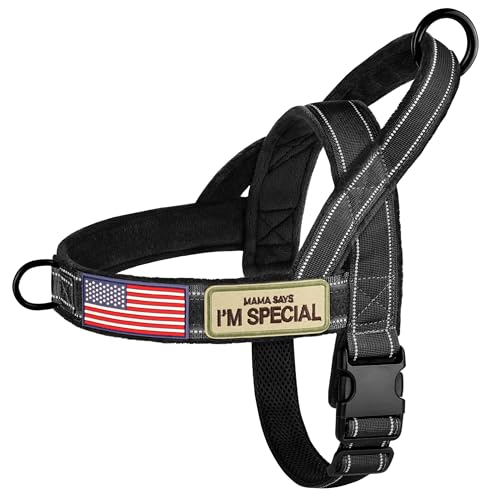
Forestpaw No Pull Dog Harness with Handle, XL, Black
A Closer Look At Each Pick
Most harnesses make you buy the leash separately; this MOOGROU set bundles one in, and the leash doubles as a car restraint. The vest carries a MOLLE webbing system, a grid of sewn straps that lets you attach pouches or ID panels anywhere along the body.
You get five pairs of hook-and-loop patches covering messages like “IN TRAINING” and “DO NOT PET”, plus a clear window holding an anti-lost name card. For anyone walking a reactive bully through crowded areas, that visible communication does real work before you say a word.
Standout Benefits
- Patch panels let strangers read your dog’s status instantly, useful in parks and vet waiting rooms.
- Included leash doubles as a car harness, trimming one purchase off your setup.
- Name card window helps recovery if your dog slips away on a walk.
- MOLLE layout accepts extra pouches for treats or waste bags on longer outings.
Points To Note
- The patch surface collects lint and dog hair, so plan on occasional cleaning to keep messages legible.
- Tactical styling runs heavier than a basic padded vest, which some dogs need time to accept.
Who It Suits Best
Handlers training a young bully breed who want clear public signaling plus a full kit in one order.
Where A Simpler Pick Shines Instead
Daily walkers who skip the patch system will prefer the lighter Dog Friendly Co. Large harness reviewed below.
Getting a vest over a wide bully skull is the worst part of every walk, and AUNZO solves it with an extra buckle at the neck. You clip the neck strap open and closed rather than threading your dog’s head through, a small change you’ll appreciate twice a day.
The brand lists English Bulldogs, Dobermans, Huskies, Rottweilers, and Labradors among its recommended fits, so deep chests are clearly part of the design brief. Compared with the MOOGROU set above, you trade the patch system for a distinctive ethnic-pattern shell and a simpler, lighter wear experience.
Strengths Worth Knowing
- Neck buckle eliminates head-threading entirely, ideal for head-shy dogs.
- No-pull construction aims at escape resistance without choking pressure.
- Sizing guidance spans bulldogs through greyhounds, so broad chests have documented room.
- Bright orange shell adds visibility on early morning or dusk walks.
Honest Caveats
- Measure chest and neck girth before ordering; the maker stresses careful sizing, and large-breed returns get tedious.
- One size per listing means less adjustability headroom than multi-size platforms.
Quick Facts
Right Fit For
Owners of broad-headed breeds who fight the same over-the-head struggle every morning.
Consider Something Else When
Handlers needing public-status patches will find more utility in the MOOGROU tactical set at number one.
Not every bully mix fills out a large frame, and this medium-sized version from Dog Friendly Co. targets exactly that gap. Staffy crosses and compact pocket bullies often sit between standard sizes, and adjustable neck and chest straps give you the slack to dial in a snug fit.
One detail deserves attention before checkout: the base harness ships with only a heavy-duty back D-ring. A front D-ring, the attachment point that discourages pulling by redirecting your dog sideways, sells separately as a modular add-on. In our view that modularity suits owners who’d rather not pay for hardware they won’t use, though pullers should budget for the upgrade.
Useful Highlights
- Adjustable neck and chest straps prevent choking or strain on shorter, stockier frames.
- Heavy-duty back D-ring handles everyday leash duty without flexing.
- Modular front D-ring option lets you add no-pull control only when needed.
- XXS through XL sizing means multi-dog households can match gear across pets.
Small Caveats
- Front D-ring costs extra, so true no-pull walking requires a second purchase.
- Back-clip-only setups give strong pullers more leverage than front-attachment designs.
Who Should Grab It
Owners of smaller bully mixes who want clean everyday styling and a tailored fit over bulk.
A Better Fit Elsewhere
Full-size American Bulldogs and Rottweilers should step up to the Large purple version next in line.
This is the same platform as the sky blue medium above, scaled up for dogs like adult Staffordshire Terriers and Boxers. The shared design language makes it an easy recommendation: adjustable neck and chest straps tuned to stop choking or strain, backed by a heavy-duty back D-ring rated for daily walking.
Where it differs from the tactical entries earlier in this list is feel. There’s no MOLLE grid, no patch panel, just a padded vest meant to disappear on the dog during a long stroll. Owners commonly report that streamlined vests like this one cause fewer rub points under the front legs than heavily featured alternatives, though coat type always plays a role.
Everyday Perks
- Wide adjustment range accommodates muscular chests without pinching shoulders.
- Strap tension distributes leash force across the torso instead of the throat.
- Optional front D-ring converts it into a no-pull rig for determined pullers.
- Purple colorway stands out in low light better than black or grey shells.
Things To Weigh
- The front D-ring remains a separate purchase, adding cost for no-pull use.
- Minimalist padding offers less protection for dogs that drag against fences or brush.
Feature Snapshot
Made For
Large bully owners prioritizing comfort and simple daily wear over tactical extras.
Look Elsewhere When
Working handlers who need a grab handle for control should jump ahead to the Forestpaw XL further down.
Summer heat changes the harness math for dense-coated breeds, and xipebros answers with a double-layer mesh body. Mesh breathes where solid nylon traps warmth, which keeps pit bulls and similar short-coated powerhouses cooler on humid evening walks.
The design routes the leash attachment near the shoulders, spreading pressure across the chest rather than the neck. That geometry also removes any chance of throat compression, a genuine concern with collar-walking a strong dog. Reflective elements earn their keep after dark; drivers pick up the glint well before headlights reach the dog itself. Against the pricier Dog Friendly Co. vests, you give up modular hardware but gain airflow and a friendlier entry cost.
Well-Handled Touches
- Double-layer mesh balances tensile strength with ventilation for warm climates.
- Shoulder-level leash point distributes force evenly, easing strain on both ends of the lead.
- Widened chest strap on larger sizes improves durability under sustained pulling.
- Reflective trim boosts visibility during night walks.
Worth Bearing In Mind
- Mesh weaves can snag on rough surfaces, so check the fabric after brush-heavy trail sessions.
- Sizing runs specific to the XXL cut; measuring girth first avoids the usual return loop.
Details At A Glance
Who Will Love This
Budget-conscious owners in hot regions walking powerful but trainable dogs on a schedule.
Where Another Pick May Suit
Rough-terrain hikers will favor the abrasion-resistant 1000D nylon of the Forestpaw harness closing this list.
Plastic buckles are the first failure point on most harnesses, and ICEFANG swaps them for metal. On a dog that throws its weight into a leash, that difference compounds over months; metal hardware simply doesn’t develop stress cracks the way molded polymer can.
The halter-style strap vest sits closer to the body than the padded vests ranked above, trading some cushioning for a lower profile and freer movement. ICEFANG publishes detailed girth ranges per size, Small running roughly 14 to 18 inches at the neck up to X-Large near 28 inches, and the brand is upfront about measuring before buying. That precision cuts both ways: expect an accurate fit, but respect the chart rather than guessing.
Positive Takeaways
- Metal buckles resist cracking under repeated hard loads.
- Published neck and chest measurements per size make fitting predictable.
- Low-profile halter cut allows natural shoulder movement during exercise.
The Fine Print
- Less padding than vest-style rivals, so very lean-coated dogs may feel strap pressure.
- Exact sizing leaves little forgiveness; a mid-growth puppy will outgrow it quickly.
Key Specs
Built With In Mind
Detail-oriented owners of fully grown, muscular dogs who trust a tape measure over guesswork.
Swap It Out When
Anyone wanting plush padding and color options will get more satisfaction from the Dog Friendly Co. Purple vest.
The top-loop handle is what separates this Forestpaw from everything above it. A firm grip at the back lets you steady an 80-plus-pound dog past another walker, guide it into a car, or hold position at a curb, something a D-ring alone never manages gracefully.
Underneath that handle sits serious material spec: premium 1000D nylon, a term describing tightly woven cordura-grade fabric, paired with a POM buckle and alloy D-ring for tear and abrasion resistance. The XL cut lists a fixed 21-inch front chest panel with an adjustable belly span of 32 to 39 inches, aimed squarely at dogs between 80 and 110 pounds. The maker suggests leaving two fingers of clearance beyond actual measurements, a tip worth following.
A Few Highlights
- Rear handle gives immediate physical control in tight or tense moments.
- 1000D nylon shrugs off abrasion from pavement, brush, and rough play.
- Alloy D-ring and POM buckle hold up to sustained heavy loading.
- No-pull geometry supports leash training without throat pressure.
Things To Consider
- The unadjustable 21-inch front panel locks in fit, so borderline chest measurements are risky.
- Heavier construction adds warmth compared with the mesh-bodied xipebros option.
The Numbers That Matter
The Right Fit
Owners of full-grown American Bullies, Mastiffs, or Rottweilers who want hands-on control during city walks.
Reach For A Different Pick When
Hot-climate walkers should weigh the ventilated xipebros mesh harness instead, especially under 80 pounds.
What Matters Most Before Choosing Harnesses For Bully Breeds
Girth Beats Weight Every Time
Breed weight charts mislead constantly because bully builds vary enormously within one weight class. Wrap a soft tape around the widest part of the ribcage and the base of the neck, then match those numbers to the manufacturer’s own chart. Two fingers of slack beyond the measurement is the standard comfort rule.
Attachment Point Shapes Your Walk
Back clips suit calm walkers and jogging partners, while front clips redirect a lunging dog sideways and drain pulling momentum. Several picks here offer both paths, sometimes with the front ring sold separately. Decide which behavior you’re managing before committing.
Hardware And Fabric Determine Lifespan
Metal buckles and alloy D-rings outlast polymer equivalents under repeated load, and 1000D nylon resists the abrasion that frays cheaper weaves within a season. Hot climates argue for mesh bodies; rough terrain argues for dense woven shells.
Control Features Earn Their Place
A rear handle looks minor until you need to physically steady a powerful dog near traffic. Patch panels communicate temperament to strangers. Match these extras to your actual environment rather than accumulating features you’ll never touch.
Key Considerations Across These Picks
Traps First Timers Fall Into
The most common error is sizing by weight alone, which produces harnesses that rub armpits or slide sideways on a deep chest. Ordering a back-clip vest for a committed puller is the second; the geometry fights you all walk long. Measure first, then buy for behavior.
The Case For Spending Up
Higher-tier models put money into metal buckles, denser nylon, and published sizing charts. Those details translate directly into years of service instead of one snapped buckle. For dogs over 80 pounds, the upgrade typically pays for itself the first time cheap hardware holds.
Bottom Line
Bully breeds deserve gear matched to their build, not their weight class. Measure neck and chest girth, pick the attachment style that fits your dog’s walking habits, and let materials decide between the finalists. Any of these seven will hold up to honest daily use once the fit is right, and the right choice is simply the one that matches your dog’s size and your routine.
