

A Doberman pulls differently than most dogs. The breed’s deep chest and lean frame mean a generic vest either rides up into the throat or slips sideways at the first lunge, which is why so many Dobie owners cycle through three or four options before finding one that holds. This roundup focuses on harnesses with wide adjustment ranges, front and back attachment points, and enough structure to handle a muscular 70-pound dog without chafing. Whether your dog is in training, working service tasks, or just dragging you down the sidewalk every morning, one of these seven will fit the job.
Your Options, Compared

MOOGROU Tactical Dog Harness and Leash Set with 10 Patches

Yungaspy No Pull Tactical Dog Harness Service Dog Vest (Green, M)

HEYCAHVA Tactical Dog Harness Full Metal Buckles (Black, XL)

Dog Friendly Co. Dog Harness for Large Dogs (Khaki, Large)
Forestpaw No Pull Dog Harness with Large Handle (Brown, M)
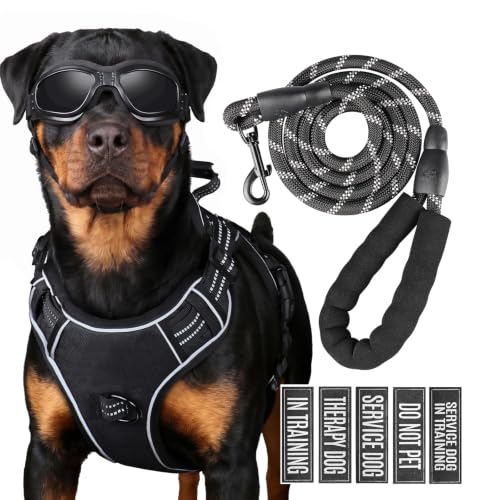
yimeis No Pull Tactical Dog Harness and Leash Set with Patches (Black, L)

Yintrest No Pull Reflective Front Clip Pet Vest (Black, L)
The Details Behind The Selections
Few harnesses arrive this complete. The MOOGROU set bundles a vest-style harness with a matching leash that can also serve as a car restraint, plus a clear ID window so a lost-dog card stays readable through rain and mud. Ten hook-and-loop patches come included, letting you label your dog’s status at a glance.
For anyone starting training with an adolescent Doberman, that patch system earns its keep. Swap “IN TRAINING” for “DO NOT PET” depending on the day’s session, and strangers at the park adjust their approach before you say a word. Compared with bare-bones vests like the Yintrest further down, you’re paying for communication tools as much as control.
Key Advantages
- Leash doubles as a car restraint, saving a separate purchase
- Ten patches cover training, service, and temperament messaging
- Clear window keeps contact details visible and protected
- MOLLE webbing accepts extra pouches for long outings
Things To Consider
- Owners commonly report needing to re-check strap tension after the first few weeks as padding compresses
- More patches and panels mean more surface to wipe down after muddy walks
Feature Snapshot
Who Should Grab It
New Doberman owners running structured obedience or public-access training who want labeling and control sorted from day one.
Swap It Out When
Skip this kit and reach for the HEYCAHVA tactical harness if heavy metal buckles matter more to you than patch variety.
The olive-green Yungaspy reads less military and more trail dog, which suits owners who hike rather than drill. Its medium size targets neck girths of roughly 18 to 22 inches and chest spans up to about 40 inches, a range that fits adolescent Dobermans still filling out. Four sizes run from S to XL, so you can size up as your dog matures.
No-pull designs like this distribute leash pressure across the chest instead of the throat, and that matters doubly on a breed built for pulling power. Where the MOOGROU set leans toward urban training sessions, this one feels at home on dirt paths and long weekend treks. In our view, it’s the quieter choice for owners who want function without a wall of patches.
Standout Benefits
- No-pull geometry eases throat strain during strong lunges
- Size range accommodates growing adolescents across four steps
- Muted green styling blends into outdoor settings
Small Caveats
- Measure carefully against the chart; between-size dogs may find the medium snug across a broad Doberman chest
- Fewer included accessories than kit-style picks, so budget separately for patches or a second leash
The Right Fit
Hikers and K9-style trainers with a medium-framed Doberman who prioritize pull control over accessory mounting.
Another Choice May Suit
Larger, full-grown Dobies with deeper chests fit the HEYCAHVA XL better, since its chest range stretches to 46 inches.
This is the harness built around a simple premise: plastic buckles are the failure point on strong dogs. The HEYCAHVA swaps them all for full metal hardware, and its five adjustment points tune neck, chest, and body fit across a generous 27-to-46-inch chest span. The manufacturer explicitly calls out deep-chested breeds, Dobermans among them, and recommends sizing up for comfort when measurements land between sizes.
Night walks get a small bonus here: two glow-in-the-dark patches ship with the vest, one marked for service work and one for training. MOLLE webbing runs along both flanks, so water bottles or waste-bag pouches clip on without rattling. Against the lighter Yungaspy above, this is the pick for a mature male Dobie at full muscle.
What Pays Off
- All-metal buckles remove the most common breakage point on powerful pullers
- Five adjustment locations dial in fit on deep, narrow chests
- Glow-in-the-dark patches improve visibility after dusk
- Dual-side MOLLE carries gear symmetrically without shifting
Points To Note
- Metal hardware adds weight, which smaller or senior dogs may notice on long wear
- The glow patches dim over time and typically need sunlight exposure to recharge
Quick Facts
Made For
Owners of full-grown, powerful Dobermans who walk in traffic or low light and want hardware that won’t snap mid-lunge.
Reach For A Different Pick When
Dog Friendly Co.’s khaki harness suits you better if minimalist everyday style outweighs tactical load-carrying.
Not every Doberman owner wants to look like a deployment unit. The khaki Dog Friendly Co. harness strips the category back to clean lines and adjustable straps, sized across XXS to XL with independent neck and chest tuning. One detail separates it from everything else here: the front D-ring is a modular add-on sold separately.
The stock configuration gives you a single heavy-duty back ring for everyday leashed walks. Front-clip attachment, the setup that discourages pulling by steering the dog’s shoulders, becomes available once you buy the add-on piece. That modularity keeps the base price down but does add a decision. Think of it as buying the chassis now and the steering upgrade later.
The Case For It
- Adjustable neck and chest straps fit a wide span of large builds
- Modular front ring lets you upgrade to no-pull walking later
- Restrained khaki look works in town and at the office dog park alike
Where It May Fall Short
- Front D-ring costs extra, unlike the integrated clips on the Yintrest below
- No handle or MOLLE means limited emergency control on reactive days
Core Details
Best Suited To
Well-mannered adult Dobies whose owners value a tidy everyday harness and don’t need tactical extras.
Skip It When
Choose the yimeis set instead if your dog is actively in service training and you need patches and a leash bundled in.
The standout feature here is the oversized top handle, and for a Doberman owner it solves a real problem: short moments where you need instant physical control, like stepping aside for a cyclist or separating a greeting gone tense. A firm grip beats fumbling for a collar every time.
Construction leans on 1000D nylon, a dense weave rated for tear and abrasion resistance, paired with a POM buckle and alloy D-ring. The medium runs a fixed 17-inch front chest panel with an adjustable belly band from 23 to 28 inches, aimed at dogs in the 28-to-50-pound band. That sizing note matters: many adult Dobermans outgrow the medium, so measure honestly before ordering. The brown tone hides city grime well between washes.
Points In Its Favor
- Large handle gives immediate hand control in tight situations
- 1000D nylon shrugs off abrasion from brush and pavement
- Alloy D-ring resists bending under sudden leash loads
Less Ideal Details
- Fixed front chest width limits fine-tuning compared with fully adjustable rivals
- Medium sizing suits younger or smaller Dobies only; big adults need another pick
Who Will Love This
Owners of teenage Dobermans in the 30-to-50-pound range who want a soft-grip safety handle during city walks.
Look Elsewhere When
The HEYCAHVA XL handles full-sized adults far better, with a chest range stretching nearly twice as wide.
Where the MOOGROU kit covers the basics, the yimeis bundle goes further: twelve morale patches instead of ten, a thicker 1.2cm leash stretched to 120cm, reflective trim, a control handle, and full MOLLE webbing. Everything a service-dog-in-training household needs arrives in one box, sized large for chest girths of 20 to 34 inches and necks of 19 to 25 inches.
The included leash deserves mention. At that thickness it feels substantial in hand against a lunging Dobie, and the length leaves room for loose-leash practice without tangling your feet. Reflective stitching across the vest helps on early-morning routes. Owners commonly report that the Velcro panels hold patches securely through rough play, though frequent washing tends to soften the loop fabric over time.
The Good Stuff
- Twelve patches support evolving service and training labels
- Thick 120cm leash handles strong dogs confidently
- Reflective detailing improves dawn and dusk visibility
- Top handle offers quick restraint near traffic
What To Weigh
- Hook-and-loop panels collect lint and pet hair, needing occasional cleaning
- Large sizing tops out below the biggest males; verify chest tape numbers first
Essential Details
Whose Shelf It Belongs On
Service-dog handlers and serious amateur trainers running a mid-to-large Doberman through public access work.
Consider Something Else When
The simpler Yintrest vest makes more sense for casual neighborhood walkers who’ll never use twelve patches.
Every list needs the honest value option, and this is it. The Yintrest delivers the two features that actually change pulling behavior: a front leash ring that redirects a charging dog sideways, and a rear ring for relaxed heel work. Two metal attachment points, no add-ons required, unlike the Dog Friendly Co. harness that charges separately for its front clip.
The shell uses abrasion-resistant Oxford fabric, a tightly woven synthetic that stands up to daily friction, with reinforced stitching at stress seams. Reflective thread wraps the vest in a full 360 degrees, catching headlights from any angle on night walks. You give up MOLLE webbing, patches, and a bundled leash here, but the core job, stopping the choke-and-pull cycle on a strong chest, gets done for less money than anything else on this page.
Practical Advantages
- Front and rear rings included, ready for anti-pull training immediately
- 360-degree reflective threading maximizes night visibility
- Oxford shell with reinforced seams withstands daily wear
A Few Limitations
- No handle or gear mounting, so emergency control depends entirely on the leash
- Basic padding tends to flatten faster than premium vests, per common owner reports
Key Specs
Right Fit For
Budget-conscious owners of a young or mid-size Doberman who mainly need reliable pull control on daily neighborhood loops.
Where A Sibling Pick Shines
Handlers wanting patches, a matched leash, and heavier build should step up to the yimeis three-piece set.
What Matters Most Before Choosing Harnesses For Doberman
Measure Twice, Order Once
A soft measuring tape around the widest part of the chest and the base of the neck tells you more than any weight chart. Dobermans carry unusual proportions: a deep ribcage under a relatively narrow frame. Leave a two-finger gap under every strap so the vest moves with the dog instead of sawing into the armpit.
Attachment Points Drive Training
Front clips redirect a pulling dog by turning its shoulders, while back clips suit calm, trained walkers. Having both, as on the Yintrest and yimeis models, lets you match the ring to the day’s lesson. A single back ring works fine only once loose-leash manners are already solid.
Hardware Outlasts Fabric
Buckles and D-rings fail before nylon does on powerful breeds. Full-metal hardware, like the HEYCAHVA’s buckles, removes the weakest link entirely. Plastic components cost less but deserve honest scrutiny before trusting them to a 70-pound sprinter.
Match Extras To Reality
Patch systems, MOLLE webbing, and ID windows earn their space for service and training dogs. For a settled family companion they’re dead weight. Buy for the routine you actually live, not the one you imagine.
Key Considerations Across These Picks
Traps First Timers Fall Into
Sizing by weight alone sinks more purchases than anything else. Two dogs can weigh identically while needing different vest sizes entirely. The second trap is ignoring strap adjustability; a fixed-panel harness that fits today may pinch next season as muscle develops.
What The Higher Tier Buys
Spending up generally buys metal hardware, denser webbing, and finer adjustment granularity. Those upgrades pay off for strong pullers, daily long-distance walkers, and reactive dogs. Casual strollers with an obedient adult rarely feel the difference worth paying for.
Bottom Line
Your Doberman’s age, chest depth, and daily routine should drive this decision more than any ranking. Growing adolescents fit the Yungaspy or Forestpaw; full-power adults belong in the HEYCAHVA; service teams get the most from the yimeis or MOOGROU kits. Measure your dog tonight, order accordingly, and give any new harness a week of short walks before judging the fit. The right vest disappears on the dog, and that’s exactly how you’ll know.
