

Scooping a litter box twice a day gets old fast, and the smell that comes with it is worse. A self-cleaning box paired with real odor control changes the daily routine: waste gets raked or rotated away on its own, and the air in your home stops announcing that you own cats. This roundup covers eight options for 2026, from budget-friendly automated boxes to a standalone ozone deodorizer you can pair with any setup. Multi-cat households, apartment dwellers, and anyone tired of the 6 a.m. scoop will find something here worth a look.
Your Options, Compared

DuckSky Multi-Function Self Cleaning Litter Box 65L+9L

Lohhuby Automatic Cat Litter Box Self Cleaning (White)

Mimfam AS11 Automatic Self Cleaning Litter Box (Grey)
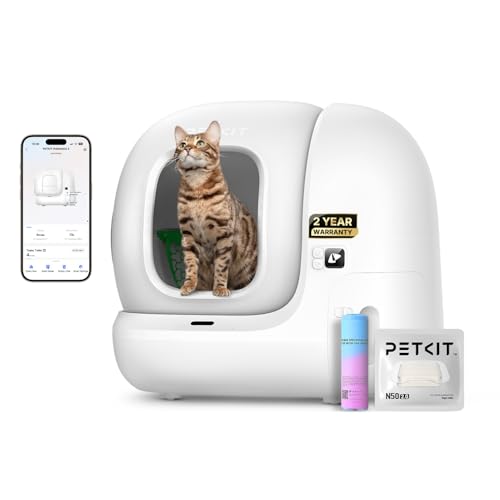
PETKIT PuraMax 2 Automatic Self-Cleaning Litter Box

PetPivot Open Top Self Cleaning Cat Litter Box

PETKIT Purobot Max 3 Self-Cleaning Cat Litter Box

Ladnut Ozone & Negative Ion Cat Odor Deodorizer

BCHARYA Self Cleaning Cat Litter Box with APP Control
A Closer Look At Each Pick
The headline here is sheer volume: 65 liters of toilet space plus a separate 9-liter waste compartment. In a three-cat house, that combination means fewer emptying trips and less chance of a mid-week overflow. Instead of the usual pull-out drawer, this model uses an integrated disposal system that moves waste straight into its own bin.
The 2026 revision also addresses the concern that keeps many cat owners away from automatic boxes entirely, namely a cat being inside during a cycle. App control rounds out the package, letting you trigger cleans and check status remotely. Ships from the brand’s US warehouse with a 30-day return window, which softens the risk of trying it.
A Few Highlights
- 65L of interior room gives large or multiple cats genuine elbow space during use
- All-in-one waste disposal replaces drawer collection, so mess stays contained in one bin
- Includes three rolls of liner bags plus an odor eliminator cartridge to start you off
- App-based remote control suits people who travel or work long shifts
Things To Consider
- The large footprint demands floor space; measure your spot before ordering
- Liner bags and cartridges are recurring costs some owners report adding up over a year
Key Specs
Who It Suits Best
Households with two or more cats that want maximum capacity and are comfortable managing consumables through an app-connected device.
A Better Fit Elsewhere
Single-cat owners in smaller apartments will likely prefer the Lohhuby’s open-design footprint and lighter overall presence.
Where the DuckSky goes big, the Lohhuby keeps things modest and approachable. Its open-style design targets medium cats and kittens specifically, which matters because enclosed automatic boxes can intimidate younger animals still learning litter habits. Easy access means fewer accidents outside the box during the transition period.
An app handles scheduling and status updates over 2.4GHz WiFi, and a built-in health monitor tracks usage patterns. That last feature quietly earns its keep: changes in visit frequency often show up before anything else does, giving you an early heads-up worth having. One availability caveat applies, covered below.
Where It Excels
- Open-top access helps kittens and cautious cats adapt without stress
- Health monitoring flags shifts in bathroom habits through the companion app
- Anti-pinch safety design protects curious paws during cleaning cycles
- Quiet operation keeps nighttime cycles from waking light sleepers
Small Caveats
- Connectivity runs on 2.4GHz WiFi only, which older dual-band routers sometimes complicate
- Stock has been listed as unavailable at times, so check current status before planning around it
Made For
Owners of one or two medium-sized cats, or anyone bringing home a kitten who wants automation without an intimidating enclosure.
Swap It Out When
Multi-cat homes needing serious capacity should step up to the Mimfam AS11, whose larger waste bin handles heavier shared use.
Some automatic boxes sound like a small appliance churning away at 2 a.m.; the Mimfam AS11 runs at 32dB, roughly the level of a quiet library whisper. For apartments with thin walls or bedrooms near the litter corner, that spec alone justifies a closer look. The open-top entrance measures 16.33 by 15.35 inches, generous enough for bigger cats to enter and turn around freely.
Safety hardware is layered rather than token: four pairs of infrared sensors work alongside three hall sensors, pausing any cycle the moment a cat is detected inside and resuming after exit. The 10-liter waste container supports up to ten days between manual dumps for a single cat, though multi-cat homes should expect to empty sooner.
A Few Strong Suits
- 32dB operation makes overnight cleaning genuinely unobtrusive
- Seven combined sensor pairs halt cycles instantly when a cat enters
- Oversized top opening accommodates large breeds without squeezing
- Removable bin and disposable liners simplify weekly deep cleans
Points To Note
- Ten-day waste claims assume one cat; two or more cats cut that interval considerably
- Liner replacement is ongoing upkeep, and skipping it tends to invite residue buildup at the seams
Feature Snapshot
Right Fit For
Noise-sensitive households and multi-cat owners who want strong safety sensing without paying flagship prices.
Reach For A Different Pick When
App-centric users who want remote scheduling may find the PETKIT PuraMax 2’s connected ecosystem a better match.
PETKIT treats odor as an engineering problem rather than an afterthought, and the PuraMax 2 shows it. A sealed waste bin works together with the N50 2.0 odor remover module, a two-part system that traps smells at the source instead of masking them. Compared with the Mimfam’s passive liner approach, this active setup holds up noticeably better in warm rooms where ammonia builds quickly.
The basic bundle arrives well stocked: trash bags, a litter sifter, a magnetic litter remover, and a low entrance that helps shorter or older cats climb in. Setup guidance matters here, because placement affects performance more than most buyers expect.
Everyday Advantages
- Sealed bin plus N50 2.0 module attacks odor at two stages instead of one
- Works with most standard clumping litters, avoiding proprietary refill lock-in
- Low entrance design welcomes kittens, seniors, and short-legged breeds
- Bundle includes sifter, bags, and removal tools so day one needs no extra purchases
Practical Considerations
- PETKIT specifies flat, hard flooring; carpet placement can interfere with the sensors
- This version does not support the K3 Smart Spray accessory, which some shoppers assume is included
Details At A Glance
Who Will Love This
Tech-comfortable owners of one to three cats who want a mature app ecosystem and serious odor engineering in one unit.
Not Your Match When
Shoppers wanting zero apps and zero subscriptions will get more satisfaction from the PetPivot’s fully standalone operation.
Not everyone wants another app account, and the PetPivot respects that. There is no download, no subscription, no WiFi handshake; the unit runs its cleaning schedule independently, set once and left alone. Senior pet owners and anyone wary of connectivity headaches will appreciate how little can go wrong without a network dependency.
The safety story is unusually thorough. Seven pairs of infrared sensors provide wide coverage, a touch-sensitive pedal interrupts motion on contact, and a mechanical limiter backs both up as a final physical stop. An included access step gives senior cats a stable, assisted climb, and the modular body disassembles tool-free in seconds for deep cleaning, solving the dust-in-the-seams problem that plagues sealed units over time.
Advantages To Know
- App-free operation removes subscriptions, pairing issues, and firmware worries entirely
- Triple-layer safety combines infrared coverage, a contact pedal, and a mechanical limiter
- Quick-release modular build makes thorough cleaning realistic rather than dreaded
- Bundled entry step supports arthritic or aging cats
Where It May Fall Short
- No remote monitoring means you will not know fill levels until you walk past the unit
- Owners who enjoy usage analytics and health tracking will miss the data richer models provide
Who Should Grab It
Older cat owners, minimalists, and households with senior cats who value reliability and easy maintenance over smart features.
Another Choice May Suit
Data-driven owners tracking feline health trends will get more out of the Lohhuby’s built-in health monitor and app reporting.
The Purobot Max 3 sits at the top of PETKIT’s range, and the upgrades over the PuraMax 2 are concrete rather than cosmetic. The opening grows to 10.5 inches with a low threshold, welcoming cats from 3.3 to 22 pounds, including overweight, senior, and short-legged animals. Inside, a 76-liter chamber gives even large breeds room to move.
Odor handling runs through three layers: a semi-enclosed shell that blocks leakage, immediate sweeping of waste into the sealed compartment, and the N50 2.0 remover working continuously. The third-generation anti-stick mat resists litter clinging to the base, while the patented ShieldBase forms a 360-degree waterproof seal against edge accidents. It is a lot of engineering aimed at one goal, never smelling it.
Strengths Worth Knowing
- Three-stage odor containment outperforms single-method designs in warm, humid rooms
- 76L interior plus a 10.5-inch low entry serves nearly every cat size and mobility level
- Anti-stick mat generation three cuts residue buildup and scrubbing time
- Waterproof, scratch-resistant ShieldBase survives edge urination without floor damage
Trade Offs
- The premium positioning puts it well above budget boxes like the BCHARYA
- Larger dimensions demand dedicated floor space and a nearby outlet
Core Details
Best Suited To
Owners of large, senior, or mobility-limited cats who want the most complete odor and leak protection available in this lineup.
Look Elsewhere When
Budget-first shoppers will find the BCHARYA covers core automation and scent control at a friendlier entry point.
This pick breaks the pattern: it is not a litter box at all, but a compact air treatment unit designed to sit near one. Two technologies do the work. Ozone reacts with ammonia and hydrogen sulfide, the compounds behind that sharp litter smell, while negative ions cause airborne dust particles to clump and settle. A sensor monitors conditions and adjusts output accordingly.
Because it works alongside any existing setup, it pairs naturally with a basic manual box, or supplements an automatic one during hot summer months when even sealed bins struggle. Placement flexibility is the quiet advantage here; the same unit can serve a mudroom, a laundry corner, or a small apartment bath.
Real Benefits
- Dual ozone and negative-ion action targets odor compounds rather than covering them with fragrance
- Negative ions also reduce fine dust, a real win for allergy-prone households
- Sensor-driven operation adjusts to actual air conditions instead of running blindly
- Works with any litter box, manual or automatic, no compatibility concerns
Things That May Matter
- It treats air, not the litter itself, so regular scooping or an automatic box remains necessary
- Effectiveness depends on room size and airflow; very large open spaces dilute results
The Right Fit
Renters and small-space dwellers who cannot replace their current box but want measurable improvement in surrounding air quality.
Consider Something Else When
Anyone replacing their box anyway should put the budget toward the PETKIT PuraMax 2, whose sealed bin handles odor at the source.
Closing out the list is the value play. The BCHARYA delivers the essentials, automated scooping, app control, quiet cycling, and a roomy interior for several cats, without the premium pricing of the PETKIT tier. Its distinguishing trick is a separate aromatherapy compartment that releases scent as part of the odor strategy, a gentler approach than sealed-bin-only designs.
Efficient sifting also stretches your litter supply, since clean granules get returned to the pan instead of tossed with the waste. Over months of ownership, that reduction in litter consumption is where the value case quietly builds itself.
A Favorable Mix
- Aromatherapy compartment adds an active scent layer most rivals skip
- App control enables remote scheduling for busy or traveling owners
- Efficient sifting returns clean litter, cutting refill frequency and cost
- Quiet operation suits bedrooms and small apartments
- Liners included in the box, so setup starts immediately
What To Weigh
- Aromatherapy refills become a recurring purchase some owners eventually drop
- Sensor and safety documentation is thinner than on the PetPivot or Mimfam, worth reviewing carefully for anxious-cat homes
Product At A Glance
Whose Shelf It Belongs On
First-time automatic-box owners and cost-conscious multi-cat households testing whether automation fits their routine.
Where A Sibling Pick Shines
Once committed to the category, upgrading to the PETKIT Purobot Max 3 brings stronger sealing and far greater capacity.
What Actually Matters Before You Buy
Capacity And Cat Count
Match the waste bin to your household honestly. A 9 to 10 liter container suits one or two cats comfortably, while three or more cats will have you emptying every few days regardless of marketing claims. Underestimating this is the fastest route back to daily chores.
Odor Strategy
Sealed bins, activated modules, aromatherapy, and ozone units each attack smell differently. Warm, humid homes benefit most from active systems like the PETKIT N50 pairing, while cooler climates often manage fine with passive sealing and good liners.
Safety Sensing
Infrared pairs, hall sensors, weight detection, and pinch protection vary widely between models. Kittens and small cats deserve redundant sensing, so prioritize units listing multiple sensor layers rather than a single detection method.
Connectivity Trade-Offs
App control adds scheduling convenience and health data but introduces WiFi requirements and occasional pairing friction. Decide early whether remote features matter to you, because the best app-free and app-heavy boxes serve very different owners.
Key Considerations Across These Picks
Where Shoppers Go Wrong
The classic mistake is buying on capacity claims alone and ignoring placement rules. Several models, PETKIT’s included, specify hard flat flooring because carpet interferes with sensors. Another frequent slip is forgetting consumables: liners, cartridges, and aroma refills all carry ongoing costs that shape true ownership expense.
What Separates Premium From Basic
Higher-tier units spend money on layered odor engineering, redundant safety sensing, and refined mechanics like anti-stick surfaces and sealed bases. Those upgrades pay off most in multi-cat homes, hot climates, and households with senior cats, where basic designs show their limits fastest.
Frequently Asked Questions
How often do I empty a self-cleaning litter box?
Most 10-liter waste containers handle about a week for one cat. Multi-cat households typically empty every two to four days depending on traffic.
Do these boxes work with any cat litter?
Clumping litter is required for sifting mechanisms, and most models accept standard clumping varieties. Always confirm compatibility, since some brands perform better with finer granules.
Are automatic litter boxes safe for kittens?
Models with multiple infrared sensor pairs and anti-pinch design pause cycles when detecting movement. Very young kittens still warrant supervision during the first weeks of use.
Can a deodorizer replace regular cleaning?
No, air treatment units complement scooping rather than replacing it. Waste removal remains essential for hygiene and odor control.
Do these require WiFi to function?
App-free models like the PetPivot run entirely offline. Connected models usually retain basic scheduled cleaning even when WiFi drops, though remote controls pause.
Closing Thoughts
The right choice comes down to your cats and your tolerance for technology. Large or senior cats point toward the PETKIT Purobot Max 3, noise-sensitive homes suit the Mimfam AS11, and simplicity seekers will be happiest with the PetPivot. Whichever direction you lean, matching capacity to your actual cat count matters more than any single feature. Measure your space, count your cats, and pick accordingly.
