
Bird songs fill the air with enchanting melodies, creating a symphony of nature that captivates your senses. You might wonder why birds sing. Their songs serve crucial purposes, such as attracting mates, defending territory, and communicating with one another. In fact, nearly all bird species utilize sound for communication, underscoring the importance of these vocalizations. Understanding the meanings behind each unique sound reveals a fascinating world of interaction among these creatures.
Scientific studies show that monitoring bird songs can provide valuable data for forest managers, helping to balance biodiversity conservation with other management objectives.
Key Takeaways
Bird songs serve vital purposes, including attracting mates and defending territory, showcasing the complexity of avian communication.
Males often sing to impress females, with a varied song repertoire indicating health and fitness, which can enhance mating success.
Birds use songs to mark their territory and warn rivals, minimizing aggression and establishing boundaries in their environment.
Understanding the difference between songs and calls enhances your appreciation of bird communication, as songs are longer and more complex than calls.
Active listening techniques, such as focusing on specific calls and using mnemonics, can improve your ability to identify and appreciate bird sounds.
Why Birds Sing

Mating Calls
Mating calls play a vital role in the lives of many birds. Male birds often sing to attract females during the breeding season. Their songs serve as a signal of fitness and health. When you hear a male singing, he is likely trying to impress a potential mate. Research shows that males with precise song notes attract females more effectively. A varied repertoire keeps female interest alive, preventing them from becoming bored.
Key Points about Mating Calls:
Males sing to showcase their strength and vitality.
Female preferences for specific calls can drive sexual selection.
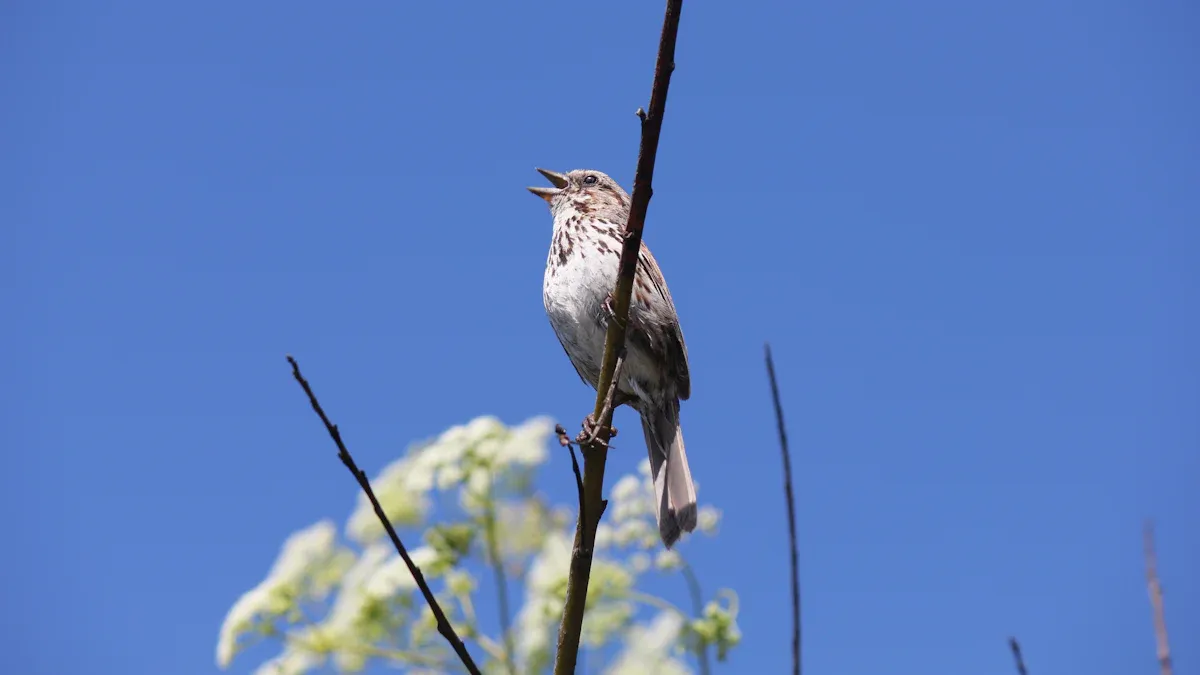
In song sparrows, males with larger song repertoires tend to be healthier and more attractive to females.
A study involving 7,000 songs of wild blue tits revealed that male vocal consistency peaks during the female fertile period. This finding suggests that consistent singing is crucial for mate selection. The ability to adapt and modify songs can also influence mating success.
Territorial Defense
Birds also sing to defend their territory. Their songs mark boundaries and communicate presence to rivals. When you hear a bird singing, it may be warning others to stay away. This behavior minimizes aggression between neighboring males.
Key Points about Territorial Defense:
Songs repel rival males from intruding on territories.
Male birds use songs to establish territorial boundaries.
Soft songs can signal focused attention but may increase the risk of intrusions.
Research indicates that male song sparrows engage in song type matching, responding to intruding males with the same song type. This behavior occurs more frequently than chance, highlighting its importance in territorial defense. In urban areas, birds even modify their songs to higher frequencies to avoid low-frequency urban noise.
Males that sang more soft songs were more likely to attack than those that produced few or none.
Understanding why birds sing helps you appreciate their complex social interactions. Their songs are not just beautiful sounds; they are essential tools for survival and reproduction.
Songs vs. Calls
Characteristics of Songs
Bird songs are intricate and melodious. They consist of longer sequences of notes that create a structured pattern. These songs often serve two main purposes: attracting mates and defending territories. When you hear a bird singing, it usually indicates that the bird is either trying to impress a potential mate or warning rivals to stay away.
Here are some key features of bird songs:
Structure: Songs have a complex acoustic structure, often featuring various notes and rhythms.
Function: They primarily relate to reproductive activities, helping birds establish their presence and attract partners.
Complexity: Songs require greater muscle control in the syrinx, the unique vocal organ in birds. This complexity allows for a wide range of sounds and variations.
Feature | Bird Songs |
|---|---|
Structure | Longer, melodious series of notes |
Function | Primarily associated with courtship activities |
Complexity | More complex due to greater muscle control in syrinx |
Characteristics of Calls
In contrast, bird calls are shorter and simpler. They often consist of brief sounds that convey specific messages. Calls serve various functions, including communication between flock members and signaling alarms. When you hear a quick chirp or a sharp note, it likely indicates a call rather than a song.
Key characteristics of bird calls include:
Structure: Calls have a simple acoustic structure, making them easy to produce.
Function: They can relate to both reproductive and self-maintenance activities, such as alerting others to danger or keeping in touch with flock members.
Complexity: Calls are generally less complex than songs, requiring less control over the syrinx.
Feature | Bird Calls |
|---|---|
Structure | Brief sounds, simple acoustic structure |
Function | May relate to reproductive or self-maintenance |
Complexity | Generally less complex |
In avian communication, songs and calls play distinct roles. Songs attract mates and establish territories, while calls facilitate communication among birds. Understanding these differences enhances your appreciation of how birds sing and interact with one another.
Bird Call Types
Birds communicate through various calls, each serving a specific purpose. Understanding these calls helps you appreciate the complexity of avian communication. Here are three primary types of bird calls:
Alarm Calls
Alarm calls warn other birds about potential dangers. These calls can signal different types of predators, allowing birds to react appropriately. For example, some species use distinct calls for aerial threats, like hawks, and different calls for ground predators, like snakes. This differentiation enhances survival chances.
Evidence Type | Description |
|---|---|
Study 1 | Alarm calls help birds warn each other of danger, highlighting their role in anti-predation strategies. |
Study 2 | The urgency of alarm calls can vary, indicating which threats require immediate action. |
When you hear a sharp, urgent call, it often means a predator is nearby. Birds like the Japanese tit use specific calls to indicate higher threat levels, prompting immediate action from their flock.
Contact Calls
Contact calls maintain group cohesion among birds. These calls help regulate spacing, ensuring individuals do not crowd each other. They also facilitate group movement, especially when preparing to fly together.
Function of Contact Calls | Description |
|---|---|
Regulating Spacing | Helps maintain appropriate distances between individuals. |
Facilitating Group Movement | Increases when a group is preparing to move, aiding in coordinated movement. |
Birds like the Black-capped Chickadee have at least 16 distinct categories of vocalizations, most of which are classified as calls. These calls enhance social bonds and indicate individual identity within the group.
Food Calls
Food calls assist birds in locating food sources and group members. For instance, red crossbills use contact calls to find each other while foraging. Different ecomorphs of crossbills have unique call dialects, helping them identify one another in shared areas.
Red crossbills use calls to locate group members.
Calls help birds identify and locate each other among different ecomorphs.
By recognizing these calls, you can better understand how birds interact with their environment and each other.
Identifying Bird Sounds
Listening Techniques
To identify bird sounds effectively, you can use several techniques. Here are some tips to enhance your listening skills:
Focus on Specific Calls: Pay attention to individual calls. This practice helps you build a mental library of bird sounds.
Analyze Sound Characteristics: Notice the tone, pitch, and note patterns. Each bird has unique vocal traits that can help you distinguish them.
Use Mnemonics: Create memory aids to remember bird songs. Associating sounds with images or phrases can make recall easier.
Engaging actively with the sounds you hear can significantly improve your identification skills. Describe the sounds, draw diagrams, or write notes about their characteristics. This active listening approach, combined with repetition, will sharpen your ability to recognize different species.
Resources for Identification
Several resources can assist you in identifying bird sounds. Here are some popular tools:
Application | Key Features |
|---|---|
Merlin Bird ID | Offers over 300,000 bird sounds and allows users to record sounds. It provides free access to a vast database. |
BirdNET | Features real-time audio processing and instant species identification, trained on over 3,000 bird species. |
eBird | Tailored features for different skill levels, helping you track your birding experiences. |
You can also refer to field guides like the *Peterson Field Guide to Bird Sounds of Eastern North America*. This guide includes a Visual Index that categorizes sounds by characteristics, making it easier to identify them.
Using these resources, you can enhance your understanding of bird vocalizations. With practice and the right tools, you will become more adept at recognizing the beautiful symphony of bird songs around you.
Birds sing for several important reasons. They primarily use their songs to:
Declare territory and attract mates.
Signal ownership and availability to females, with male birds being the main singers.
Foster social bonds and warn of predators, as some female songbirds also sing.
Bird songs exhibit context dependence, similar to human language. This complexity adds depth to their communication.
Next time you hear a bird sing, take a moment to listen. Explore resources to learn more about these fascinating sounds in your environment. 🌳🎶
FAQ
What is the difference between bird songs and calls?
Bird songs are longer, melodious sequences used mainly for attracting mates and defending territory. Calls are shorter, simpler sounds that convey specific messages, such as alarms or contact between flock members.
Why do some female birds sing?
Female birds sing to communicate with their mates and establish territory. Their songs can also attract males and signal their presence, especially during the breeding season.
How can I learn to identify bird sounds?
You can improve your skills by focusing on specific calls, analyzing sound characteristics, and using mnemonics. Engaging actively with the sounds you hear will enhance your recognition abilities.
Do all birds sing?
Not all birds sing. While many species produce songs, others rely primarily on calls. Some birds, like flightless species, may have limited vocalizations due to their habitats and lifestyles.
Why do birds change their songs in urban areas?
Birds often modify their songs in urban environments to avoid low-frequency noise from traffic and machinery. Higher frequencies help them communicate effectively despite the background noise.