

Live plants change everything about a tank, but they demand real light, not the dim strip that came with your starter kit. Anyone who has watched stem plants stretch pale and leggy under weak LEDs knows the frustration. The right fixture fixes that with proper spectrum, a sane daily schedule, and controls you’ll actually use. This roundup covers eight planted-tank fixtures across nano tanks to four-foot displays, so you can match wattage and footprint to your setup without guesswork.
The Shortlist At A Glance
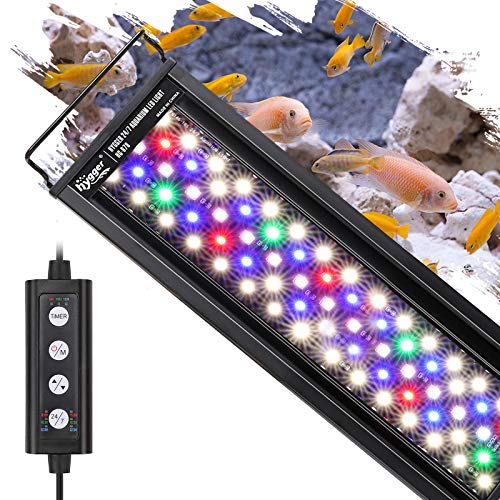
hygger 18W 24/7 Lighting Aquarium LED Light

DaToo Mini Clip On Aquarium Light 7W

hygger 26W 24/7 Lighting Aquarium LED Light

hygger Submersible LED Aquarium Light 8W

FZONE 60W Aquarium Light for Plants

SEAOURA 24/7 LED Aquarium Light 48-54 Inch

Fluval Plant 3.0 LED Planted Aquarium Lighting
AQQA Clip On Aquarium Light
More Details On Our Top Picks
The appeal here is automation. The built-in timer walks through an orange sunrise ramp, a long white daylight stretch, then a blue moonlight fade before shutting off, so plants get a consistent photoperiod even when your mornings are chaos. An extendable bracket spans most standard rimmed tanks, and seven color channels let you tune the look.
For a low-tech planted tank with anubias, java fern, or crypts, this is about as hands-off as lighting gets. You can also build a custom schedule in DIY mode if the default cycle doesn’t line up with your room.
Strong Points
- Preset 24/7 cycle means zero daily fiddling once it’s set
- Gentle sunrise and sunset ramps reduce stress on skittish fish
- DIY mode lets you set time, color, and brightness independently
- Extendable bracket fits a range of tank widths without extra hardware
Things To Consider
- The default window runs late into the evening, so shift it manually for early bedtimes
- Owners commonly report the bracket needs careful seating on thicker rims
Key Specs
Who It Suits Best
Busy keepers running low-to-mid light plants on a standard rimmed tank who want set-and-forget scheduling.
A Better Fit Elsewhere
Deeper tanks over 20 inches benefit from the brighter hygger 26W version later in this list.
Nano tanks are awkward to light because most fixtures dwarf them. This DaToo clip lamp is built for one to three gallon aquariums, clamps onto thin glass, and swivels so you can angle light onto moss balls or a single betta plant. Power comes from USB, which makes desk and office setups painless since any phone charger works.
The honest read is that 7 watts won’t push demanding stem plants hard, but slow growers and marimo do fine at ten brightness levels across white, red, blue, and green modes.
What We Like
- Clips on in seconds, no bracket or hood modification needed
- USB power suits desks, dorms, and offices where outlets are scarce
- Ten brightness steps help dial in algae-safe intensity on tiny volumes
Minor Gripes
- Limited spread means corners of wider bowls stay dim
- Not suited to plants with high light demands
Right Fit For
Betta keepers and desktop aquarists with one to three gallon tanks who want tidy, adjustable accent lighting.
Swap It Out When
Tanks from five gallons up get better coverage from the AQQA clip-on reviewed further down.
This is the same platform as the 18W hygger at number one, scaled up. The extra wattage pushes usable light deeper into the water column, which matters once your tank passes roughly 18 inches tall or you’re growing carpeting species that need intensity at the substrate. The sunrise-daylight-moonlight programming carries over unchanged, along with the seven-color palette and extendable brackets.
You may find the step up unnecessary for shallow tanks, but for 20-gallon longs and taller planted builds it’s the difference between surviving plants and thriving ones.
Highlights
- Higher output reaches the substrate in deeper tanks
- Same automated 24/7 cycle as its smaller sibling
- DIY scheduling covers custom photoperiods and color mixes
- Adjustable brightness helps balance against algae pressure
Softer Spots
- Overkill for shallow nano setups where the 18W model costs less
- Longer body needs adequate canopy clearance above the glass
At A Glance
Made For
Intermediate hobbyists with 20-gallon-plus planted tanks chasing denser growth without app complexity.
Where A Sibling Pick Shines
Shallow tanks under 14 inches are better served by the 18W hygger, saving money with ample light.
Open-top and rimless tanks often reject hood-mounted lights entirely, and that’s where a submersible bar earns its keep. This 8-watt unit sits inside the tank along the back wall, sealed to IP68 waterproofing standards, meaning it’s rated for continuous underwater operation. Five rows of 2835 and 5050 LED chips give it more punch than typical submersible strips, and nine colors plus adjustable brightness cover both plant needs and evening mood lighting.
The gradual 15-minute on and off transitions are a genuinely thoughtful touch, sparing fish the shock of lights snapping on.
Upsides
- IP68 sealing allows safe permanent submersion
- Five chip rows deliver brighter, more even coverage than basic strips
- Slow fade transitions avoid startling livestock
- Timer and 24/7 mode automate the whole day-night rhythm
Points To Note
- In-tank placement means occasional algae wiping on the housing
- 8 watts limits reach in tanks beyond its stated 8-17 inch range
Feature Snapshot
Who Will Love This
Rimless aquascape fans who want invisible hardware and clean sightlines above the waterline.
Consider Something Else When
Standard rimmed tanks get easier mounting from the bracket-style hygger 18W at the top of this list.
High-tech planted tanks, the kind with CO2 injection and root tabs, need serious photon delivery, and 60 watts aimed at 35 to 43 inch tanks is firmly in that territory. FZONE spreads six rows of RGB, white, and UV LEDs across a wide four-inch emission surface, which reduces the hot spots and patchy color that cheaper bars produce. UV diodes support pigmentation and growth, while the white channel keeps energy use reasonable.
App control handles timers, sunrise and sunset fades, and per-channel tuning, so you can shape the spectrum precisely as your planting matures.
Reasons To Buy
- 60W output sustains demanding carpet and stem plants
- Wide emission surface evens out illumination across long tanks
- UV plus RGB plus white channels allow fine spectral control
- App-based sunrise and sunset programming runs unattended
Honest Caveats
- Intensity this high pairs best with CO2 and fertilization, not low-tech tanks
- App-dependent features mean a phone is part of the setup routine
Quick Facts
Whose Shelf It Belongs On
Advanced aquascapers running injected CO2 on three-foot-plus layouts who want pro-level spectrum control.
Another Choice May Suit
Four-foot low-tech community tanks are better matched by the SEAOURA 24/7 model coming next.
Standard 55 and 75 gallon tanks measure four feet long, and few budget-friendly fixtures cover that span properly. SEAOURA does, stacking six rows of chips, two 5054 and four 2835, for even brightness edge to edge. Control comes from a touch panel with an LCD screen and a built-in clock, which some owners find more reliable than Bluetooth apps since nothing depends on a phone staying paired.
Compared to the FZONE above, you give up raw wattage and UV but gain simpler operation and full-length coverage for big community planted tanks.
Bright Spots
- Six-row chip array covers 48-54 inch tanks uniformly
- Touch controller with LCD display feels precise day to day
- Built-in clock keeps schedules accurate after power blips
- 24/7 mode automates dawn-to-dusk transitions
Small Caveats
- No app control, so adjustments happen at the tank
- Output suits moderate light plants rather than carpet-heavy scapes
Details At A Glance
Who Should Grab It
Keepers of 55 or 75 gallon planted community tanks who want dependable automation without smartphone dependence.
Reach For A Different Pick When
CO2-injected scapes on similar lengths need the heavier output of the FZONE 60W instead.
Fluval’s reputation in the hobby rests on build quality, and the Plant 3.0 reflects it. Six distinct LED band waves form a spectrum engineered specifically around chlorophyll absorption, and the FluvalSmart app exposes every channel for tuning. A programmable 24-hour cycle with gradual ramps rounds out the package, sized here at 22 watts for 15 to 24 inch tanks.
It’s a premium option in a compact size, and the polish shows in the aluminum housing and consistent output owners report over years of use.
Plus Points
- Six-band spectrum tuned for plant photosynthesis
- FluvalSmart app enables deep per-channel customization
- Programmable 24-hour cycle with smooth transitions
- Established brand with widely reported long-term reliability
Trade Offs
- 22 watts caps suitability at smaller tanks than the FZONE covers
- Premium positioning costs more than comparable-output rivals
Best Suited To
Dedicated planted-tank hobbyists with 15 to 24 inch aquascapes who value refined engineering and app depth.
Look Elsewhere When
Budget-conscious starters on similar tank sizes will find the hygger 18W delivers most of the automation for less.
Clip-on fixtures live or die by heat management, since a small body pushing plant-grade output gets warm fast. AQQA addresses that with a widened, thickened aluminum shell whose larger surface sheds heat efficiently, protecting both the 5050 and 2835 diodes and your water temperature. Full-spectrum output covers what rooted plants need, and 24/7 plus DIY modes handle scheduling.
Against the DaToo mini clip earlier in this list, this one targets slightly larger tanks and brings fuller programming, making it the middle ground between nano accents and bracket systems.
Standout Traits
- Oversized aluminum body dissipates heat effectively
- Full-spectrum diodes support genuine plant growth
- Both automated and fully manual scheduling available
- Clamp mounting adapts to varied tank rims
Areas To Watch
- Clip arms need checking periodically for grip on slick glass
- Light spread depends heavily on clamp angle positioning
Core Details
The Right Fit
Small-space aquarists with five to fifteen gallon planted tanks who want bracket-free mounting and real plant output.
Not Your Match When
True nano bowls under three gallons are better served by the smaller DaToo 7W clip lamp.
What Matters Most Before Choosing Led Aquarium Lightings For Plants
Match Output To Tank Depth And Plants
Wattage only means something relative to water depth and species. Slow growers like anubias thrive under modest fixtures such as the 8W submersible, while carpeting plants in CO2-injected tanks want the 60W tier. Measure your tank length first, then check the manufacturer’s stated coverage range before anything else.
Decide Between Automation And Manual Control
A 24/7 preset cycle handles photoperiod consistency automatically, which prevents the algae swings caused by irregular lighting hours. App-based control adds per-channel spectrum tuning but ties features to your phone. Panel-driven units like the SEAOURA trade that flexibility for reliability.
Factor In Mounting Style
Bracket lights suit standard rimmed tanks, clips work on rimless and odd-shaped glass, and submersible bars disappear entirely inside open-top aquascapes. Your tank’s rim and canopy clearance narrow the field faster than any spec sheet.
Plan For Heat And Maintenance
Aluminum housings dissipate heat far better than plastic, protecting diode lifespan and water temperature. Submersible units need periodic algae wipes, and clip arms deserve an occasional grip check.
Key Considerations Across These Picks
Traps First Timers Fall Into
The classic error is buying on tank length alone and ignoring depth, leaving substrate-level plants starved. Another common slip is pairing a high-output fixture with a low-tech tank and wondering why algae takes over within weeks.
Where The Extra Money Goes
Higher-tier models spend on diode density, aluminum heat sinks, and finer control granularity. That translates to deeper light penetration and steadier long-term output, which pays off once you move past easy plants into demanding species.
Frequently Asked Questions
How many hours of light do planted tanks need daily?
Most planted tanks do well with 8 to 10 hours on a consistent schedule. Automated 24/7 modes handle this without daily attention.
Can regular LED shop lights grow aquarium plants?
Some general-purpose LEDs provide usable spectrum, but they lack the wavelength balance and waterproofing designed for aquariums. Purpose-built fixtures make tuning far simpler.
Do brighter lights cause more algae?
Excess intensity without matching plant mass, nutrients, and CO2 often fuels algae outbreaks. Match output to your tank’s actual demands.
Are submersible aquarium lights safe?
Units rated IP68 are sealed for continuous underwater use. Always confirm the rating before placing any fixture below the waterline.
Is app control worth paying extra for?
App control matters most for high-tech tanks needing per-channel spectrum changes. Low-tech keepers rarely touch those settings and can save money elsewhere.
Closing Thoughts
Every tank on your stand deserves light matched to its plants, not whatever came in the box. Start with your tank’s dimensions and ambition level, then let the shortlist above narrow things down. Whichever route you take, a stable photoperiod will do more for your plants than any single spec. Happy aquascaping.
