

A good light does more than make a tank look pretty. It sets the rhythm your fish live by, feeds your plants, and decides whether that aquascape you planned actually comes together. The catch is that most tanks get whatever fixture came bundled with the hood, and those rarely do any of the three jobs well. This shortlist covers programmable full-spectrum fixtures, app-controlled units, and reef-grade panels so you can match the light to what’s actually living in your water.
The Shortlist At A Glance
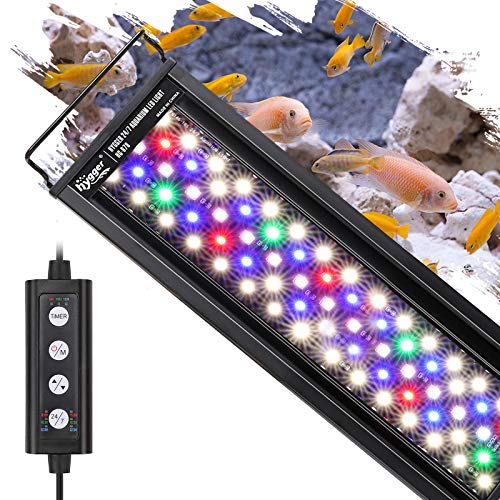
hygger 18W 24/7 Aquarium LED Light with Extendable Bracket

hygger 14W 24/7 Aquarium LED Light with Extendable Bracket

Wills 100W Full Spectrum LED Reef Light

SEAOURA 24/7 LED Aquarium Light with Timer, 48-54 Inch

SEAOURA WRB LED Aquarium Light with Timer, 18-24in

Fluval Aquasky 2.0 Bluetooth LED Aquarium Light, 27W

FZONE Solo Series Nano LED Aquarium Light
More Details On Our Top Picks
The headline feature here is the built-in natural cycle: an orange sunrise gradient in the early morning, white daylight through the day, then a blue moonlight phase before lights-out. You program it once and the fixture handles every transition on its own, which means no more forgetting to switch the tank off at midnight.
Beyond the automatic mode there’s a DIY track where time, color, and brightness are all yours to set, backed by seven color options and an extendable bracket that spans different rim widths. For most mid-size planted tanks, that combination covers everything a typical week demands.
Strong Points
- Automated sunrise-to-moonlight schedule removes daily fiddling entirely
- DIY mode lets you dial in exact timing, hue, and intensity per channel
- Extendable bracket fits a range of tank widths without extra hardware
- Gradual color shifts avoid startling skittish fish at dawn and dusk
Things To Consider
- Owners commonly note the default schedule needs adjusting to match your own wake-up hours
- Button-based programming takes a few sessions to memorize
Key Specs
Who It Suits Best
Hobbyists running a standard planted community tank who want dependable automation without paying app-control prices.
A Better Fit Elsewhere
Anyone keeping corals should look at the Wills 100W reef panel instead, since its spectrum is built for photosynthesis rather than ambience.
This is the smaller sibling of the hygger 18W unit above, sharing the same sunrise-daylight-moonlight automation and DIY programming but stepping down to 14 watts. That lower output suits shallower or shorter tanks where the bigger model would blast low-growing plants and wash out pale substrate.
You still get the extendable bracket and the seven-color palette, so nothing about the ownership experience changes except intensity. In our view, that makes this the more sensible choice for standard 10-to-20-gallon setups rather than a compromise.
What We Like
- Same automated 24/7 scheduling as its larger sibling at gentler output
- Lower wattage keeps electricity use negligible year-round
- Extendable bracket adapts to narrow rims easily
Minor Gripes
- May under-light deeper tanks or demanding carpeting plants
- Menu navigation mirrors the 18W model, so expect a learning curve there too
Right Fit For
Beginners with small-to-medium freshwater tanks who want plant-friendly light on autopilot.
Where A Sibling Pick Shines
Deeper tanks over roughly 20 inches tall benefit from the extra output of the hygger 18W version instead.
Everything before this point has been freshwater territory. The Wills panel plays a different game entirely: 100 watts of full-spectrum output tuned around specific wavelengths, including 450nm blue for coral fluorescence, 530nm actinic for that vivid pop, and 660nm red to drive photosynthesis in both corals and plants.
Warm 3000K and cool 6500K whites round out the mix so colors read naturally rather than neon. The manufacturer rates coverage for a 24-by-24-inch footprint with no hot spots, which matters enormously in reef keeping since uneven PAR (photosynthetically active radiation, the light corals actually consume) creates dead zones where corals starve.
Bright Spots
- Targeted wavelength blend supports coral growth and fluorescence together
- Even spread across a 24″x24″ area reduces shading problems
- Doubles as a high-output option for dense planted tanks
- Compact 20″x7″x2.4″ body stays discreet over the tank
Points To Note
- Overkill for fish-only freshwater setups, and excess light invites algae
- At 100W, heat management and mounting height deserve attention during installation
Feature Snapshot
Made For
Reef keepers and serious planted-tank hobbyists who need genuine photosynthetic output, not just decoration.
Swap It Out When
A standard community freshwater tank is better served by the SEAOURA 48-54 inch model below, which costs less and runs cooler.
Long tanks are awkward. Most fixtures leave dark ends or force you to run two units, and that’s exactly the gap this SEAOURA fills with its 48-to-54-inch span. Inside sit six rows of LED chips, two rows of brighter 5054 diodes paired with four rows of 2835 chips, a layout the maker positions as delivering steadier, more uniform illumination than typical programmable bars.
Control happens through a touch controller with an LCD screen and a built-in clock, so schedules persist without a phone app in the loop. For a 55-gallon show tank in a living room, that independence from Bluetooth pairing is quietly practical.
Reasons To Buy
- Six-row chip array spreads light evenly across very wide tanks
- LCD touch controller with internal clock keeps schedules running standalone
- One bar covers footprints that would otherwise need paired fixtures
- 24/7 programming handles dawn-to-dusk transitions automatically
Small Caveats
- The long rigid body needs clear clearance above open-top tanks
- Some owners report the controller cable length limits placement flexibility
Details At A Glance
Who Will Love This
Keepers of 4-foot planted or community displays who want one clean fixture instead of a daisy-chained pair.
Consider Something Else When
Nano tank owners will find the FZONE Solo Series far better proportioned for compact footprints.
Where the last SEAOURA chased length, this one chases finesse. The WRB designation refers to its three independently driven channels (white, red, blue), which combine into eleven colors across ten dimming steps. That granularity lets you warm up a shrimp tank or cool down a betta display without swapping fixtures.
The detail worth highlighting is the 15-minute fade between modes. Sudden light changes stress tank inhabitants, and this gradual ramp keeps everyone calm, which you’ll notice most with shy species that hide whenever the lights snap on.
Plus Points
- Three-channel WRB mixing yields eleven colors and ten dimming levels
- 15-minute fades prevent startle responses in nervous fish and shrimp
- Preset 6, 8, and 12-hour timers with auto on/off keep cycles consistent
Softer Spots
- Preset-only timers limit custom schedule lengths compared to fully programmable rivals
- Output suits shallow nano tanks more than tall planted columns
Best Suited To
Shrimp keepers and nano aquascapers working within an 18-to-24-inch footprint who value gentle transitions.
Not Your Match When
You want hour-by-hour custom scheduling, in which case the hygger 18W’s DIY mode is the stronger tool.
Fluval is one of the few aquarium brands with decades of mainstream credibility, and the Aquasky 2.0 reflects that pedigree. This 27-watt bar targets 36-to-48-inch freshwater and fish-only marine tanks, combining RGB color control with bright 6500K white LEDs for a clean, natural daylight look.
All operation runs through the FluvalSmart app over Bluetooth, which means deep customization but also a hard dependency on your phone. Compared to the button-driven hygger units earlier in this list, setup is faster once paired, though the trade-off shows up the moment a firmware update or phone change interrupts your routine.
Highlights
- Full RGB control plus 6500K whites for accurate daytime color rendering
- FluvalSmart app enables precise scene building and scheduling
- Trusted brand with broad accessory ecosystem behind it
- Suits both planted freshwater and fish-only saltwater displays
Worth Noting
- App-exclusive control frustrates anyone who prefers physical buttons
- Bluetooth range limits remote adjustments to nearby rooms
Quick Facts
Who Should Grab It
Phone-first hobbyists with 40-to-55 gallon mixed-community or fish-only marine tanks who value brand support.
Reach For A Different Pick When
Button-only households should stick with the SEAOURA LCD-controller bar, which schedules without any app at all.
Nano planted tanks punish weak lights faster than anything else in the hobby, and the FZONE Solo answers with a genuinely full-spectrum WRGB engine: 18 RGB diodes alongside 18 white ones, each color channel controlled independently. That separation is what separates a light you tune from a light you merely dim.
Bluetooth app control handles brightness and color adjustments precisely, and the fixture doubles for terrarium duty. Against the simpler SEAOURA WRB unit, you’re paying up for finer channel control and denser output, which demanding carpeting plants like Monte Carlo tend to reward.
Upsides
- Independent WRGB channels allow true spectral tuning per plant species
- 36 total diodes pack serious density into a nano-scale body
- Bluetooth app gives precise, repeatable brightness and color settings
- Works for aquariums and terrariums alike
Honest Caveats
- Nano sizing won’t stretch to larger tanks despite the strong output
- App-dependent control adds a pairing step some owners find fiddly at first
Core Details
Whose Shelf It Belongs On
Dedicated aquascapers running high-tech nano planted tanks who treat lighting as part of the design.
Another Choice May Suit
Casual small-tank keepers will be happier with the cheaper, simpler SEAOURA WRB bar and its preset timers.
What Matters Most Before Choosing Led Aquarium Lights
Match Output To Tank Depth
Light falls off fast underwater, so a 14W bar fine over a 12-inch-deep tank will starve plants sitting 24 inches down. As a rough rule, taller or densely planted tanks need higher wattage and more diode density, while shallow shrimp bowls thrive on modest output. Measure your water column first, then shop.
Decide Between Buttons And Apps
Programmable fixtures split into physical-controller models like the hygger and SEAOURA bars, and Bluetooth app units like the Fluval Aquasky 2.0 and FZONE Solo. App control offers finer tuning; buttons keep working when phones don’t. Your daily habits matter more than spec sheets here.
Look At Spectrum, Not Just Brightness
Full-spectrum means the fixture emits wavelengths plants and corals actually use, typically blues around 450nm and reds near 660nm alongside whites. Fish-only tanks can prioritize appearance, but planted and reef systems live or die by usable spectrum.
Check Fit Before Checkout
Extendable brackets cover a range of rim widths, but fixed-length bars do not. Confirm your tank’s actual rim-to-rim measurement against the stated fit range, and leave clearance for lids, cables, and the controller box.
Key Considerations Across These Picks
Traps First Timers Fall Into
The classic error is buying on tank length alone and ignoring depth, which leaves carpeting plants leggy within weeks. Another frequent misstep: pairing a high-output reef panel with a fish-only freshwater tank, then fighting algae all summer because the light was simply too much.
What The Higher Tier Buys
Spending up generally buys independent color channels, denser diode arrays, and app-level precision rather than raw brightness alone. That upgrade pays off for aquascapers chasing specific plant growth, while casual community tanks rarely notice the difference beyond the invoice.
Frequently Asked Questions
How many hours a day should aquarium lights run?
Most planted tanks do well with 8 to 10 hours on a consistent schedule. Consistency matters more than duration, since erratic cycles encourage algae.
Do LED aquarium lights work for growing plants?
Yes, provided the fixture offers a full spectrum with adequate intensity for your tank depth. Shallow tanks succeed with modest bars, while deeper planted tanks need higher-output units.
Can I leave my aquarium light on overnight?
Leaving lights on around the clock stresses fish and fuels algae growth. Use a moonlight setting or timer instead so the tank gets a proper dark period.
What size light do I need for my tank?
Match the fixture’s rated fit range to your tank’s rim-to-rim length, then verify output suits the water depth. Both numbers appear in manufacturer specifications.
Are app-controlled aquarium lights reliable?
Modern Bluetooth fixtures like the Fluval Aquasky 2.0 hold schedules reliably once configured. The main inconvenience is re-pairing after phone changes or app updates.
Closing Thoughts
The right light depends less on brand loyalty than on honest self-assessment: how deep your tank runs, whether plants or corals share the water, and how much tinkering you actually enjoy. Any of these seven will outperform a stock hood light by a wide margin. Start with your tank’s measurements, match them against the fit ranges above, and let the inhabitants decide the rest.
