

A good hood does quiet work every day: it slows evaporation, blocks dust, keeps light where you want it, and stops jumpers from ending up on the floor. Anyone who has come home to a dried-out betta on the carpet knows why this small accessory matters so much. The six options below cover the main routes you can take, from a classic rigid LED hood to magnetic mesh and tempered glass canopies, so there’s a fit whether you run a planted 29-gallon or a starter 10-gallon kit.
The Shortlist At A Glance

MarineLand LED Aquarium Hood 30 x 12 inch

Tetra LED 10 Gallon Complete Fish Tank Kit

NestBasics Magnetic Anti-Jumping Net Cover
NestBasics Magnetic Aquarium Lid Net Cover

CUCZUUS Clear Tempered Glass Canopy 29.21 x 11.69in
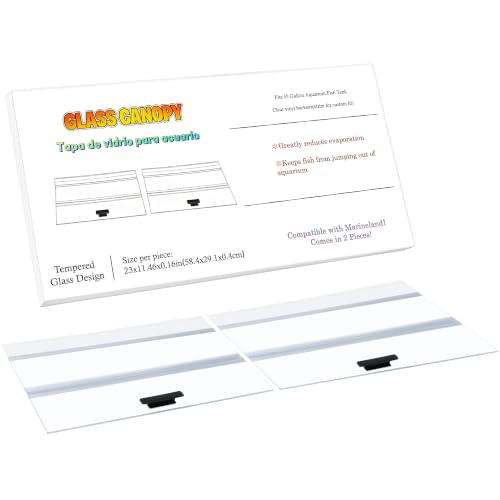
CUCZUUS 2PCS Clear Tempered Aquarium Canopies
More Details On Our Top Picks
This is the straightforward route: a purpose-built hood sized for standard 30 x 12 inch tanks, finished in black so it disappears against most stands and backgrounds. MarineLand has been making aquarium equipment for decades, which matters here because fit tolerances on mass-produced tanks are unforgiving.
In a living room setup, the integrated lighting means one less cord and fixture to mount separately. You lift the front edge for feeding and maintenance instead of removing a whole lid, which is the daily convenience that separates a real hood from a sheet of glass.
Strong Points
- Sized to match common 30 x 12 inch tanks, so alignment is usually plug-and-play
- Built-in LED lighting handles both viewing light and daytime illumination
- Hinged access makes feeding quick without pulling the entire cover off
- Black finish hides water spots and blends with most furniture
Things To Consider
- The fixed footprint only suits tanks built to that exact dimension; measure your rim first
- Owners of older tanks occasionally report needing minor trimming around filter cutouts
Who It Suits Best
Aquarists running a standard 30-gallon who want a no-fuss, name-brand hood with lighting already handled.
Where A Sibling Pick Shines
Shoppers wanting a fully transparent look should compare the CUCZUUS Clear Tempered Glass Canopy, which suits planted display tanks better than an opaque plastic hood.
Where the MarineLand hood is a single component, this Tetra package solves the whole problem at once: a 10-gallon glass tank, low-profile hinged hood with LEDs, internal filter with cartridge, plus sample-size conditioner and food and a setup guide. For a first tank on a desk or a kid’s dresser, that removes nearly every compatibility guess.
The included filtration runs mechanical media to catch debris alongside chemical filtration using Ultra-Activated Carbon, which targets odors and discoloration. The energy-efficient LEDs produce a natural daylight effect that flatters small community setups without cooking the water.
What We Like
- Everything arrives matched: hood, light, filter, and tank share one design language
- Hinged low-profile hood gives easy top access in tight spaces like dorm rooms
- Carbon-based chemical filtration helps keep smaller water volumes clear longer
- Setup guide shortens the learning curve for brand-new fishkeepers
Worth Noting
- Sample-size conditioner and food run out fast, so budget for full bottles within weeks
- An internal filter takes up swimming space compared with an external unit
Quick Facts
Made For
Beginners setting up their first freshwater tank who want one box to handle lighting, covering, and filtration together.
Swap It Out When
Experienced hobbyists upgrading an existing 10-gallon will get more value from the NestBasics Magnetic Anti-Jumping Net Cover rather than replacing a working tank.
Standard hoods assume your tank is a standard shape. This NestBasics kit flips that assumption: you build the cover yourself from adhesive-backed magnetic strip, grooved magnetic strip, plastic trim strip, corner buckles, and a net panel measuring roughly 4.92 by 3.28 feet. The mesh approach also lets heat and humidity escape, something solid lids can trap.
It suits openings with a perimeter up to about 13.12 feet, which covers most large rectangular tanks and plenty of odd footprints. Breeder racks and axolotl or puffer setups, where jumping is a constant risk, are the obvious use case.
Highlights
- Cuts to any shape, so unusual tank openings finally get proper coverage
- Magnetic edges let you peel back a section for feeding in seconds
- Mesh breathes, helping gas exchange and reducing condensation buildup
- Generous 13.12 feet of strip covers even larger tank perimeters
Small Caveats
- Installation takes patience: cleaning the glass well before applying adhesive strips is widely reported as the make-or-break step
- Adhesive-backed strips can lose grip over time on textured or silicone-heavy rims
- You’ll want scissors and a flat surface; it’s a DIY project, not a drop-on lid
Feature Snapshot
Right Fit For
DIY-minded keepers with jumper-prone species or non-standard tank openings who don’t mind a one-time installation session.
Not Your Match When
Anyone wanting a clean glass aesthetic on a standard 29-gallon will prefer the CUCZUUS Clear Tempered Glass Canopy instead.
This is the smaller sibling of the NestBasics kit reviewed above, scaled down for nano and mid-size tanks. Instead of 13.12 feet of strip, you get 6.56 feet of adhesive-backed and grooved magnetic strip, matching plastic trim, four corner buckles, and a net panel around 4.9 by 2.46 feet. Betta bowls, shrimp cubes, and 10 to 20 gallon rectangles fall comfortably inside that envelope.
The same strengths carry over: breathable mesh, magnetic access panels for feeding, and a custom fit for awkward openings. The trade-off is simply reach, since anything beyond a 6.56-foot perimeter needs the larger version.
Upsides
- Right-sized material for nano tanks, so less trimming waste than the big kit
- Mesh keeps jumpers contained while letting equipment cords pass through gaps
- Magnetic closure means one-handed feeding access on desktop tanks
Points To Note
- Surface prep matters: owners commonly report adhesion failures when the rim isn’t cleaned thoroughly first
- Netting can sag slightly over wide spans unless supported with the included buckles
Who Will Love This
Betta and shrimp keepers with small desktop tanks who need escape protection without bulky plastic lids.
Another Choice May Suit
Keepers with openings approaching 13 feet should step up to the NestBasics Magnetic Anti-Jumping Net Cover, which doubles the strip length for larger tanks.
Tempered glass, for anyone new to the term, is heat-treated so it resists cracking and breaks into dull fragments rather than shards. That makes it the premium choice for a canopy sitting directly above open water. This single panel measures 29.21 x 11.69 inches at roughly 0.16 inches thick, aimed at most 20-long and 29-gallon tanks from brands like Aqueon, MarineLand, and Perfecto.
Visually, glass wins. Light passes through almost untouched, so pendant or clip-on fixtures above the tank perform at full strength, and the aquascape reads clean from every angle. Evaporation drops noticeably too, which means fewer top-offs during the week.
Bright Spots
- Glass stays optically clear for years, unlike plastic that yellows and scratches
- Sharp reduction in evaporation cuts your refill routine significantly
- Compatible with common 20-long and 29-gallon tank brands
- Blocks jumpers without dimming your lighting
Honest Caveats
- It does not fit Top Fin tanks, so measuring your opening to the millimeter before ordering is essential
- The handle attaches with thin double-sided tape, which some owners find needs re-seating over time
Details At A Glance
Best Suited To
Planted-tank hobbyists and aquascapers who want invisible coverage and run external lighting above the waterline.
Look Elsewhere When
Keepers needing flexible access for frequent feedings may find the NestBasics Magnetic Anti-Jumping Net Cover more convenient day to day.
Longer tanks rarely work with one rigid panel, because filter hoses and heater cords need somewhere to exit. This two-piece CUCZUUS set solves that: each tempered glass panel measures about 23 x 11.46 inches, letting you leave a gap for equipment while still covering the rest of the waterline. Compared with the single-panel canopy above, you’re trading continuity for practicality.
The clear vinyl back strip along the rear edge is wider than older designs, which helps close the gap against the tank wall and further limits evaporation. Like all glass canopies, it also keeps fish where they belong.
Plus Points
- Two panels allow cable and filter cutouts without cutting glass yourself
- Wider vinyl back strip seals the rear gap better than earlier versions
- Tempered glass resists the scratching and clouding that ruin plastic covers
- Greatly reduces evaporation, saving top-off trips each week
Room For Improvement
- Fit varies across manufacturers, so measure your tank opening precisely before committing
- Two glass panels mean two surfaces to wipe down during algae cleanings
Core Details
Whose Shelf It Belongs On
Owners of longer rimmed or rimless tanks running hang-on-back gear who still want near-full glass coverage.
Reach For A Different Pick When
Aquarists with a single standard 29-gallon opening and no equipment gaps are better served by the single-panel CUCZUUS Clear Tempered Glass Canopy.
What Matters Most Before Choosing Fish Tank Hoods
Measure Twice, Order Once
Tank openings vary by manufacturer even at identical nominal sizes, sometimes by several millimeters. Grab a ruler, measure the inside of your rim to the closest millimeter, and compare it against the listed canopy dimensions. Glass canopies in particular have zero forgiveness, while magnetic mesh kits absorb small errors through overlap.
Match The Cover To Your Livestock
Jumping risk drives everything. Bettas, puffers, killifish, and axolotls demand full coverage, whereas slow community fish tolerate partial covers. Solid hoods contain light and humidity but trap heat; mesh breathes but lets more evaporation through; glass sits in the middle with excellent clarity and strong evaporation control.
Think About Your Lighting Plan
A rigid hood with built-in LEDs simplifies wiring but locks you into its output. A glass canopy pairs with any external fixture, which planted-tank keepers usually prefer. Desktop kits like the Tetra bundle handle lighting for you, which is half the appeal.
Weight The Daily Routine
Feeding frequency decides how much access matters. Hinged hoods flip open one-handed, magnetic nets peel back a corner, and glass panels must be lifted and set aside. Frequent feeders and hands-on keepers should favor quick-access designs.
Key Considerations Across These Picks
Traps First Timers Fall Into
The most common mistake is ordering by tank label instead of actual opening measurement, then discovering a quarter-inch gap that defeats the whole purpose. Second is ignoring equipment clearance: filter tubes and heater cords need exits, which is exactly why two-piece glass sets exist. Skipping surface cleaning before applying adhesive magnetic strips is another widely reported failure point.
Where The Extra Money Goes
Higher-tier options spend on materials and precision. Tempered glass costs more than acrylic or plastic because it stays optically clear for years and resists warping under lamp heat. Brand-name hoods justify their pricing through exact dimensional matches to common tank standards. Paying up pays off most for display tanks you’ll photograph; utility tubs and breeders can happily run mesh.
Closing Thoughts
The right hood comes down to three honest questions: what fits your rim, what contains your fish, and how often your hands go in the water. Measure carefully, match the cover to your livestock, and pick the access style that fits your routine. Any of these six will do its quiet job well once it actually fits.
