

Saltwater tanks punish sloppy gear. A heater that drifts a few degrees or shuts off mid-winter can stress corals and fish faster than almost any other equipment failure, and anyone who has come home to a cold nano tank knows the feeling. This shortlist covers eight heaters built for marine and freshwater setups, from 5-gallon betta cubes to 135-gallon reef systems. Each one earns its place on specific strengths: thermostat accuracy, safety cutoffs, build materials, or sheer wattage coverage. Match the pick to your tank size and your tolerance for dials versus digital displays, and you’ll have stable water temperatures without overspending.
The Shortlist At A Glance

EHEIM Jager Aquarium Thermostat Heater 50W
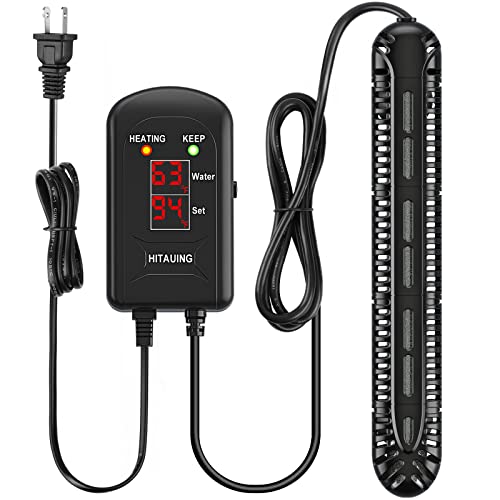
HiTauing 300W Aquarium Heater with LED Display

hygger Small Betta Tank Heater with LED Display

Fluval M 150-Watt Submersible Aquarium Heater

hygger 500W Submersible Fish Tank Heater

DaToo Adjustable 50W Submersible Fish Tank Heater

hygger 300W Heater with Digital LED Controller

Marina Submersible Aquarium Heater 100 Watt
More Details On Our Top Picks
Eheim’s Jager line has been a fixture in hobbyist sumps and nano tanks for decades, and this 50-watt version carries that reputation forward. The TruTemp dial is the detail that matters most: it lets you recalibrate the thermostat against a separate thermometer, so the setpoint actually matches what your tank reads.
The shatter-resistant glass housing suits both fresh and marine water, and an indicator light confirms heating status at a glance. For a small reef or refugium where stability beats raw power, that recalibration ability is worth more than any extra feature.
Strong Points
- TruTemp dial lets you match the thermostat to your own thermometer, cutting drift worries
- Dry-run protection shuts the element off when water level drops too low during water changes
- Fully submersible, so it tucks horizontally under a rock ledge or behind macroalgae
- Shock-resistant, shatter-proof glass holds up to years of saltwater service
Things To Consider
- Analog dial means no digital temperature readout; pair it with a standalone thermometer
- 50 watts only suits smaller volumes, roughly up to 25 gallons depending on room temperature
Who It Suits Best
Hobbyists running nano reefs, refugiums, or quarantine tanks who value proven thermostat accuracy over digital bells and whistles.
A Better Fit Elsewhere
Tanks from 40 to 75 gallons need more muscle, which is where the HiTauing 300W Aquarium Heater with LED Display takes over comfortably.
Where the EHEIM Jager leans analog, this HiTauing goes fully digital. A 300-watt element rated for 40 to 75 gallon tanks pairs with an LED display showing live temperature, so you stop squinting at a dial through condensation. Five stacked safety protections cover the failure modes that worry saltwater keepers most.
The 8.2-foot cord split between cable and power sections gives you real flexibility in cabinet routing, and two suction cups hold the 10.6-inch body steady against strong return flow. Owners commonly report quick heat-up times, though the long body needs vertical clearance in shallower stands.
Highlights
- LED display shows actual water temperature without a separate thermometer check
- Five independent safety layers address overheating, dry running, and related faults
- Long 8.2-foot cord simplifies routing behind cabinets and around dosing equipment
- Saltwater-rated construction handles corrosive marine conditions
Minor Gripes
- At 10.6 inches long, it may not fit low-profile sumps or shallow all-in-one chambers
- Suction cups tend to lose grip over time; reseat them during routine maintenance
Quick Facts
Made For
Keepers of 40 to 75 gallon community or softy tanks who want digital monitoring without paying controller-heater prices.
Where Another Pick Shines
Larger systems past 80 gallons should step up to the hygger 500W Submersible Fish Tank Heater instead.
Most heaters are simply too much heater for a 5-gallon cube, cycling hard and cooking the water. Hygger solves that by offering four wattages, 10 through 100 watts, matched to tanks from 1 to 26 gallons, so a pico shrimp jar gets gentle heat rather than an oversized element.
The quartz glass body runs 2mm thick, a meaningful upgrade over thin budget tubes that crack during cleaning. An LED display keeps readings visible even in a desktop setup, and the range spans both fresh and marine water. In our view, this is the sensible entry point for anyone starting small.
Upsides
- Four wattage options prevent overpowering tiny volumes
- Thickened 2mm quartz glass resists cracking during gravel vacuums and rearranging
- LED display works well on desks and nightstands where dials are hard to read
- Rated for marine use despite the betta-friendly sizing
Small Caveats
- Pick carefully against the size chart; the wrong wattage will either lag or overshoot
- Small elements work harder in cold rooms, so winter basements may push the limits
Right Fit For
Betta keepers, shrimp hobbyists, and office-desk aquarists running tanks between 1 and 26 gallons.
Swap It Out When
A 30-gallon display calls for the Marina Submersible Aquarium Heater 100 Watt, which offers more headroom at similar simplicity.
Some tanks are photographed as often as they’re enjoyed, and a black glass tube dead center ruins the shot. Fluval’s M series answers with a mirrored finish that reflects the rockwork and water around it, letting the heater blend into the aquascape instead of fighting it.
Underneath the looks sits serious construction: shock-resistant borosilicate glass wrapped around a high-density ceramic heat sink, which spreads warmth more evenly than bare-coil designs. At 150 watts it covers tanks up to 45 gallons, slotting neatly between the EHEIM Jager’s 50 watts and the larger hygger units in this list.
Bright Spots
- Mirrored housing visually disappears against rockwork and background plants
- Ceramic heat sink distributes heat smoothly, reducing hot spots near the tube
- Borosilicate glass tolerates thermal shock better than standard soda-lime tubes
- Compact footprint fits tight sump compartments and all-in-one rear chambers
Points To Note
- No digital readout; verification still requires a separate thermometer
- Mirror coating can show scratches if scraped during algae removal
Feature Snapshot
Who Will Love This
Display-focused aquarists with 20 to 45 gallon reefs or planted marine biotopes who care how the equipment looks.
Consider Something Else When
Digital-readout fans should look at the HiTauing 300W Aquarium Heater with LED Display, which trades the mirror finish for live temperature data.
Once your system crosses 60 gallons, undersized heaters run flat-out and still lose ground on cold mornings. This hygger’s 500-watt element is sized for 66 to 135 gallon aquariums, giving large mixed reefs and predator tanks genuine headroom instead of constant maximum output.
Two protective behaviors stand out. Heating stops automatically when water climbs past 94°F, and the unit also cuts off when water level falls below the minimum line, the classic failure point after a big water change. The 10.1-foot cord reaches outlets well away from the stand, and the 10.8-inch body needs a tall chamber to submerge fully.
Reasons To Buy
- 500 watts covers up to 135 gallons without straining
- Automatic shutoff above 94°F protects livestock during thermostat faults
- Low-water cutoff prevents cracked glass and burned elements after drain-downs
- Extra-long 10.1-foot cord simplifies cabinet wiring
Softer Spots
- Overkill for anything under roughly 60 gallons; expect short, frequent cycles
- Long body demands deep sump chambers or tall display corners
Details At A Glance
Whose Shelf It Belongs On
Keepers of large FOWLR or mixed reef systems between 66 and 135 gallons who want single-unit heating with layered cutoffs.
Reach For A Different Pick When
Mid-size 40 to 80 gallon tanks get better value from the hygger 300W Heater with Digital LED Controller below.
Setting up a first saltwater tank already costs plenty, and the heater is one place where a modest spend still works fine. DaToo’s D1 uses an electronic chip thermostat rather than a bimetallic strip, which generally means tighter cycling than old-school dial heaters at this price tier.
The adjustable control lets you dial in a target and leave it, and the 50-watt rating matches small marine and freshwater volumes. Compared with the EHEIM Jager at the same wattage, you give up the recalibration dial and brand pedigree, but gain a lower entry cost. For a starter tank or a backup unit in the closet, that trade makes sense.
Plus Points
- Electronic chip thermostat cycles more consistently than basic bimetallic designs
- Adjustable setting adapts to seasonal room temperature swings
- Low commitment price suits experimental setups and quarantine duty
Worth Noting
- No recalibration option, so accuracy depends on factory calibration holding true
- Verify performance with a trusted thermometer during the first week
Who Should Grab It
First-time hobbyists and anyone needing an inexpensive spare for hospital or acclimation tanks up to roughly 15 gallons.
Not Your Match When
Accuracy-critical nano reefs deserve the EHEIM Jager Aquarium Thermostat Heater 50W and its user-recalibratable dial.
This is the sibling of the 500-watt hygger earlier in the list, scaled down to 300 watts for 40 to 80 gallon systems, and it adds the feature serious reefers ask for first: an external controller. Adjustments happen outside the tank, no wet hands reaching into the display.
The intelligent leaving-water system stops heating the moment the element exits the water, addressing the cracked-glass scenario that ends most cheap heaters. Overheat cutoff kicks in above 94°F. With a 10.8-inch body and 10.1-foot cord, plan your sump layout the way you would for its bigger brother.
What We Like
- External LED controller means setpoint changes without touching tank water
- Automatic stop when lifted out of water prevents dry-fire damage
- 94°F overheat cutoff adds a second layer of livestock protection
- 300 watts comfortably serves 40 to 80 gallon marine systems
Trade Offs
- Controller and probe add clutter compared with a simple dial tube
- More electronics mean more potential failure points over a decade of use
Core Details
Best Suited To
Frag tank and LPS keepers running 40 to 80 gallons who want controller-style precision without a separate external thermostat.
Another Choice May Suit
Systems beyond 80 gallons should move to the hygger 500W Submersible Fish Tank Heater for adequate recovery speed.
There’s a reason this style of heater stays popular year after year: it does the basics without fuss. Marina’s 100-watt unit targets tanks up to 30 US gallons, the sweet spot for a first saltwater setup, and every control lives on the tube itself.
The temperature dial sits high on the body for easy access, a pilot light shows heating status instantly, and a bumper guard shields curious fish and cleanup crew from hot glass. High-impact construction gives it a durability edge over thinner budget tubes like the DaToo D1, though you trade away any digital feedback.
Positives
- Top-mounted dial adjusts easily even once the tank is stocked and scaped
- Bumper guard protects both the glass and your fish from contact burns
- Pilot light gives instant confirmation the element is cycling
- High-impact glass shrugs off routine bumps during maintenance
Honest Caveats
- Analog-only operation means cross-checking with a separate thermometer
- 100 watts tops out around 30 gallons; larger rooms in winter may strain it
Spec Overview
The Right Fit
New marine hobbyists running standard 20 to 30 gallon tanks who want dependable, no-frills heating they can adjust one-handed.
Look Elsewhere When
Desktop volumes under 10 gallons fit the hygger Small Betta Tank Heater with LED Display far better.
What Matters Most Before Choosing Marine Aquarium Heaters
Wattage And Tank Volume
The usual guideline runs 3 to 5 watts per gallon for typical room temperatures, adjusted upward for cold basements and downward for warm apartments. Undersizing forces constant maximum output, which wears elements faster and leaves no recovery margin after water changes. When in doubt, round up one size rather than down.
Thermostat Type And Accuracy
Analog dial heaters rely on factory calibration, while chip-based electronic thermostats cycle tighter and digital controllers let you verify setpoints directly. Whatever you choose, keep an independent thermometer in the tank. Trusting any heater’s internal reading alone is how slow drifts go unnoticed until corals react.
Safety Cutoffs Worth Paying For
Dry-run protection and overheat shutoff address the two failures that end most heaters early: exposed elements after a drain-down, and stuck-on heating during a thermostat fault. Saltwater keepers benefit doubly here, since a cooked tank costs far more than the upgrade.
Placement And Maintenance Habits
Position the heater where return flow sweeps past it for even distribution, never trapped in dead space behind rockwork. Reseat suction cups monthly, wipe mineral film off the glass during water changes, and unplug the unit 15 minutes before removing it so the glass cools safely.
Key Considerations Across These Picks
Traps First Timers Fall Into
The classic error is buying one big heater for a tank that really wants two smaller units running in parallel, since a single failure then takes the whole system down. Another common slip is hiding the heater completely behind rock, which blocks heat circulation and makes status checks impossible. Skip both by planning placement before aquascaping.
What Separates Premium From Basic
Higher-tier models buy you external controllers, layered cutoffs, and thicker borosilicate or quartz glass. Those features matter most in stocked reefs where a failure costs hundreds in livestock. For a fish-only starter tank, a straightforward dial heater like the Marina does the job; the premium tier pays off once corals move in.
Frequently Asked Questions
How many watts does a marine tank need?
Aim for 3 to 5 watts per gallon under normal room conditions. Cold rooms or large temperature swings justify moving toward the higher end of that range.
Can freshwater heaters be used in saltwater?
Only models explicitly rated for marine use, since salt corrodes unsuitable components faster. Every heater in this list carries a marine-suitable rating.
Where should the heater sit in the tank?
Place it in the strongest flow path, typically near the return pump outlet. Good circulation spreads heat evenly and prevents false readings at the thermostat.
Do I still need a separate thermometer?
Yes, always. Internal sensors drift over time, and an independent thermometer is the only way to catch that drift before it affects livestock.
How long do aquarium heaters last?
Most serve two to four years before seals and elements wear out. Inspect the glass and test accuracy against a thermometer every few months, replacing proactively rather than waiting for failure.
Closing Thoughts
The right heater comes down to honest math: tank volume, room temperature, and how much automation you want managing the setpoint. Start with wattage, layer in the safety cutoffs your livestock deserves, and keep a thermometer in the water regardless of what the box promises. Any of these eight will hold steady in the right tank; matching the pick to your setup is the part only you can do.
