

A reef tank lives or dies by its light. Corals photosynthesize, fish colors pop or fade, and algae blooms follow the wrong spectrum, so the fixture you hang over your tank shapes everything below it. Whether you’re setting up a first nano cube or upgrading a four-foot mixed reef, this shortlist covers fixtures that balance spectrum quality, control options, and everyday practicality without demanding a specialist’s budget.
The Shortlist At A Glance

CURRENT USA Orbit Marine LED Saltwater Reef Light 24-36″

Current USA Orbit Marine LED Reef Light with Bluetooth App Control 24-36″
Current USA Orbit Marine LED Saltwater Reef Light 36-48″

Wills 100W Full Spectrum LED Reef Light

SMATFARM 95W Sunrise Sunset Moonlight Coral Reef Light with Timer
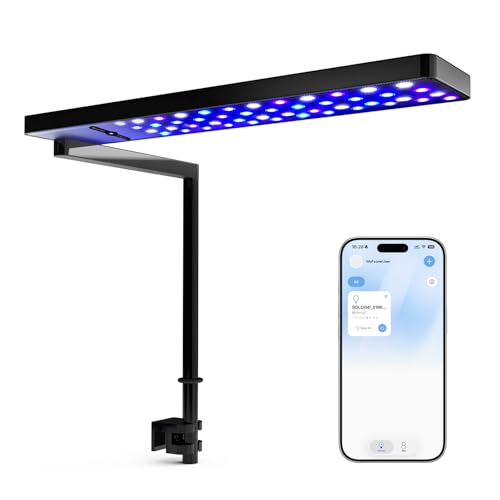
FZONE Solo Series Nano LED Marine Reef Light

SMATFARM 60W Programmable LED Reef Light

NICREW Clip-on Marine Aquarium Light
What Each Pick Brings To The Table
The Current USA Orbit Marine is the fixture you reach for when a standard 24 to 36 inch tank needs dependable light without app accounts or firmware updates. Its slim rail sits low over the water, and the adjustable color spectrum lets you dial in a look that flatters both fish and soft corals.
What separates it from budget bars is the built-in control loop that also manages eFlux wave pumps, so lighting and flow run off one schedule. In a busy living room tank, that means fewer remotes and fewer things to forget.
Good Reasons To Consider
- Adjustable color spectrum lets you tune whites and blues to match coral placement and personal taste
- Integrated eFlux pump control consolidates light and flow scheduling into one system
- 24-hour IR programming automates dawn-to-dusk cycles without daily input
- Slim profile keeps the fixture visually quiet over rimmed or rimless tanks alike
Things To Consider
- IR remote control requires line of sight, which gets awkward with cabinets above the tank
- Owners commonly report intensity is better suited to soft corals and LPS than demanding SPS colonies
Who It Suits Best
A first-time saltwater keeper running a 20 to 40 gallon fish-and-invertebrate setup who wants automation without an app dependency.
Where Another Pick Suits Better
Hobbyists who want phone-based control should look at the Current USA Bluetooth model reviewed next, since it adds wireless scheduling over the same platform.
This is the same Orbit Marine platform as the entry model above, but with Bluetooth baked in and the LOOP app handling the heavy lifting. You build schedules, adjust channels, and sync eFlux wave pumps from your phone instead of pointing a remote at the tank.
The payoff shows up during vacations and busy weeks: lighting changes happen on schedule whether you’re home or not. For most mid-size reef builds, that convenience alone justifies stepping up a tier.
What Makes Sense
- Bluetooth app control means schedules persist even when you’re away from the tank
- Wireless pairing with eFlux pumps creates coordinated flow-and-light storms that mimic real tides
- Wide color spectrum renders coral fluorescence noticeably better than single-channel bars
- No extra hub or controller box cluttering the stand
Worth Noting
- App-dependent control frustrates anyone who prefers physical buttons, and Bluetooth range limits adjustments to nearby rooms
- Like its sibling, output favors softies and LPS over high-demand SPS
At A Glance
Made For
The connected-home hobbyist running a 24 to 36 inch mixed reef who wants set-and-forget automation managed entirely from a phone.
Consider Something Else When
Keepers chasing serious SPS growth will get more usable PAR from the Wills 100W unit later in this list, at a friendlier price point.
Longer tanks are where most budget fixtures fall apart, leaving dark corners at the ends of a four-foot aquarium. This stretched version of the Orbit Marine spreads its adjustable spectrum across 36 to 48 inches, keeping edge corals out of shadow.
You still get the 24-hour IR programming and eFlux pump coordination from the smaller model, just scaled up. The honest trade-off is the same one its sibling carries: it flatters fish and softer corals more than it powers light-hungry stonies.
A Strong Showing
- Extended coverage eliminates the dead zones typical of undersized bars on 48 inch tanks
- Same integrated pump control as the 24-36 inch version, so upgrades stay consistent across multiple tanks
- Adjustable spectrum adapts as your livestock mix evolves from fish-only toward corals
Minor Gripes
- IR remote only works within sight of the receiver, a nuisance for recessed hoods or wall-mounted shelves
- Single-fixture coverage may leave deep sand beds dimmer than some aquascapes need
Right Fit For
Anyone stocking a standard 55 gallon or four-foot breeder with community fish, live rock, and moderate coral demand.
Look Elsewhere When
App-first users should compare it against the Current USA Bluetooth 24-36 inch model, which trades length for wireless convenience on shorter tanks.
Where the Current USA fixtures prioritize convenience, the Wills goes straight after raw spectral coverage. A 100 watt array packs 450nm royal blue for fluorescence, 530nm actinic tones for visual pop, and 660nm red alongside warm 3000K and cool 6500K whites, giving corals and plants the wavelengths they actually use for photosynthesis.
The compact 16 x 8 x 2.4 inch body concentrates that output into roughly a 24 x 24 inch footprint, which suits square tanks and focused grow zones. For the money, few panels match this wavelength density.
Useful Strengths
- Multi-wavelength design supports both reef corals and planted freshwater conversions
- High wattage in a small body delivers penetration deeper than slim-bar rivals at similar cost
- Balanced white blending keeps the tank looking natural rather than permanently blue-washed
- Even spread across its rated footprint avoids hot spots directly under the panel
Trade Offs
- No app or wireless control mentioned, so scheduling depends on whatever timer you pair with it
- The dense panel runs warm, and owners commonly report dust buildup on the housing needs occasional cleaning
Quick Facts
Who Will Love This
Budget-conscious reefers growing LPS and soft corals in a square or cube tank who care more about spectrum than smart features.
Not Your Match When
Keepers wanting sunrise-sunset automation will find the SMATFARM 95W model further down far easier to program day cycles on.
Corals respond to rhythm as much as raw brightness, and this SMATFARM fixture leans hard into that idea. Its timer and dimmer simulate sunrise, sunset, and moonlight phases, ramping between 0 and 100 percent so livestock experience gradual transitions instead of abrupt on-off shocks.
Under the hood sit 24 five-watt SMD LEDs behind high-transmission optical lenses, a combination that pushes usable light down toward the rockwork. Group control support matters too: run two units side by side on a longer tank and they follow one program.
Reasons It Performs
- Full 0-100% dimming lets you acclimate new corals gradually and prevent light shock
- Built-in timer handles dawn, dusk, and lunar phases without external controllers
- Group control synchronizes multiple fixtures for wider tanks under a single program
- Five-watt LEDs with optical lenses deliver stronger penetration than typical chip-on-board panels
Points To Note
- Programming happens through remote and touch controls rather than a smartphone app, which some keepers find dated
- Bracket mounting takes patience to level properly on rimless glass
Feature Snapshot
The Right Fit
An intermediate keeper growing LPS and mixed corals who wants authentic day-night cycling without paying flagship-brand prices.
Another Choice May Suit
Nano tank owners should skip this one’s footprint and consider the FZONE Solo Series, sized specifically for small rimless setups.
Nano reefs are unforgiving. With only ten or twenty gallons of water, a badly tuned spectrum stresses corals fast, and oversized fixtures cook them. The FZONE Solo Series answers with 56 LEDs split across four independent channels spanning white, royal blue, deep blue, warm white, green, red, and UV.
The manufacturer-tuned channel ratio leans heavily blue, around 70 percent, which is exactly what drives coral fluorescence and coloration. App control rounds it out, letting you adjust each channel independently from your phone while the tank sits on a desk or shelf.
What Pays Off
- Four independent channels give fine-grained control rare at this size class
- Blue-dominant ratio enhances fluorescence and supports healthy coral pigmentation
- Smart app control makes dialing in a nano tank quick and repeatable
- Compact form suits rimless and pico builds where clearance is tight
Softer Spots
- Output ceiling limits it to lower-light corals; demanding SPS colonies will want more power
- Small fixtures concentrate heat near the water surface, so ventilation in enclosed cabinets deserves attention
Core Details
Built With In Mind
The desk-side reefer running a rimless nano or pico tank stocked with soft corals and zoanthids who wants app-level tuning in a tiny package.
Skip It When
Larger tanks deserve the SMATFARM 60W programmable unit, whose wider spread and higher output suit 40-plus gallon systems far better.
Deep tanks punish weak lights. This second SMATFARM entry, the G3, pushes 60 watts through 26 five-watt LEDs across three channels of white, blue, and violet-blue, with enough penetration to reach substrate-level rockwork in taller aquariums.
Wireless programmability covers dimming and timing, and the wide coverage claim targets oversized saltwater systems specifically. Compared with the brand’s 95W model earlier in this list, the G3 trades some finesse in day-cycle simulation for broader spread and simpler channel management.
Useful Touches
- Three-channel layout simplifies tuning compared with multi-channel competitors
- Violet-blue channel adds the actinic depth many budget whites lack
- Wireless programmable dimming and timer handle daily cycles hands-free
- 26 high-power LEDs sustain output across wide, deeper tanks
Room For Improvement
- Only three channels means less spectral fine-tuning than the FZONE offers nano keepers
- High-power diodes generate noticeable heat, and dust on the housing warrants periodic checks
Key Attributes
Whose Shelf It Belongs On
The reefer running a 40 to 75 gallon mixed system with rockwork stacked high, needing spread and penetration over boutique features.
Reach For A Different Pick When
Smaller tanks are better served by the NICREW clip-on reviewed last, which costs less and mounts in seconds on nano glass.
Every reef starts somewhere, and the NICREW clip-on is a gentle entry point. Designed for 2.5 to 5 gallon nano tanks, it clamps onto the glass in seconds with no hanging kit, no brackets, and no drilling. Blue and white LEDs adjust independently from 0 to 100 percent, so you can find a balance that suits fish, live rock, and low-light soft corals.
A 15-minute ramp-up and ramp-down softens transitions, sparing skittish fish the startle of instant light. Compared with the FZONE Solo, it gives up app control and channel count but wins decisively on simplicity and price.
Bright Spots
- Clip-on mount installs in seconds on rimmed nano tanks
- Independent blue and white dimming from 0-100% covers basic customization
- Gentle 15-minute fade transitions reduce stress on fish
- Shimmer effect adds visual depth to small aquascapes
Honest Caveats
- Output suits fish, live rock, and low-light softies only; stony corals will struggle
- The clamp grip loosens over time on thicker glass, worth checking occasionally
Who Should Grab It
A complete beginner setting up a first 2.5 to 5 gallon saltwater tank with live rock and hardy soft corals.
A Better Fit Elsewhere
Once corals demand more, the FZONE Solo Series Nano LED provides the channel control and spectrum depth this little clip-on can’t.
Choosing Between These Fixtures Without Regret
Match Output To Your Livestock
Soft corals and zoanthids thrive under modest intensity, while SPS colonies demand strong PAR, a measure of usable light for photosynthesis, delivered consistently. Overbuying wastes money and fuels algae; underbuying starves corals slowly. Write down your target species before comparing wattage numbers.
Coverage Beats Peak Brightness
A fixture rated for 24 inches stretched over a 48 inch tank leaves dark ends and unhappy corals. Measure your tank’s actual length and depth, then choose a light whose stated coverage matches or exceeds it. Two smaller units often beat one undersized bar.
Control Style Shapes Daily Life
Remotes require line of sight, apps require Bluetooth range, and timers require nothing at all. Think honestly about how often you’ll adjust settings after week one. Most keepers program once and rarely touch the fixture again, which makes simple, reliable scheduling more valuable than feature lists suggest.
Key Considerations Across These Picks
Traps First Timers Fall Into
The classic error is buying for looks instead of livestock needs. A gorgeous blue-heavy bar that can’t penetrate past twelve inches of water will disappoint any reefer hoping to grow stony corals. Heat is the second blind spot: high-wattage panels in closed cabinets raise water temperature, so plan ventilation before installation day.
What Separates Premium From Basic
Higher-tier fixtures buy you independent channels, smoother dimming curves, and wireless ecosystems that coordinate pumps and lights together. That matters most for mixed reefs where coral species have different demands. Fish-only tanks gain almost nothing from those extras, which is why the entry-level Current USA models remain sensible choices for simpler setups.
Frequently Asked Questions
How many hours per day should reef lights run?
Most mixed reef tanks do well with 8 to 10 hours of full intensity, bookended by ramp-up and ramp-down periods. Consistency matters more than the exact number, so a timer or app schedule pays for itself quickly.
Can I use these lights on a freshwater tank?
Several picks here, notably the Wills full-spectrum panel, include wavelengths suited to planted freshwater setups. Always check the spectrum description first, since marine-specific fixtures lean heavily blue for coral coloration.
Do I need a special fixture for a rimless tank?
Rimless tanks work with hanging kits, bracket-mounted arms, or clamp-style lights depending on the model. The FZONE and SMATFARM units here accommodate rimless glass, while the NICREW clip-on expects a rim to grip.
What does PAR mean and why does it matter?
PAR stands for Photosynthetically Active Radiation, the light wavelengths corals use for energy. Higher PAR at depth means you can keep more demanding corals lower in the tank, not just near the surface.
How long do LED aquarium lights typically last?
Quality LED arrays commonly run for years before output degrades noticeably, though drivers and fans can fail sooner. Keeping housings dust-free and ensuring airflow around the fixture extends working life considerably.
Closing Thoughts
The right light depends less on the biggest number and more on honest matching: tank size, coral ambitions, and how much control you actually want. Start simple if you’re new, step up to programmable power as your reef matures, and let your livestock dictate the upgrade path. Any fixture on this list will serve you well in the role it was built for.
