

A cloudy tank is the fastest way to lose interest in the hobby. The right filter system does most of the heavy lifting quietly in the background, so you spend your time enjoying the fish instead of scrubbing glass. This shortlist covers seven options across different tank sizes and setups, from small desktop aquariums to large showpiece tanks. Whether you keep turtles, koi, or a community of tetras, one of these should match your water volume, your maintenance habits, and your budget.
The Shortlist At A Glance

Atlantis Aqua Submersible Aquarium Filter for Large Tanks

TARARIUM Turtle Tank Filter Power Adjustable 20-75 Gal. 290GPH

TARARIUM 290GPH Turtle Tank Aquarium Filter for 20-85 Gallon
Aqueon SmartClean Power Filter with EcoRenew Cartridge

coospider-repta Internal Fish Tank Filter for 55-150 Gallons
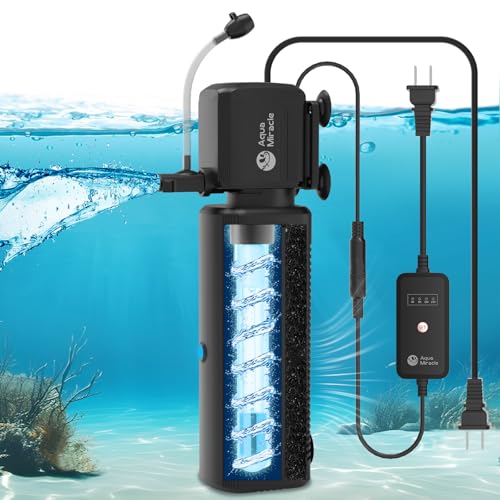
AquaMiracle Aquarium U-V Filter with Timer for Green Water Control

Fluval FX2 High Performance Canister Aquarium Filter
More Details On Our Top Picks
Most internal filters pull water in from the sides, which means debris near the substrate often gets left behind. This Atlantis Aqua unit takes a different route: it draws water through the bottom of the housing, so the full column of tank water cycles through the media rather than skimming past it. In a busy 75-gallon community tank, that difference shows up as less settled waste sitting on the gravel.
The submersible format also keeps things quiet, since the pump runs underwater rather than hanging off the back rim. Owners commonly report it suits tanks in the 55 to 100 gallon range, which puts it squarely in the large-aquarium category alongside the Fluval canister further down this list.
Strong Points
- Bottom-draw intake captures waste that settles near the substrate, not just floating particles.
- Fully submerged operation keeps noise down, a real benefit in bedrooms or living rooms.
- Sized generously for 55 to 100 gallon tanks, so you get headroom rather than running at its limit.
- No external plumbing needed; drop it in, position it, and plug it in.
Things To Consider
- Internal units take up visible space inside the tank, unlike an external canister such as the Fluval FX2.
- The sponge media needs regular rinsing in removed tank water to keep flow strong over time.
Who It Suits Best
Keepers running large freshwater community tanks who want strong circulation without external equipment cluttering the stand.
Where A Sibling Pick Shines
Smaller planted or nano setups under 30 gallons are better served by the Aqueon SmartClean, whose cartridge system is easier to service weekly.
Turtle keepers know the struggle: reptiles are messy eaters, and most fish-oriented filters choke on the load. This TARARIUM model pushes up to 290 gallons per hour through three stages, starting with a double-sided mesh sponge that clips out for cleaning, then finishing with ceramic bio-balls. Those bio-balls give beneficial bacteria a porous home, which is what actually breaks down ammonia (the toxic compound fish and turtle waste produces).
The waterfall-style return adds surface agitation, which helps oxygen exchange in shallow reptile habitats. Adjustable flow matters here too, since a strong current can stress shrimp or young frogs sharing the enclosure.
What We Like
- Three-stage layout handles both debris trapping and biological breakdown in one compact unit.
- The clip-out sponge makes weekly rinsing a two-minute job.
- Dial-back flow protects delicate tank mates like shrimp and frog tadpoles.
- Waterfall output boosts oxygen levels naturally in low-water enclosures.
Worth Noting
- Ceramic media should be swished gently during cleanings so you don’t wash away established bacteria colonies.
- At higher flow settings, some owners find the waterfall sound noticeable in quiet rooms.
Quick Facts
Made For
Reptile hobbyists keeping turtles, frogs, or mixed-species enclosures between 20 and 75 gallons who want adjustable, multi-stage filtration.
Swap It Out When
Very shallow setups under about three inches of water call for the newer TARARIUM 290GPH model below, which runs at just 2.6 inches minimum depth.
This is the sibling to the TARARIUM unit above, tuned for shallower water. Where the earlier model needs more depth to run properly, this one operates with as little as 2.6 inches of water above the intake. That single spec changes everything for basking-style turtle tubs, where keepers deliberately keep levels low so hatchlings can reach the surface easily.
It combines circulation, debris removal, and oxygenation in one body, rated across freshwater, saltwater, and even murky outdoor-style setups from 20 to 85 gallons. Flow stays adjustable, so you can dial it down for resting animals and back up after feeding time.
Highlights
- Runs at just 2.6 inches minimum water depth, ideal for basking platforms and hatchling tubs.
- Bottom suction pulls waste off the floor where turtles actually leave it.
- Handles freshwater, saltwater, and muddy water without modification.
- Adjustable power lets you match current strength to shy or juvenile animals.
Small Caveats
- Intake sponges clog faster in turtle tanks than fish-only systems, so plan on rinsing them every few days during heavy feeding periods.
- The upper end of its 85-gallon rating assumes light stocking; heavily loaded reptile tanks benefit from pairing it with a second unit.
Right Fit For
Turtle owners with shallow basking-style habitats between 20 and 45 gallons who need reliable filtration at low water levels.
Another Choice May Suit
Larger koi ponds and deep display tanks beyond 85 gallons are better matched to the coospider-repta internal filter, which stretches its rating all the way to 150 gallons.
Water changes are the chore everyone skips, and skipped changes mean algae and stressed fish. Aqueon’s SmartClean design attacks that problem directly: a simple lever lets you divert dirty water straight out of the filter into a bucket without dismantling anything or reaching into the tank. For anyone maintaining a 10 or 20 gallon tank on a kitchen counter, that convenience compounds week after week.
The included EcoRenew cartridge handles mechanical and chemical filtration, and the whole hang-on-back assembly runs quietly enough for offices and bedrooms. Adjustable flow lets you soften the current for bettas and other slow-swimming species.
Upsides
- One-lever partial water changes cut maintenance time dramatically compared with siphoning alone.
- Quiet operation suits desks, nightstands, and shared living spaces.
- Adjustable flow protects long-finned fish like bettas from constant battling against the current.
- Works in both freshwater and saltwater setups within its 10 to 20 gallon range.
Points To Note
- Cartridge-based systems mean ongoing replacement purchases rather than reusable sponge media.
- Hang-on-back filters need a rim clearance of roughly an inch, worth checking against framed or thick-glass tanks before ordering.
Who Should Grab It
Beginners and busy apartment dwellers running small freshwater or saltwater tanks who want the lowest-effort maintenance routine possible.
Reach For A Different Pick When
Keepers who prefer washable, reusable media over cartridges will get better long-term value from the Atlantis Aqua submersible unit at the top of this list.
Big tanks usually mean big spending, but this coospider-repta unit covers an enormous range, from 55 gallons up to 150, with a 300 GPH pump doing the work. That flow figure refers to how many gallons the pump moves per hour, and at this level it’s enough to turn over a large koi vat or turtle pond several times daily. An adjustable valve on top doubles as an aerator, adding dissolved oxygen that koi and active turtles burn through quickly.
Filtration relies on dual layers of deep black biochemical sponge, which trap particles while hosting bacteria that strip odors. Compared with the TARARIUM models earlier in this list, this one trades fine-polish clarity for raw capacity and price.
Bright Spots
- 300 GPH pump has genuine headroom for tanks up to 150 gallons.
- Built-in aeration valve raises oxygen levels without buying a separate air pump.
- Dual deep sponge layers handle both particle capture and odor control.
- Wave-making output mimics natural current, which many koi respond well to.
Room For Improvement
- Sponge-only media lacks dedicated biological chambers, so very heavily stocked tanks may want supplemental ceramic media.
- The unit’s footprint inside the tank is substantial; measure your rear glass panel before committing.
Built With In Mind
Koi keepers and multi-turtle households running large indoor vats or stock-tank ponds who need serious turnover on a modest budget.
Not Your Match When
Anyone fighting persistent green water will get better results from the AquaMiracle UV filter next, since sponge filtration alone doesn’t address suspended algae.
Green water is suspended algae, and no amount of sponge filtration removes it. That’s the gap this AquaMiracle fills: ultraviolet light inside the unit disrupts free-floating algae cells as water passes through, clearing the pea-soup look that frustrates so many pond and turtle tank owners. A built-in timer controls the UV cycle, so you’re not burning the bulb around the clock unnecessarily.
The SV-1000 variant pairs a 12-watt pump with 300 GPH maximum flow, sized for tanks from 60 to 150 gallons, and includes a filter sponge that catches uneaten food and plant debris ahead of the UV chamber. An aeration mode and rainfall setting round out the water-movement options.
Reasons To Buy
- UV clarification targets green water directly, something standard media can’t do.
- Timer function extends bulb life by running the lamp only when needed.
- Included sponge pre-filter traps waste before it reaches the UV chamber.
- Aeration and rainfall modes add oxygenation variety for fish and turtles alike.
Honest Caveats
- UV bulbs have a finite lifespan and need periodic replacement, an ongoing cost worth budgeting for.
- Clearing green water takes days of continuous use, not hours, so patience matters.
At A Glance
Whose Shelf It Belongs On
Pond-style and sunlit turtle tank owners battling recurring algae blooms in 60 to 150 gallon setups.
Consider Something Else When
Crystal-clear planted aquascapes with healthy plant mass rarely need UV at all; the Fluval FX2’s multi-stage canister approach preserves water clarity more elegantly there.
Everything before this point has been an internal or hang-on unit. The Fluval FX2 sits outside the tank entirely, tucked into your stand, and represents the high end of hobbyist filtration. Its basket-in-basket tray design stacks multiple media layers in one removable cassette, so a monthly service means lifting one basket instead of fumbling with loose rings. The built-in powered water change system is the feature long-time keepers rave about: it purges dirty water directly to a sink or drain without buckets.
SMART PUMP technology monitors performance and adjusts automatically, while auto start/stop means refills begin flowing again on their own after maintenance. Compared with the Atlantis Aqua internal unit, this is a step up in both cost and capability, aimed at keepers who treat their aquarium as a serious investment.
Plus Points
- Powered water change feature eliminates bucket hauling entirely.
- Nested media baskets make routine servicing fast and organized.
- Self-regulating pump maintains consistent output as media loads up.
- External placement frees all interior tank space for aquascaping.
- Multi-stage design supports mechanical, biological, and chemical media together.
Softer Spots
- Requires cabinet space beneath the tank and proper hose routing, a non-starter for open-frame stands.
- Higher upfront investment than any internal option on this list.
The Right Fit
Dedicated aquarists running large display tanks who view filtration infrastructure as a decade-long purchase.
Look Elsewhere When
First-time keepers with modest budgets will be happier starting with the Aqueon SmartClean and upgrading later once the hobby sticks.
Factors To Weigh Before Choosing Filter Systems For Aquarium
Match Flow To Your Stocking Level
Manufacturers rate filters by tank size, but stocking density matters just as much. A 75-gallon tank holding twenty goldfish produces far more waste than the same tank with a few angelfish. As a rule of thumb, aim for a filter rated slightly above your actual volume whenever animals are messy feeders. Turtles and koi sit firmly in that category.
Internal Versus External Design
Internal filters submerge inside the tank: easy to install, invisible plumbing, but they occupy aquascape space. External canisters hide in the stand and offer larger media capacity, at the cost of setup complexity and cabinet room. Small tanks favor internal or hang-on-back designs; displays over 75 gallons reward the canister route.
Media Type And Ongoing Costs
Cartridge systems are convenient but create recurring purchases. Reusable sponge and ceramic media cost more upfront attention and less money over years. Decide which trade-off fits your habits honestly, because the best filter is the one you’ll actually maintain.
Special Problems Need Special Tools
Green water, low water levels, and heavy bioloads each call for targeted features: UV clarification, shallow-depth intakes, or oversized flow rates respectively. Identify your specific pain point first, then shop for the attribute that solves it rather than chasing generic specs.
Key Considerations Across These Picks
Traps First Timers Fall Into
The most common mistake is undersizing: buying for the tank you own today, then upgrading livestock six months later. Buy for the mature tank you plan to keep. Second slip-up is ignoring maintenance access; a filter buried behind rockwork never gets cleaned, and clogged media silently degrades water quality.
What Separates Premium From Basic
Higher-tier units like the Fluval FX2 charge more for engineering, not marketing: self-regulating pumps, powered water changes, and modular media baskets all reduce lifetime labor. Paying up makes sense once keeping is a confirmed hobby, not before.
Bottom Line
Clear water comes from matching the tool to the tank, not from spending blindly. Small desktop setups thrive with the Aqueon, shallow turtle tubs need the low-depth TARARIUM, and serious displays justify the Fluval. Start with your real pain point, whether that’s algae, mess, or maintenance time, and let it guide the choice. Your fish will notice the difference long before your guests do.
