

Deep-chested breeds like Greyhounds, Dobermans, and Boxers slip out of ordinary harnesses because their narrow waists leave extra room at the ribs. The right harness hugs the widest part of the torso without pinching, and that difference shows up on every single walk. This list focuses on adjustable, well-padded designs that hold their shape on broad chests, from casual neighborhood loops to trail work.
The Main Contenders

Wilderdog Lightweight Dog Harness with Reflective Straps (Huckleberry)

Dog Friendly Co. Dog Harness for Large Sized Dogs (Brown, XL)
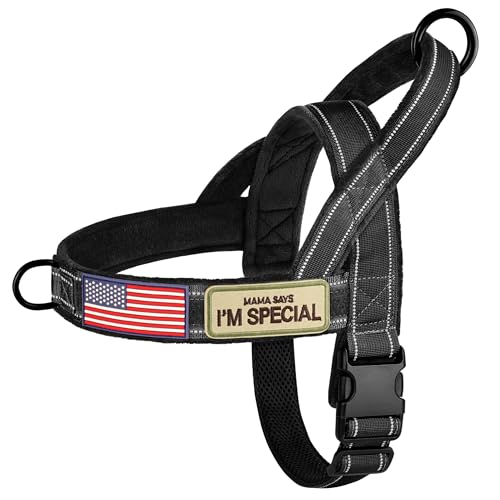
Forestpaw No Pull Dog Harness with Large Handle (XL, Black)

APAKBAK No Pull Dog Harness with Handle, Soft Mesh Padded Vest

Gavpepy No Pull Tactical Vest Harness, 900D Nylon (Large Black)

OneTigris No Pull Adjustable Tactical Harness with Soft Padding

Azinoo Blue No-Pull Dog Harness with 2 Leash Clips (L)
The Picks, Examined More Closely
This one skips the bulk that most vest-style gear carries. It slips over the head, closes with two side-release buckles, and adjusts independently at the neck and shoulders, which matters when a deep chest tapers quickly behind the ribs.
On rocky terrain, the top handle earns its keep: you can steady your dog over boulders or lift them into the car without grabbing fur. Compared with the heavier tactical options further down this list, it disappears under a coat and dries fast after creek crossings.
A Few Highlights
- Two D-ring points, one at the chest and one on the back, let you switch between training control and relaxed walking.
- The grab handle gives you a safe way to assist over obstacles or hold your dog close near traffic.
- Reflective stripes make dusk and dawn walks noticeably safer along unlit roads.
- Independent neck and shoulder straps help you dial in a snug fit on a barrel-shaped torso.
Things To Consider
- The overhead design frustrates some head-shy dogs, so practice indoors before your first hike.
- Strap adjustment does most of the fitting work here, so measuring your dog before ordering pays off.
Who It Suits Best
Weekend hikers whose deep-chested companions cover mixed terrain and need occasional physical assistance.
Where Another Pick Suits Better
Owners of very large working breeds will find the wider size coverage of the OneTigris tactical harness a safer starting point.
Where the Wilderdog leans rugged, this one reads clean and understated, with a brown finish that suits city walks as much as park trips. The standard setup ships with one heavy-duty back D-ring built for everyday leashing.
The interesting part is modularity. A front D-ring exists as a separate add-on sold apart from the base harness, so you only pay for front-clip control once pulling behavior actually demands it. Neck and chest straps adjust across an XXS through XL range, which helps households with more than one dog share a brand they trust.
Positive Takeaways
- A reinforced back ring handles daily walking loads without stitching stress.
- Modular front-clip support means you upgrade only when leash manners call for it.
- Adjustable straps at both the neck and chest accommodate broad torsos with tapering frames.
Worth Noting
- No front attachment comes in the box, so strong pullers need the separate add-on before day one.
- With no top handle listed, owners who regularly lift or steady their dogs may want a different design.
Made For
Urban owners of large, already-mannered dogs who value a low-profile look over tactical hardware.
Consider Something Else When
Training a dedicated puller calls for the Forestpaw harness instead, since its front control and large handle come included.
Sizing is where this pick gets serious about deep chests. The extra-large version pairs an unadjustable 21-inch front chest panel with a belly band spanning 32 to 39 inches, aimed at dogs between roughly 80 and 110 pounds. That fixed front panel sits right across the broadest part of a barrel torso, which is exactly where escape pressure usually builds.
Construction follows the same practical streak: 1000D nylon (a dense, tear-resistant weave rating), a POM acetal buckle, and an alloy D-ring. Owners commonly report that tightly woven shells like this one shrug off brush and abrasion well but benefit from occasional brushing-out after muddy trails.
Noteworthy Benefits
- The oversized top handle gives handlers real leverage during training corrections or roadside holds.
- 1000D nylon resists tearing and abrasion far better than standard webbing vests.
- A wide belly-chest adjustment window covers the deep-chest-to-narrow-waist shape precisely.
Small Caveats
- The fixed 21-inch front panel leaves no room for growth, so measure carefully before committing.
- Heavier fabric takes longer to dry after rain than mesh-lined alternatives like the APAKBAK below.
At A Glance
Right Fit For
Handlers running leash-training sessions with powerful dogs in the 80-to-110-pound bracket.
Not Your Match When
Smaller or lighter deep-chested dogs belong in the Azinoo harness, whose large size starts at much lower weight ranges.
Hot summers change the calculus entirely. A padded nylon vest that feels fine in March can overheat a thick-coated dog by July, and that is where this mesh-lined design pulls ahead of the Forestpaw reviewed above. Airflow through the lining keeps long walks comfortable in warm weather.
Control comes from a split layout: a front clip that discourages pulling by redirecting the dog toward you, plus a back ring suited to loose-leash strolls and training drills. Adjustment points sit at both the chest and the belly, letting you close the gap that lets deep-chested dogs back out of looser vests.
Everyday Perks
- Mesh padding breathes during summer walks and dries quickly after swims.
- Dual clip positions let you shift between pull management and relaxed walking without swapping gear.
- Two independent adjustment zones create an escape-resistant fit on tapered frames.
- The included handle adds a quick-control option near roads or crowded paths.
Points To Note
- Mesh linings are generally less abrasion-proof than ballistic nylon, so heavy brush work wears them faster.
- Fine debris and burrs tend to lodge in woven mesh, so a post-hike check keeps it clean.
Quick Facts
Who Will Love This
Owners in warm climates walking deep-chested dogs daily through neighborhoods rather than rough backcountry.
Look Elsewhere When
Heavy-duty trail use favors the Gavpepy 900D vest, which trades some breathability for far tougher shell material.
Some dogs simply generate more force than a standard vest should absorb. This tactical-style harness targets that reality with 900D ballistic nylon (a high-denier weave used in military-grade gear) and reinforced cross-stitching at load points. The stated fit range is unusually generous: chest girth from roughly 15 to 35 inches and neck girth from about 16.5 to 26 inches.
That spread is why it works for barrel-chested builds, since you can tighten well past the ribcage without compressing the throat. Dual control handles give you grip options at both ends of the vest, useful for German Shepherds, Rottweilers, and Huskies that lunge unexpectedly.
Everyday Advantages
- The enormous girth range fits everything from lean sighthounds to heavily muscled guard breeds.
- 900D nylon with cross-stitching stands up to years of hard pulling, based on how this construction class typically performs.
- Two separate handles let you steer from the chest or stabilize from behind.
- Padded interior panels distribute leash pressure instead of concentrating it at one strap.
Trade Offs
- Tactical hardware adds weight, which smaller or senior dogs may find tiring on long outings.
- The black shell absorbs heat, so midday summer walks call for shade breaks.
The Numbers That Matter
Best Suited To
Owners of strong working or hunting breeds that snap standard harnesses at the seams.
Skip It When
Lightweight everyday comfort matters more than armor, which points you toward the Wilderdog at the top of this list.
Next to the Gavpepy, this one trades a slightly narrower size ladder for a clearer three-step structure. Medium covers necks from 16 to 23 inches and chests from 24 to 32 inches for dogs between 30 and 60 pounds, while XL stretches to a 31-to-40-inch chest and dogs up to 140 pounds. Measuring neck, chest, and back length before ordering is genuinely necessary here.
The build balances toughness with wearability: high-strength nylon webbing, metal buckles, and a mesh lining that keeps the tactical silhouette breathable. In our view, that combination makes it the better choice for dogs that need serious hardware every single day rather than occasionally.
What Earns Its Place
- Three clearly defined sizes with published neck, chest, and back measurements remove guesswork.
- Metal buckles hold up where plastic clips commonly crack under sudden lunges.
- Mesh lining adds ventilation that most tactical vests skip entirely.
- Soft padding spreads pressure across the chest during hard stops.
A Few Limitations
- Back-length specs mean a correct girth fit can still ride awkwardly on unusually long or short bodies.
- Nylon webbing collects dirt visibly, so regular rinsing keeps it looking fresh.
Feature Snapshot
The Right Fit
Daily trainers with large athletic breeds who want durable gear that still breathes in warm weather.
Another Choice May Suit
Occasional weekend hikers get more comfort per ounce from the Wilderdog Lightweight Harness higher up this list.
The large size here spans necks from 17 to 24 inches and chests from 24 to 32 inches, landing squarely in the territory occupied by Huskies, Labradors, and Shepherds. Five metal delta-shaped rings, distributed across the front and back, anchor leashes from multiple angles depending on what the walk demands.
Four adjustable straps do the real fitting work, tightening around a deep ribcage while leaving shoulder motion untouched. Quick-snap buckles make on-and-off painless, which matters twice a day for apartment dwellers. Padded Oxford nylon over breathable mesh mirrors the comfort approach of the APAKBAK while adding more attachment versatility.
The Case For It
- Five metal rings give you more leash-position flexibility than any other pick here.
- Four adjustable straps create a growth-friendly fit for young dogs still filling out.
- Reflective elements improve visibility on early morning and evening routes.
- Lightweight construction keeps small-framed handlers in comfortable control.
Honest Caveats
- Multiple straps take a minute to set correctly the first time, so expect a short learning curve.
- Oxford nylon shells generally show scuffing sooner than the 900D material on the Gavpepy vest.
Key Specs
Perfect Match For
Multi-dog households wanting one adaptable harness style that covers Huskies, Labs, and Shepherd mixes alike.
Swap It Out When
Dogs pushing past 110 pounds need the Forestpaw XL, whose belly range extends well beyond this one.
What Matters Most Before Choosing a Harness for a Deep-Chested Dog
Measure the Girth, Not the Weight
Weight ranges are a starting point, nothing more. Two 70-pound dogs can carry completely different chest depths, and a harness sized by weight alone often floats loose across a barrel torso. Wrap a soft tape around the widest part of the ribs, just behind the front legs, and compare that number to the manufacturer’s girth range first.
Watch the Escape Routes
Deep-chested dogs back out of harnesses by reversing their shoulders through a loose chest panel. A fixed front plate, like the Forestpaw’s 21-inch panel, closes that gap mechanically. Designs relying purely on adjustable straps need enough adjustment points, ideally four or more, to lock the fit down.
Balance Padding Against Heat
Padded vests protect skin at pressure points but trap warmth on double-coated breeds. Mesh linings such as those on the APAKBAK and Azinoo solve this for warm climates, while denser shells suit cold-weather hiking.
Front Clip or Back Clip
A front clip redirects a pulling dog toward you and teaches leash manners faster. Back clips suit trained walkers and jogging. Several picks above offer both, so you can switch as training progresses.
Key Considerations Across These Picks
Traps First Timers Fall Into
Ordering by breed name instead of measurement tops the list. A “large” from one brand equals a “medium” elsewhere, and returns cost you weeks of walking time. Second, skipping the two-finger check after fitting: you should slide two fingers flat under every strap. Tighter than that restricts breathing, looser invites a backward slip.
Where The Extra Money Goes
Higher-tier harnesses spend on denier ratings, metal hardware, and reinforcement stitching. Those upgrades matter most for dogs over 80 pounds or habitual pullers. A calm 45-pound walker gains little from 1000D nylon, while a lunging Rottweiler can crack plastic buckles in a single season.
Closing Thoughts
Barrel-chested dogs deserve gear shaped for their geometry, not scaled-up generic vests. Start with a tape measure, prioritize girth range over marketing size labels, and match shell weight to your climate and activity level. Any of these seven will hold a deep chest securely once fitted correctly, and the right one simply makes every walk feel easier for both ends of the leash.
