

Internal filters sit inside the tank itself, which makes them a favorite for anyone tired of bulky hang-on-back units or noisy canisters cluttering the cabinet below. They’re easy to install, simple to clean, and they disappear into the aquascape once positioned right. The catch is choosing one sized correctly for your tank and livestock, since an undersized pump leaves water cloudy while an oversized one blasts shy fish around like a washing machine. This shortlist covers everything from 3-gallon shrimp tanks to 300-gallon monster setups, so you can match flow rate, filtration stages, and footprint to your exact aquarium.
The Shortlist At A Glance

Atlantis Aqua Submersible Aquarium Filter (75 Gallon)
Atlantis Aqua Quiet Fish Tank Filter (20-55 Gallon)
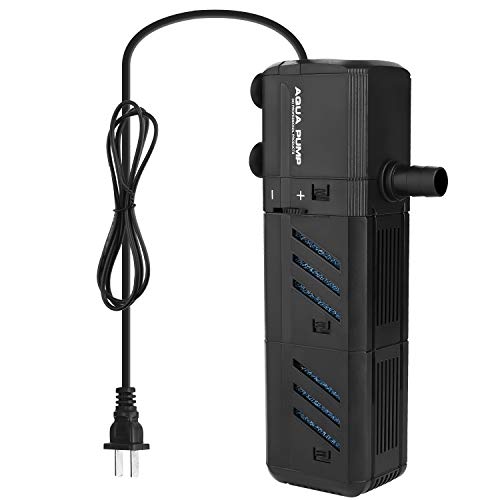
NO.17 Submersible Aquarium Internal Filter 12W 320 GPH

TARARIUM Turtle Tank Filter 290GPH 20-75 Gal

NICREW Internal Aquarium Filter up to 20 Gallons 100 GPH
Pawfly Internal Aquarium Filter 55 GPH

coospider-repta Internal Filter for 55-150 Gallon Tanks
NO.17 Adjustable Fish Tank Filter 400GPH 15W
More Details On Our Top Picks
Most internal filters pull water through side intakes, which means some of it shortcuts past the media unfiltered. The Atlantis Aqua takes a different route: it draws from the bottom of the unit, forcing every gallon through the complete filtration column before it returns to the tank.
In a busy 75-gallon community tank stocked with messy mid-level swimmers, that full-path design is the difference between weekly glass wipes and monthly ones. Owners commonly report it runs quietly enough for a living room setup, which matters when the tank doubles as room decor.
Strong Points
- Bottom-draw intake pushes water through the entire filter body instead of letting it bypass the media along the sides.
- Sized generously for 55 to 100 gallon tanks, so it keeps headroom on heavily stocked systems.
- No disposable pads to swap out, which cuts long-term running costs and maintenance trips to the store.
- Submersible form factor hides inside the tank rather than hanging over the rim.
Things To Consider
- The sponge media needs regular rinsing in removed tank water; neglect it and flow drops noticeably within a few weeks.
- You may find the unit visually prominent in shallow or minimalist scapes where hiding spots are limited.
Key Specs
Made For
Keepers running 55 to 100 gallon freshwater community tanks who want set-and-forget mechanical filtration without recurring pad purchases.
Where A Sibling Pick Shines
Smaller 20 to 55 gallon tanks are better served by the Atlantis Aqua Quiet Fish Tank Filter, which scales the same bottom-draw concept down without overpowering modest stock levels.
This is the smaller sibling of the Atlantis Aqua unit above, built around the same bottom-intake philosophy but tuned for tanks between 20 and 55 gallons. That size band covers the majority of hobbyist aquariums, from a 29-gallon planted community to a 40-breeder cichlid setup.
The quiet operation claim holds up in typical bedroom and office placements according to widely reported owner feedback, though any submersible pump hums slightly against hard surfaces. Positioning it on soft substrate or foam padding tends to mute residual vibration further.
What We Like
- Same full-column bottom draw as its larger sibling, so water can’t take the lazy path around the media.
- Broad 20 to 55 gallon rating gives you flexibility to upgrade your stocking without replacing the filter.
- Reusable media design means no recurring pad purchases eating into your budget.
Minor Gripes
- Rinsing the sponge every couple of weeks is part of the deal; skip it and clarity suffers.
- In very lightly stocked 20 gallon tanks, the flow may feel stronger than delicate species prefer.
Right Fit For
Mid-size tank owners who want one dependable internal unit covering everything from a 29-gallon planted display to a 55-gallon community.
Another Choice May Suit
Nano keepers under 20 gallons should step down to the NICREW Internal Aquarium Filter, whose gentler 100 GPH output suits small planted tanks far better.
GPH stands for gallons per hour, and at 320 of them, this NO.17 moves serious water for an internal unit. The manufacturer rates it for 50 to 150 gallon tanks, and the adjustable pump lets you dial flow down rather than running flat-out all the time.
The 5.25-foot power cord deserves attention during planning: measure your distance to the outlet before ordering, because extension cords near water are a hassle you don’t want. A lift height of nearly four feet also means it can drive a small spray bar or run uphill to a secondary chamber.
Highlights
- 320 GPH maximum flow handles large volumes, roughly turning over a 100 gallon tank three times per hour at full tilt.
- Adjustable output lets you soften current for bettas or crank it for goldfish and cichlids.
- Replacement sponges are sold separately in multi-packs, keeping maintenance cheap over years of ownership.
- 12-watt motor sips power compared to equivalent external canisters.
Softer Spots
- The cord length limits placement flexibility in wide rooms; plan your outlet position first.
- At full flow, the current may be too aggressive for slow-moving long-finned species unless dialed back.
Quick Facts
Who Should Grab It
Keepers of 50 to 150 gallon freshwater tanks who want strong, tunable circulation without plumbing an external canister.
Swap It Out When
Tanks beyond 150 gallons call for the NO.17 400GPH model later in this list, which adds 80 more gallons per hour of headroom.
Turtles are the wrecking balls of the aquarium world, producing waste volumes that humble ordinary fish filters. The TARARIUM answers with a three-stage system: two dense double-sided mesh sponge layers trap debris first, then ceramic bio-balls host beneficial bacteria that break down dissolved waste.
Biological filtration, briefly: porous media where nitrifying bacteria colonize and convert toxic ammonia into safer compounds. The open porosity of ceramic bio-balls gives those colonies plenty of real estate, which is exactly what heavy-bioload reptile tanks need. Low water level compatibility seals the deal for paludariums.
Bright Spots
- Dual-layer double-sided sponges catch everything from food scraps to shed skin before it circulates.
- Ceramic bio-ball stage supports robust bacterial colonies for ammonia control under heavy bioloads.
- Works at low water levels, a genuine rarity among internal filters and essential for basking setups.
- Rated for both freshwater and saltwater, adding flexibility for mixed-species keepers.
- Adjustable steady flow suits turtles, shrimp, and frogs alike.
Points To Note
- Turtle waste loads sponges fast; expect rinsing intervals measured in days rather than weeks.
- The multi-stage assembly takes slightly longer to disassemble and reseat than single-sponge designs.
Details At A Glance
Who Will Love This
Reptile and amphibian keepers running 20 to 75 gallon turtle, frog, or shrimp habitats with low water lines and heavy waste output.
Look Elsewhere When
Pure fish-only tanks above 55 gallons get better value from the coospider-repta Internal Filter, which trades the waterfall design for higher raw flow and aeration.
NICREW has built a reputation on affordable gear that does the basics well, and this 100 GPH internal filter fits that mold precisely. Activated carbon, a chemical filtration medium that absorbs odors and discoloration, pairs with fine foam here to cover mechanical and chemical duties in one compact body.
The adjustable air regulator is the standout detail. It distributes a gentle, bubble-rich flow, which oxygenates the water without blasting a 10-gallon betta tank into turbulence. For small planted aquariums, that balance of circulation and calm is hard to find at this tier.
Plus Points
- Activated carbon stage absorbs odors and tannin staining, keeping small tanks visibly fresh.
- Fine foam traps debris and waste without pulling tiny fish into the intake.
- Adjustable air regulator lets you tune bubble output and current strength to suit shy species.
- Compact footprint disappears behind plants and driftwood in nano scapes.
Small Caveats
- Carbon exhausts within weeks and needs periodic replacement to keep absorbing effectively.
- 100 GPH tops out quickly; anything beyond 20 gallons will feel under-filtered.
Whose Shelf It Belongs On
Betta, guppy, and planted nano tank keepers working within 20 gallons who want quiet, gentle, chemically assisted filtration.
Reach For A Different Pick When
Breeding projects with fry or shrimp colonies benefit more from the Pawfly Internal Aquarium Filter, whose fine sponge intake is specifically designed not to suck up babies.
Shrimp keepers and breeders live in fear of powerful intakes, and rightly so: newborn fry vanish into standard filter inlets within hours. The Pawfly solves this with fine sponge filtration wrapped around a modest 55 GPH pump, trapping debris while staying physically incapable of ingesting baby anything.
Two outlet styles come in the box, a drenching pipe and a spraying pipe, and a sliding knob adjusts flow freely. In a 5-gallon shrimp cube, that combination delivers circulation, light oxygenation, and zero casualties, which is about as good as small-tank filtration gets.
Standout Traits
- Fine sponge intake provides mechanical and biological filtration without endangering shrimp or fry.
- Two interchangeable outlet pipes let you switch between drenching and spraying water patterns.
- Slide-adjustable flow knob offers precise tuning for delicate 3 to 10 gallon environments.
- Promotes circulation and gas exchange simultaneously in stagnant corners.
Trade Offs
- 55 GPH caps usefulness at 10 gallons; larger tanks need something beefier from this list.
- The sponge surface clogs with biofilm over time and benefits from a quick squeeze during water changes.
Core Details
The Right Fit
Shrimp breeders, fry raisers, and nano tank hobbyists running 3 to 10 gallon aquariums where livestock safety outranks raw power.
Not Your Match When
Planted community tanks up to 20 gallons gain more from the NICREW Internal Aquarium Filter, whose carbon stage tackles odors the Pawfly’s sponge-only design leaves alone.
Koi ponds and turtle tubs share a problem: surface film and dead zones that ordinary filters ignore. This coospider-repta unit attacks both with a 300 GPH pump, an adjustable aeration valve for oxygen injection, and a wave-making function that breaks up surface stagnation.
The dual-stage black biochemical sponge handles odor and impurity removal, and the decontamination focus suits outdoor-adjacent setups where debris blows in constantly. Compared to the NO.17 12W earlier in this list, you give up a little documented flow precision but gain aeration and surface agitation in one body.
Reasons To Buy
- 300 GPH pump covers 55 to 150 gallon volumes including pond-style applications.
- Adjustable aeration valve raises dissolved oxygen, supporting livelier fish and turtles.
- Wave-making output disrupts surface film that blocks gas exchange.
- Dual deep biochemical sponges strip odors and keep water visually clear.
Areas To Watch
- Owners commonly report the sponge layers need frequent cleaning in outdoor or turtle-heavy setups.
- The combined functions add bulk, so plan hiding space behind hardscape before committing.
Built With In Mind
Koi keepers, pond hobbyists, and large turtle tank owners who want filtration, aeration, and surface agitation bundled into a single submersible unit.
Consider Something Else When
Indoor display tanks where appearance matters more than aeration should lean toward the TARARIUM Turtle Tank Filter, which presents a slimmer profile with comparable biological capacity.
This is the biggest hammer in the lineup: 400 GPH from a 15-watt motor, rated by the manufacturer for tanks between 150 and 300 gallons. At that scale, most internal filters simply give up, leaving you with expensive external plumbing as the only alternative.
It shares DNA with the smaller NO.17 12W reviewed earlier, including the same 3.9-foot lift height and 5.25-foot cord, just scaled up. The honest read is that a unit this powerful belongs in monster fish tanks, indoor ponds, and heavily stocked systems where turnover volume matters more than whisper-quiet operation.
Upsides
- 400 GPH maximum flow delivers roughly 1.3 tank turnovers per hour even on a 300 gallon system.
- 15-watt efficiency keeps electricity costs reasonable despite the output.
- Adjustable pump lets you throttle down for less demanding stocking.
- Nearly 4 feet of lift height supports elevated returns and secondary chambers.
Honest Caveats
- Even throttled, residual current may stress calm species; this is a power tool, not a nano filter.
- The short cord still constrains placement in large rooms, same as its smaller sibling.
Feature Rundown
Who It Suits Best
Keepers of 150 to 300 gallon aquariums, indoor ponds, and monster fish systems needing serious internal turnover without canister plumbing.
Skip It When
Tanks under 150 gallons are overserved here; the NO.17 12W 320 GPH model delivers ample flow for that range with a smaller footprint and lower draw.
What Matters Most Before Choosing Internal Aquarium Filters
Match Flow Rate To Tank Volume
Turnover, the number of times your filter cycles the full tank volume hourly, is the number that actually predicts water quality. Community freshwater tanks do well with 4 to 6 turnovers per hour, while goldfish and turtles demand more because of their waste output. Divide a filter’s GPH by your tank gallons to check the fit before anything else.
Count The Filtration Stages
Mechanical media catches particles, biological media hosts waste-processing bacteria, and chemical media like activated carbon absorbs odors and staining. Single-sponge units handle small nano tanks fine, but anything above 30 gallons rewards a multi-stage design. Heavily stocked or reptile setups should treat biological capacity as non-negotiable.
Think About Livestock Safety First
Fine sponge intakes protect shrimp, fry, and long-finned fish from being pulled in, while bare impeller inlets do not. Slow-water species such as bettas also need adjustable flow, since a fixed high-output pump turns their tank into a treadmill. Match the intake and flow controls to your most fragile inhabitant, not your hardiest.
Plan Placement And Power Access
Measure the distance from tank to outlet before ordering, since many internal filters ship with cords under six feet. Also consider whether the unit’s visible bulk fits your aquascape, and whether you can reach it easily for the rinsing routine every sponge demands.
Key Considerations Across These Picks
Traps First Timers Fall Into
The classic error is buying by tank size alone and ignoring bioload, then wondering why a “rated for 55 gallons” filter struggles with ten goldfish. Stocking density changes everything. The second slip is skipping the rinse schedule; a clogged sponge silently strangles flow long before water turns cloudy.
When Paying More Pays Off
Higher-tier units buy adjustable pumps, multi-stage media, and durable motors that survive years of continuous duty. Spending up makes sense above 50 gallons or with messy livestock, where weak filtration costs more in lost fish than the price gap ever would. Nano keepers can stay budget-tier comfortably.
Frequently Asked Questions
How often should an internal aquarium filter be cleaned?
Rinse the sponge every two to four weeks in water removed from the tank during a change. Heavy-bioload tanks with turtles or goldfish often need attention weekly.
Can an internal filter be the only filtration in a tank?
Yes, provided its GPH rating matches your volume and bioload. Many nano and mid-size aquariums run successfully on a single well-sized internal unit.
Do internal filters oxygenate the water?
They agitate the surface as water returns, which drives gas exchange and raises dissolved oxygen. Models with dedicated aeration valves boost this effect considerably.
Where should the filter sit inside the tank?
Position it low and toward one end so flow sweeps across the substrate and pushes debris toward the intake. Avoid burying the outlet where circulation dies.
Are internal filters suitable for saltwater tanks?
Some models, like the TARARIUM reviewed above, carry explicit freshwater and saltwater ratings. Always confirm the manufacturer’s stated compatibility before marine use.
Closing Remarks
Matching an internal filter to your tank comes down to three numbers: gallons, GPH, and turnover. Get those aligned, respect the rinse schedule, and any pick on this list will hold its own for years. Start with your livestock’s needs, work backward to the spec sheet, and the right choice usually becomes obvious.
