

A big dog pulling on a thin collar turns every walk into a wrestling match, and the strain lands right where it hurts most: your dog’s throat. A well-built harness shifts that force to the chest and shoulders, giving you control without the coughing fit at the end of the block. The eight options below cover everything from padded everyday vests to MOLLE-equipped tactical rigs, so whether you’re managing a lunging adolescent Shepherd or strolling a mellow senior Lab, there’s a fit here for your situation.
The Shortlist At A Glance

Dog Friendly Co. Dog Harness for Large Dogs (Burgundy, Large)

Gavpepy Tactical Vest Harness 900D Nylon (Black, Large)

Lukovee No Pull Dog Harness and Leash Set
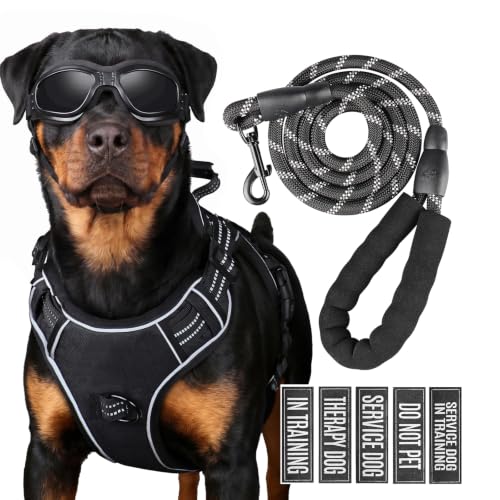
yimeis Tactical Service Dog Harness with Patches (Black, L)

Azinoo Blue No-Pull Dog Harness with 2 Leash Clips (XL)

Yintrest Front Clip Pet Vest with Control Handle (Black, L)
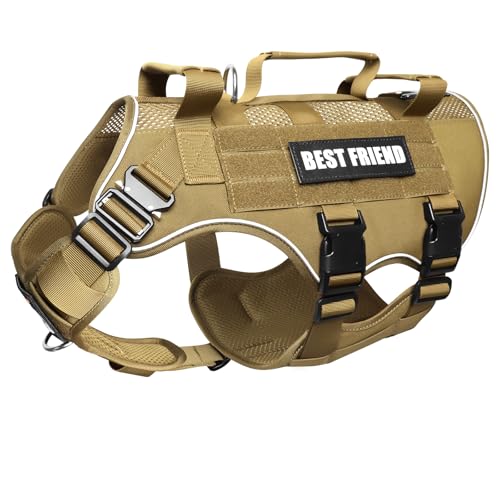
MOOGROU Air Mesh Tactical Dog Harness (Brown, Large)
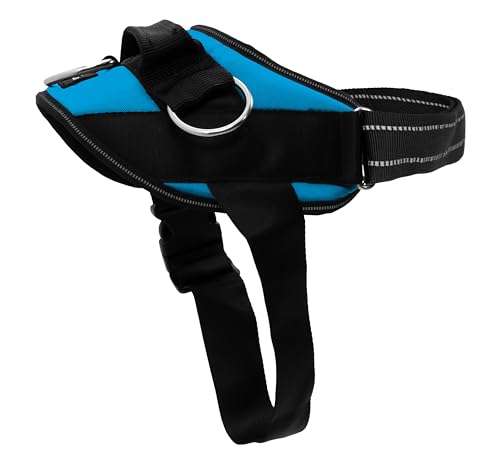
ShawnCo Essential Dog Harness (Oceanic Blue, S)
More Details On Our Top Picks
This is the pick for owners who want their dog’s gear to look as considered as the rest of the walk. The burgundy vest styling reads more boutique than tactical, yet the construction stays practical: adjustable neck and chest straps span an XXS-to-XL range, so a growing or between-sizes dog still gets a snug fit.
One detail matters before you order. The base harness ships with a single heavy-duty back D-ring for standard leash attachment, and the front clip is a separate modular add-on sold on its own. For calm walkers that’s fine; committed pullers will want that front ring from day one.
Strong Points
- Adjustable neck and chest straps dial in a secure fit across a wide size range
- The burgundy colorway looks sharp enough for café patios and city sidewalks alike
- Heavy-duty back D-ring handles everyday leash duty without flex or wear worries
- Vest cut spreads pressure over the chest instead of concentrating it at the throat
Things To Consider
- The front D-ring costs extra, so budget for the add-on if your dog pulls
- Owners commonly report sizing runs specific to this brand, so measure before choosing Large
Who It Suits Best
Style-conscious owners of calm-to-moderate large breeds who walk daily in town and want gear that doesn’t look like military surplus.
A Better Fit Elsewhere
Strong pullers are better served by the Gavpepy Tactical Vest Harness, whose dual attachment points and 900D nylon are built for exactly that job.
Some dogs don’t walk, they tow. The Gavpepy is aimed squarely at that crowd: German Shepherds, Rottweilers, Huskies, and other high-strength breeds whose enthusiasm can snap lighter gear. Its shell is 900D ballistic nylon, a dense woven fabric rated for heavy abrasion, reinforced with cross-stitching at the stress points.
Sizing is generous too, with chest girth spanning roughly 15 to 35 inches and neck girth up to about 26 inches, which covers most full-grown large breeds. Dual control handles give you a handhold for traffic crossings or vet-table restraint, something the softer Dog Friendly Co. vest simply doesn’t offer.
What We Like
- 900D nylon shell shrugs off brush, gravel, and daily hard use
- Two handles mean instant physical control near roads or crowds
- Front and back attachment points let you switch between training and relaxed walking
- Wide chest and neck adjustment range fits bulky breeds other harnesses miss
- Reflective detailing helps drivers spot you on dark morning walks
Worth Noting
- Tactical weight and padding run warm in summer heat, so expect a slower dry time after rain
- The black tactical look won’t suit anyone after a low-profile neighborhood aesthetic
At A Glance
Made For
Owners of powerful working or hunting breeds who need hardware that outlasts a determined dog’s best effort.
Where A Sibling Pick Shines
Smaller or milder dogs will find the Lukovee set lighter, softer, and easier to live with day to day.
Starting fresh with a large rescue or an adolescent Lab? This bundle removes the guesswork by pairing a soft padded no-pull vest with a matching leash, so you’re not mixing mismatched clips on day one. The design logic is straightforward: clipping to the chest ring redirects a pulling dog sideways, while the triangular chest panel spreads force so sudden lunges don’t compress the throat.
In practice, that makes it a sensible training tool rather than a permanent crutch. Attach the leash up front during loose-leash lessons, then move it to the back O-ring once your dog settles into a rhythm. Compared with the Gavpepy above, you trade ballistic durability for padding and price, which suits plenty of households just fine.
Highlights
- Front chest ring gently steers mild-to-moderate pullers without choking pressure
- Back O-ring gives you a second mode for calm, settled walks
- Soft padding keeps long walks comfortable against short coats
- Leash included means a matched set straight out of the box
Small Caveats
- Lighter build than the tactical picks here, so determined heavy pullers may test its limits
- Padded fabric holds onto mud, and owners commonly report needing regular washing during wet seasons
Feature Snapshot
Right Fit For
First-time large-dog owners running loose-leash training on a budget who want a complete starter kit.
Swap It Out When
Handlers running formal service or protection work should step up to the yimeis tactical set with its patch system and heavier leash.
Service-dog teams and serious trainers have different needs than casual walkers, and this yimeis kit acknowledges that with a three-piece package: the tactical vest itself, a 120-centimeter heavy-duty leash, and twelve morale patches for identification. Those patches matter more than they sound. A clear “SERVICE DOG” panel on the flank heads off questions at store entrances before they start.
The Large size spans roughly 20 to 34 inches of chest girth and 19 to 25 inches of neck, and the brand advises leaving a finger or two of slack under the strap. MOLLE webbing along the sides accepts small pouches, which is handy for treat bags or waste-bag rolls on longer outings.
Reasons To Buy
- Twelve included patches handle service identification and morale customization immediately
- MOLLE webbing carries pouches for treats, bags, or small gear
- Thick 1.2-centimeter leash feels substantial in hand with strong dogs
- Wide chest adjustment range suits deep-chested breeds
Points To Note
- Full kit adds bulk and weight that a minimal walker may find excessive
- Tactical nylon needs occasional brushing to shed burrs and grit after trail use
Who Will Love This
Working service-dog handlers and obedience trainers who need visible identification plus attachment real estate in one rig.
Not Your Match When
Apartment dwellers doing quick evening loops will find the Azinoo vest below faster to clip on and far less imposing.
The honest appeal of this Azinoo vest is speed. Quick-snap buckles mean you’re clipped in within seconds, which matters enormously when a 70-pound Husky has decided walk time is now. Six metal delta-shaped rings, three up front and three at the back, give you more leash-position flexibility than any other pick here except the ShawnCo.
Underneath, padded Oxford nylon pairs with breathable mesh to limit chafing on short-coated breeds, and four adjustable straps accommodate dogs still filling out. The XL sizing covers necks from 18 to 26 inches and chests from 25 to 34 inches, so measure your dog’s widest chest point before committing.
Bright Spots
- Six metal delta rings offer unusually flexible leash placement
- Quick-snap buckles make gearing up a squirmy large dog fast
- Mesh-lined padding reduces chafing during long summer walks
- Four adjustable straps track a young dog’s growth
Softer Spots
- With six rings and four straps, the initial fitting takes some patience to get even
- Metal hardware adds a bit of jingle that noise-sensitive dogs sometimes notice
Core Details
Who Should Grab It
Busy multi-walk households with energetic Huskies, Labs, or Shepherds who value fast on-off over tactical features.
Reach For A Different Pick When
Night-shift walkers prioritizing visibility above all will get more from the Yintrest vest’s 360-degree reflective threading.
Winter dog owners know the problem: it’s dark when you leave work, and a black dog in black gear disappears at the curb. The Yintrest answers with reflective thread running a full 360 degrees around the vest, so headlights catch it from any angle. That single attribute makes it the safety-first choice of this list for evening routes.
The rest of the spec sheet stays sensibly conventional. Abrasion-resistant Oxford fabric with reinforced stitching forms the body, two metal rings accept the leash at chest or back, and a top handle gives you a grab point at crosswalks. Pulling loads distribute across the torso rather than the neck, keeping the airway clear when your dog surges toward a squirrel.
Plus Points
- 360-degree reflective threads keep both of you visible to traffic after dark
- Oxford fabric with reinforced stitching stands up to daily leash strain
- Top handle offers quick manual control in tight situations
- Pressure spreads across the body, protecting the throat on lunges
Minor Gripes
- Only two leash rings, fewer positioning options than the Azinoo or ShawnCo designs
- Reflective thread can dull slightly with repeated machine washing, so hand-rinsing preserves it longer
Whose Shelf It Belongs On
Urban commuters walking medium-to-large dogs before sunrise or after sunset who put road visibility first.
Consider Something Else When
Trail users logging hot-weather miles will prefer the MOOGROU mesh harness, whose airflow beats a solid Oxford shell in summer.
Tactical harnesses usually cook a dog in July. The MOOGROU attacks that flaw directly with an air-mesh body wrapped around a 1000D nylon frame, letting heat escape instead of trapping it against the coat. For Malinois, Akitas, and Shepherds working in warm climates, that difference shows up as less panting and quicker recovery after hard play.
The hardware earns its keep too. Two shoulder-mounted metal buckles carry a proof-load rating up to 1100 pounds, which is reassuring headroom for a dog that hits the end of the leash at full sprint. MOLLE rows accept pouches, and the brown earth-tone finish blends into field environments better than black kit.
Standout Traits
- Air-mesh construction dumps heat during summer work sessions
- 1000D nylon frame delivers serious tear resistance for rugged terrain
- Metal shoulder buckles rated to 1100-pound proof load inspire confidence with powerful breeds
- MOLLE webbing supports pouches for extended outings
Honest Caveats
- Mesh panels collect seeds and burrs on grassy trails, so post-walk picking becomes routine
- Earnest tactical styling draws attention at the dog park, for better or worse
Details At A Glance
Built With In Mind
Handlers of Belgian Malinois, Shepherds, and Akitas doing outdoor work or sport in warm weather who need strength without overheating.
Another Choice May Suit
Cooler climates and indoor-leaning lifestyles get equal security from the cheaper Lukovee set without paying for field-grade materials.
Most no-pull harnesses give you two attachment choices. The ShawnCo Essential gives you three, and that third ring changes how you train. You can graduate a dog gradually, starting at the front clip for maximum steering, shifting to a middle position as manners improve, then finishing at the back ring for fully settled walks. It’s a progression system disguised as a harness.
Build quality matches the concept, with three reinforced rings set into heavy-duty materials and a padded vest shape that sits comfortably through hour-long outings. Note the sizing here: this listing is a Small in Oceanic Blue, so it suits smaller large-breed adolescents or stocky mid-size dogs rather than a full-grown Mastiff. Measure carefully against the brand’s chart before ordering.
Positives
- Three-ring layout creates a natural training progression from correction to freedom
- Reinforced rings hold up to repeated clipping and unclipping
- Padded vest body keeps pressure comfortable across the chest
- Oceanic blue colorway stands apart from the sea of black tactical gear
Areas To Watch
- This listing runs Small, so very large breeds need a different size or a different pick entirely
- Three rings take a walk or two to figure out which position suits your dog’s gait
Quick Facts
The Right Fit
Training-focused owners of smaller large-breed dogs who want a structured path from pulling to polite walking.
Skip It When
Owners of genuinely huge breeds like the Gavpepy’s intended audience should stay with that harness’s 35-inch chest range instead.
What Matters Most Before Choosing Large Dog Harnesses
Fit Beats Everything Else
A harness only controls safely when it fits. Measure your dog’s chest at its widest point and the base of the neck with a soft tape, then leave room for two fingers under each strap. Too tight rubs the armpits raw within a week; too loose lets a panicking dog back out of the vest entirely.
Deep-chested breeds like Greyhounds and Shepherds need generous adjustment ranges, which is why the Gavpepy and yimeis listings publish exact girth windows. Buy against those numbers, never against breed assumptions.
Match Attachment Points To Behavior
Front-clip rings steer a pulling dog sideways and suit training phases. Back clips feel natural to a dog already walking politely. Dual-point designs such as the Azinoo or ShawnCo let you switch as behavior improves, which saves buying twice.
Material And Climate
Ballistic nylon survives brush and rough play but traps heat. Air-mesh builds like the MOOGROU breathe well yet collect burrs. Hot-region owners should prioritize airflow; winter walkers should prioritize reflective stitching instead.
Hardware And Handles
Metal buckles and rings outlast plastic clips on strong dogs, and a top handle earns its place at every road crossing. Proof-load ratings, like the MOOGROU’s 1100-pound figure, tell you how much shock the hardware tolerates before failure.
Key Considerations Across These Picks
Traps First Timers Fall Into
The classic error is ordering by breed name instead of by tape measurement, then discovering the chest strap floats two inches off the body. The second is buying a front-clip-only harness for a dog that already walks calmly, adding friction nobody needs. Check the published girth ranges every time.
The Case For Spending Up
Higher-tier rigs buy denser fabric, metal hardware, and proof-tested buckles. For a 90-pound dog that lunges, those upgrades translate directly into years of service instead of a snapped clip in month two. Calm walkers can happily spend less.
Frequently Asked Questions
How do I measure my dog for a large harness?
Wrap a soft tape around the widest part of the chest, just behind the front legs, and note the neck circumference at the base. Compare both numbers to the manufacturer’s chart and choose the size covering them with adjustment room to spare.
Are front-clip harnesses better for pulling?
They redirect a dog’s momentum sideways, which discourages pulling without pressure on the throat. They work best as a training aid paired with consistent loose-leash practice rather than as a permanent fix.
Can a harness replace a collar entirely?
For walks, yes, since a properly fitted vest carries leash force far more safely than a collar. Most owners still keep a flat collar on for ID tags.
How tight should the straps be?
You should slide two fingers flat under any strap without forcing them. Straps that dig in cause chafing, while loose ones allow escapes.
Do tactical harnesses overheat dogs in summer?
Solid nylon versions can trap heat on long warm-weather outings. Air-mesh designs like the MOOGROU exist specifically to solve that, so match the material to your climate.
Bottom Line
Start with your tape measure, then match the harness to your dog’s actual behavior rather than the breed label. Calm daily walkers will be happy with the Dog Friendly Co. or the Azinoo, while serious pullers justify the Gavpepy’s heavy-duty build. Service teams have the yimeis kit waiting, and hot-climate athletes get real relief from the MOOGROU’s mesh. Whichever route you take, a correct fit does more for safe walks than any feature list ever will.
