

Planted tanks live or die by their light. Too little and your java fern stalls out; too much and you’re scraping algae off the glass every weekend. The right fixture handles both problems quietly, on a schedule you set once and forget.
This shortlist covers eight fixtures across nano tanks to four-foot displays, from simple plug-and-play strips to app-controlled WRGB units. Match the pick to your tank size and plant load, and you’ll spend less time fiddling and more time watching things grow.
The Shortlist At A Glance
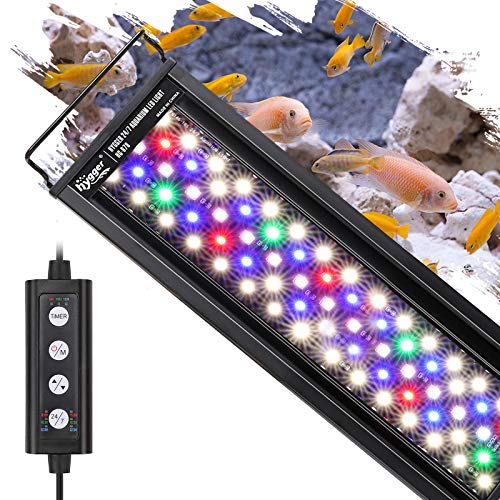
hygger 18W 24/7 Aquarium LED Light with Extendable Bracket

DaToo Mini Clip On Aquarium Light 7W for 1-3 Gallon Tanks

hygger 26W 24/7 Aquarium LED Light with Extendable Bracket
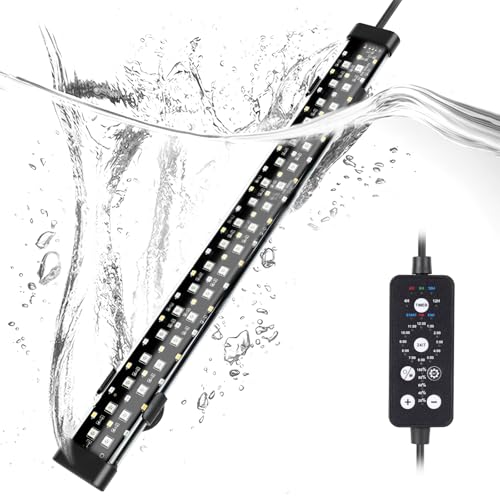
hygger Submersible LED Aquarium Light 14W 15in IP68

FZONE 60W LED Aquarium Light for Plants 35-43″

SEAOURA 24/7 LED Aquarium Light with Timer 48-54 Inch

WaterRebirth Planted Aquarium LED Light with Switch 18-24″

SEAOURA WRGB Programmable Aquarium Light 36-42in
More Details On Our Top Picks
The appeal here is automation that actually mimics nature. Out of the box, this 18-watt bar ramps through a warm sunrise glow in the early morning, holds bright white daylight through the day, then fades into a soft blue moonlight phase before shutting down overnight. You set it once and stop thinking about timers entirely.
For a low-tech planted tank with anubias, crypts, or moss, that’s plenty of intensity. An extendable bracket lets it sit securely on rims of varying widths, and a DIY mode lets you override the default schedule with custom colors, timing, and brightness.
Strong Points
- Sunrise-to-moonlight cycle runs automatically, so fish get gradual transitions instead of abrupt on/off shocks
- DIY mode unlocks seven colors plus adjustable brightness and timing for custom scapes
- Extendable bracket fits a range of tank widths without extra hardware
- Low wattage keeps running costs negligible on a 24-hour duty cycle
Things To Consider
- Owners commonly report the default schedule needs a manual shift if your viewing hours differ from its built-in clock
- Light-demanding carpeting plants may want more punch than 18 watts delivers over deeper water
Key Specs
Who It Suits Best
Beginners running small-to-medium planted tanks who want healthy plants without programming anything.
Where A Sibling Pick Shines
Deeper mid-size tanks benefit from the hygger 26W version, which adds output for denser plant growth.
Nano tanks are where most fixtures fail, simply because they’re built too big. This DaToo clip-on measures under three inches, clamps onto glass without a bracket spanning the rim, and runs off USB power, so a phone charger or power bank handles it. Betta bowls, shrimp cubes, and desktop jars finally get proper illumination.
Brightness adjusts across ten levels, and white, red, blue, and green LEDs let you shift the mood or warm up plant colors. A timer and dimmer are built in, which is rare at this size. The honest caveat: at 7 watts, this is accent lighting for low-light plants, not a growth engine for demanding stems.
What We Like
- Clips on in seconds, no bracket or lid modification needed
- USB power means one cable and any standard charger
- Ten brightness steps prevent blasting tiny volumes of water
- Built-in timer and dimmer add real control to a nano fixture
Minor Gripes
- Limited output suits mosses and anubias better than high-light carpet plants
- The clip grip can feel loose on very thick-rimmed tanks, worth checking before committing
Right Fit For
Shrimp keepers and betta owners with 1 to 3 gallon desktop setups who value a tidy, minimal look.
Swap It Out When
Tanks from 16 inches up need broader coverage, which is exactly what the hygger Submersible 15-inch bar provides.
This is the same automated sunrise-daylight-moonlight platform as the 18W hygger earlier in the list, scaled up for tanks that need more photons. The extra wattage pushes usable light deeper into the water column, which matters once you’re growing stem plants or keeping a densely planted 20-gallon long rather than a shallow moss tank.
You still get the seven-color palette, adjustable timer, and DIY scheduling, so nothing was sacrificed for the added output. In practice, that makes this the version most intermediate hobbyists should reach for first. The trade-off is a slightly higher price and more light than low-tech tanks strictly require, so dimming via DIY mode becomes part of daily ownership.
Highlights
- Higher output supports stem plants and medium-light aquascapes
- Same hands-off 24/7 cycle as the smaller model, no relearning curve
- DIY mode lets you dial brightness back for low-tech setups
- Extendable bracket covers a wide range of standard tank sizes
Softer Spots
- Overkill for shallow low-light tanks, where the 18W model does the job cheaper
- Stronger output means algae risk climbs faster when photoperiods run long
Made For
Hobbyists stepping up from beginner kits who want automated lighting with genuine plant-growing headroom.
Consider Something Else When
Four-foot tanks need wider coverage than a single bar provides, pointing you toward the SEAOURA 48-54 inch unit.
Rimless and open-top tanks break every clip-on design, and that’s precisely the gap this submersible bar fills. It’s rated IP68 waterproof, meaning it can sit fully underwater against the back glass, throwing light down through the column instead of fighting glare off the surface. Five rows of 2835 and 5050 LED chips give it noticeably more body than typical single-row submersible strips.
The 24/7 mode eases on and off over roughly fifteen minutes, sparing fish the startle of sudden darkness. Nine colors and stepped brightness round out the controls, sized for tanks between 16 and 27 inches. One ownership note: submerged fixtures collect film on the housing over time, so occasional gentle wiping keeps output honest.
Upsides
- IP68 rating allows true in-water mounting for open-top and rimless builds
- Five chip rows deliver fuller coverage than single-strip competitors
- Slow fade transitions reduce stress on skittish fish
- Rated for tens of thousands of hours of service life
Points To Note
- Underwater placement means periodic cleaning of the housing to maintain brightness
- Fixed 15-inch length limits flexibility outside its stated tank range
Quick Facts
Who Will Love This
Aquascapers with rimless or paludarium-style tanks where a top-mounted bar would ruin the clean lines.
Not Your Match When
Standard hooded tanks are simpler to serve with the WaterRebirth slim bar, which rests on the frame instead.
When your plants include demanding carpeting species like dwarf hairgrass or Monte Carlo, half-measures show up fast as leggy stems and bare patches. This FZONE unit throws 60 watts across a four-inch-wide emission surface with six rows combining RGB, white, and UV LEDs. UV chips, for context, sit at the violet end of the spectrum and support pigmentation and compact growth in high-light plants.
The wider emission face spreads light more evenly, cutting the hot-spot effect that plagues narrow bars. App control handles scheduling, sunrise and sunset fades, and channel tuning from your phone. Compared to the hygger bars, this is a serious step up in both output and price, and it expects CO2 injection and regular fertilizing to keep pace. Underpowered tanks will just grow algae instead.
Bright Spots
- 60W output sustains demanding carpets and red plants
- Wide four-inch spread reduces uneven color spots across the substrate
- App-based control makes schedule tweaks painless
- Sunrise and sunset fading protects fish from abrupt changes
Trade Offs
- Demands a balanced setup with CO2 and nutrients, or algae takes over
- Phone-dependent control frustrates anyone preferring physical buttons
Who Should Grab It
Intermediate to advanced aquascapers running high-tech 35 to 43 inch planted displays.
Another Choice May Suit
Low-tech keepers on similar tank lengths will find the SEAOURA WRGB easier to live with day to day.
Long tanks are underserved by budget lighting, and this SEAOURA bar addresses that directly with coverage for 48 to 54 inch aquariums. Six rows of chips, mixing 5054 and 2835 types, keep illumination consistent edge to edge, so plants near the ends don’t languish while center ones thrive.
Control comes through a touch panel with an LCD screen and a built-in clock, which means schedules survive power interruptions better than memory-only designs. The 24/7 programming mirrors the natural cycle approach of the hygger units but stretches it across a much longer span. For a four-foot community tank with moderate planting, this hits a genuinely comfortable middle ground between price and capability.
Plus Points
- Genuine coverage for long 48-54 inch tanks at a sensible cost
- Touch controller with LCD display simplifies daily adjustments
- Built-in clock keeps programmed cycles accurate after outages
- Six-row layout evens out brightness across the full span
Small Caveats
- Output suits medium-light plants; carpet-heavy scapes may want the FZONE’s extra wattage
- The wired controller needs a spot to sit, adding minor clutter near the tank
Whose Shelf It Belongs On
Owners of four-foot community or moderately planted tanks who want automation without app dependence.
Look Elsewhere When
Fine-grained color tuning matters more than length, which is the SEAOURA WRGB model’s specialty.
Some tanks just need light, switched on in the morning and off at night, nothing more. This WaterRebirth strip embraces that simplicity with a classic toggle switch, an extendable bracket, and a body thin enough to squeeze into tight spaces where bulkier programmable units won’t fit. Sizing spans common 10 to 55 gallon footprints depending on the variant chosen.
There’s no timer, no app, and no color cycling here, and that’s the point. Pair it with a cheap wall timer and you’ve replicated most of what the smart bars do for a fraction of the cost. The slim profile also sits discreetly inside hoods or under lids. What you give up is spectrum tuning and fade transitions, so expect a hard on/off unless external timing smooths it out.
Reasons To Buy
- Dead-simple operation, flip the switch and done
- Ultra-slim body fits hoods and tight clearances
- Extendable bracket adapts across several tank widths
- Works well with inexpensive outlet timers for automation
Areas To Watch
- No dimming or color control limits fine-tuning for sensitive plants
- Abrupt on/off switching can startle nervous fish without a timer ramp
Who It’s Built With In Mind
First-time tank owners and low-tech keepers who prioritize reliability and simplicity over features.
Reach For A Different Pick When
You want scheduled sunrises and moonlight phases, which the hygger 18W delivers out of the box.
WRGB stands for white, red, green, and blue channels controlled independently, and that’s the whole selling point here. With 180 chips across four tunable channels, you can bias the spectrum toward the 455nm blue and 660nm red wavelengths that drive photosynthesis, or push whites for crisp viewing. Published figures include a CRI of 93, PAR of 140, and 3721 lumens at 42 watts, numbers that place it firmly in serious-plants territory.
Nine preset colors, a color-cycle mode, and twenty brightness steps cover experimentation, while three timer modes handle scheduling. Against the FZONE, this trades some raw width of spread for finer per-channel control at a friendlier commitment level. Java fern, anubias, and sword plants all respond well to the red-heavy presets, based on how those spectra map to chlorophyll absorption.
Standout Traits
- Independent WRGB channels allow precise spectral tuning per plant type
- PAR of 140 supports demanding species without CO2-level extremes
- High CRI renders fish and plant colors accurately to the eye
- Three timer modes plus 20 brightness steps cover nearly any routine
Honest Caveats
- The menu depth carries a learning curve compared to one-button bars
- 36-42 inch sizing leaves gaps at either end of the length range
Details At A Glance
Perfect Match For
Aquascapers who enjoy dialing in spectra and want flagship-tier control on a mid-length tank.
Skip It When
Simple set-and-forget operation is the goal, where the WaterRebirth switch-operated bar wins on ease.
What Matters Most Before Choosing Led Lightings For Planted Aquarium
Match Output To Your Plant Load
Low-light plants like anubias, java fern, and most mosses thrive under modest wattage, so an 18W bar covers them comfortably. Stem plants and carpeting species demand far more intensity, especially in tanks deeper than 16 inches where light attenuates quickly. Overbuying wastes money and invites algae; underbuying guarantees disappointment within weeks.
Get The Controls Right
A built-in timer saves you from climbing under the cabinet every evening, and gradual sunrise or sunset fades matter more than most newcomers expect. Fish startle badly under abrupt light changes, and skittish species may hide for hours afterward. Decide early whether you prefer buttons, an LCD panel, or phone-app control, since each shapes daily use differently.
Measure Twice, Buy Once
Fixture length should roughly match your tank’s rim-to-rim span, and extendable brackets only stretch so far. Check whether your tank has a hood, a center brace, or an open top before ordering, because submersible bars, clip-ons, and rim-mounted strips each assume a different mounting situation. A five-minute measurement prevents a return shipment.
Plan For The Long Haul
LED ratings in the tens of thousands of hours sound generous, but drivers and seals fail sooner in humid fish-room air. Look for sealed housings on submersible models and remember that salt creep and mineral film need wiping off any lens a few times a year to keep output where it started.
Key Considerations Across These Picks
Traps First Timers Fall Into
The most common mistake is buying on tank gallons alone instead of dimensions and plant type. A 55-gallon tall needs very different light than a 55-gallon breeder. Second trap: skipping the timer. Consistent photoperiods of eight to ten hours keep algae in check, and manual switching almost always drifts into inconsistency.
Where The Extra Money Goes
Pricier fixtures buy spectrum control, wider chip arrays, and sturdier sealing, not just brightness. That translates directly into redder plants, tighter carpets, and fewer dead zones at tank edges. Casual keepers won’t notice the difference; dedicated aquascapers will see it within a month of setup.
Frequently Asked Questions
How many hours of light do planted aquariums need?
Most planted tanks do well with eight to ten hours daily. Consistency matters more than duration, so a timer pays for itself quickly.
Can LED lights grow aquarium plants effectively?
Yes, modern full-spectrum LEDs support strong plant growth at modest wattages. Match intensity to your specific plant species rather than assuming more is always better.
Do I need a special light for a planted tank versus fish-only?
Fish-only setups need little beyond basic visibility, while plants require appropriate spectrum and intensity. Any full-spectrum fixture aimed at planted tanks covers both roles.
Are submersible aquarium lights safe?
Quality submersible lights carry IP68 waterproofing designed for full underwater use. Keep connections above the waterline and wipe mineral film off periodically.
Why is my planted tank getting algae despite good lighting?
Algae usually signals an imbalance among light duration, nutrients, and CO2 rather than bad equipment. Shorten the photoperiod first, then review fertilizing routines before replacing hardware.
Closing Thoughts
Every tank on your stand deserves light matched to its actual plants, not the biggest number on a spec sheet. Start with your tank’s dimensions and ambition level, then pick accordingly: simple bars for low-tech setups, programmable WRGB units for serious scapes. Whichever direction you lean, a consistent photoperiod will do more for your plants than any single feature. Happy growing.
