

Live plants change everything about a tank, but they demand the right light. Too dim and your java fern stalls out; too harsh and you’re scraping algae off the glass every weekend. This shortlist covers planted-tank fixtures from nano clip-ons to 54-inch hood lights, matched to real tank sizes and skill levels.
The Shortlist At A Glance
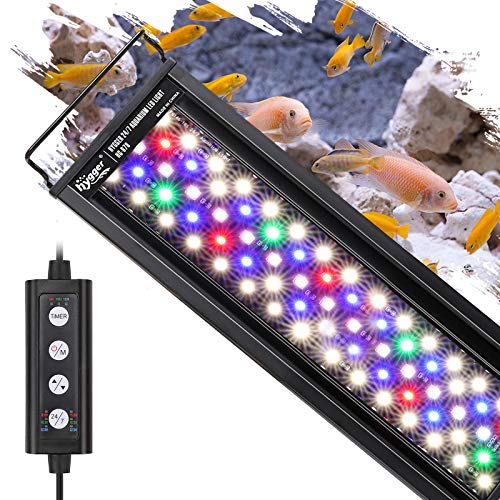
hygger 18W 24/7 Aquarium LED Light with Extendable Bracket

FZONE 60W LED Aquarium Light for Plants (Light 90)

SEAOURA 24/7 LED Aquarium Light for 18-24 Inch Tanks

SEAOURA WRGB DIY Aquarium Light for 48-54in Freshwater Tank

Pawfly 6W Clip On USB Aquarium Light with Timer

Fluval Plant 3.0 LED Planted Aquarium Lighting, 22 Watts
AQQA Clip On Aquarium Light, 24/7 & DIY Full Spectrum

IRQWY Full Spectrum LED Hood Light for 55/75 Gallon Tanks
More Details On Our Top Picks
The hygger’s headline trick is a built-in daily schedule that mimics sunrise, daylight, and moonlight without any input from you once it’s set. For anyone who travels or simply forgets timers exist, that automation is the whole reason to pick this one over a basic fixture.
The extendable bracket spans a range of standard tank widths, and seven color options let you shift the mood of an evening display. Compared with the SEAOURA touchscreen model later in this list, setup here leans simpler rather than deeper.
Strong Points
- Runs an automatic dawn-to-dusk cycle, so plants get consistent photoperiods even during busy weeks
- DIY mode lets you set your own time, color, and brightness combinations
- Adjustable bracket fits multiple tank lengths without buying separate hardware
- Moonlight setting gives you evening viewing without disturbing fish rest cycles
Things To Consider
- Owners commonly report the default schedule needs a one-time adjustment to match your actual wake-up hours
- At 18 watts, demanding carpeting plants may grow slowly under dense canopies
Who It Suits Best
Beginners and busy keepers running low-to-medium light plants like anubias and crypts on standard community tanks.
A Better Fit Elsewhere
Growth-focused aquascapers wanting app-level spectrum control should look at the FZONE Light 90 instead.
FZONE builds this 60-watt unit around a wider four-inch emission surface with six rows of LEDs, which spreads illumination more evenly than narrow-bar fixtures. That matters most in tanks between 35 and 43 inches, where single-point lights leave dark corners at the ends.
The channel mix combines RGB, white, and UV diodes, and the brand’s three-in-one RGB design aims to reduce patchy color spots across the water column. Phone control handles scheduling plus sunrise and sunset fades, so you rarely touch the fixture itself.
What We Like
- Full-spectrum output supports both plant growth and vivid fish coloration
- UV diodes add a wavelength band cheaper fixtures skip entirely
- APP control makes long-term scheduling painless once dialed in
- Even spread reduces shadowing under broad-leaved plants
- Sunrise and sunset transitions avoid startling skittish species
Trade Offs
- App-dependent control means a phone is effectively required for full customization
- Higher wattage draws more power than entry-level bars in this size range
At A Glance
Made For
Intermediate hobbyists growing mixed stem and root-feeding plants in 40-breeder-class tanks.
Where A Sibling Pick Shines
Keepers wanting physical buttons instead of an app will prefer the SEAOURA touchscreen unit at number three.
Small tanks are where most people start, and this SEAOURA targets exactly that footprint with an onboard LCD touchscreen rather than a phone app. Six buttons walk you through a 24-hour timer, and the display shows the active mode and brightness level in real time.
Inside are six rows of LEDs mixing two higher-output 5054 chips with four 2835 rows, delivering flicker-free light for day and night viewing. A DIY mode offers eight programmable segments, while the day/night mode steps through 20 brightness levels.
Highlights
- LCD touchscreen keeps programming self-contained, no app or account needed
- Eight-segment DIY mode suits custom dawn-to-dusk curves
- 20-level brightness adjustment helps dial in algae-safe intensity
- Compact length matches standard 20-gallon-long and similar footprints
Small Caveats
- Screen-based menus take a few sessions to memorize, per widely reported owner feedback
- Output suits low-to-medium light plants best, not high-demand carpets
Right Fit For
Desktop aquascapers and first-time planted-tank owners working with 18 to 24 inch tanks.
Swap It Out When
Nano bowl keepers under five gallons should step down to the Pawfly clip-on instead.
This is the muscle car of the list: 210 LED chips pushing a published PAR value of 159, which is genuinely useful headroom for demanding plants. PAR, photosynthetically active radiation, measures the light plants can actually use, and numbers above roughly 100 support most stem species at moderate depths.
Four independent WRGB channels let you tune red, green, blue, and white ratios yourself, backed by nine preset colors and 20 brightness steps. Enhanced 455nm blue and 660nm red wavelengths target photosynthesis directly, the same bands that benefit java fern, anubias, and sword plants.
Upsides
- PAR of 159 gives real overhead for high-light stems and red plants
- CRI of 93 renders fish and plant colors close to true
- Four-channel WRGB tuning beats fixed-spectrum fixtures for experimentation
- Three timer modes cover automated, manual, and custom schedules
- 48 watts stays efficient relative to its output class
Points To Note
- That much intensity invites algae in unbalanced tanks, so CO2 and fertilization need to keep pace
- Long body requires clearance above filters and lids on some stands
Feature Snapshot
Who Will Love This
Advanced aquascapers running CO2-injected 55-gallon-plus layouts with light-hungry foreground plants.
Not Your Match When
Low-tech keepers without CO2 will find gentler output in the Fluval Plant 3.0 easier to balance.
Nano tanks live on desks and dressers where a hanging fixture looks absurd, and the Pawfly solves that with a simple clamp arm. It runs off USB power, so a phone charger brick or a powered hub handles the job, though the adapter itself isn’t included in the box.
The spectrum covers 6500K white alongside 450nm blue, 520nm green, and red channels, all dimmable, with a timer built in. One smart detail: the unit flashes a warning when the power supply can’t keep up, protecting against erratic operation.
Bright Spots
- Clip mount frees up lid space and suits open-top bowls
- USB power works with common chargers you already own
- Overload warning flashes before unstable power causes problems
- Four-color dimmable palette doubles as accent lighting
Honest Caveats
- You must supply a 5V/2A adapter separately, and weaker 1A supplies cause flickering unless brightness drops
- Six watts limits growth to slow, shade-tolerant plants like mosses and anubias
Quick Facts
Who Should Grab It
Office workers and students keeping small planted bowls or shrimp cubes within arm’s reach.
Reach For A Different Pick When
Tanks past 18 inches need the broader reach of the SEAOURA 24/7 bar light.
Fluval carries serious brand weight in the hobby, and the Plant 3.0 earns it through refinement rather than raw wattage. Six distinct LED band waves form an adaptable spectrum you shape inside the FluvalSmart app, including a programmable 24-hour cycle with gradual ramping.
At 22 watts covering 15 to 24 inches, it sits in the same size class as the SEAOURA touchscreen bar but adds deeper software control and a proven track record among planted-tank keepers. You pay more for that polish, and many consider it money well spent.
Reasons To Buy
- Six-band spectrum adjusts precisely for different plant mixes
- FluvalSmart app handles full 24-hour programmable cycles
- Established brand support network simplifies replacement parts and questions
- Gradual ramping mimics natural dawn without shocking livestock
Softer Spots
- Costs noticeably more than comparable-spec budget bars
- Some owners report the mounting legs feel less substantial than the fixture body
Whose Shelf It Belongs On
Dedicated planted-tank hobbyists who want dependable hardware and granular app control in a compact footprint.
Consider Something Else When
Budget-first shoppers covering larger tanks get more coverage per dollar from the IRQWY hood light.
Clip-on fixtures usually trade build quality for convenience, but AQQA widens and thickens the aluminum shell here, which does double duty: it looks cleaner and sheds heat better. Cooler-running LEDs tend to hold their output longer, a quiet benefit you’ll appreciate years in.
Premium 5050 and 2835 diodes supply the wavelengths plants use, and a physical switch row handles brightness, timing, and on/off without any app involvement. Both 24/7 and DIY modes are on board, echoing the hygger’s automation at a clip-on scale.
Plus Points
- Thickened aluminum housing improves heat dissipation and longevity
- Physical controls mean no pairing, apps, or firmware worries
- 5050 and 2835 diode mix covers core plant growth wavelengths
- Clamp design suits rimless and open-top tanks
Minor Gripes
- Clip arms limit positioning compared with full-length bracket fixtures
- Button labels are small, so adjustments in dim rooms take a squint
The Right Fit
Rimless cube owners and minimalist scapers who want automation without hanging hardware.
Another Choice May Suit
USB-powered desk setups with tiny bowls are better served by the Pawfly clip-on’s smaller draw.
Big tanks are expensive to light well, and this IRQWY hood-style bar stretches from 48 to 54 inches thanks to adjustable brackets, matching standard 55 and 75 gallon footprints. The 48-inch body leaves room at the ends for filters and pumps, a practical touch often overlooked.
Its full-spectrum output reproduces object colors faithfully, which eases visual fatigue during long viewing sessions and keeps plants fed. Against the SEAOURA WRGB unit, you give up channel-level tuning but gain straightforward coverage across a much larger span.
Standout Traits
- Adjustable brackets accommodate 48 to 54 inch tank lengths
- Body width preserves space for hang-on-back filters
- Full spectrum supports plant growth and accurate fish coloring
- Hood-style mount works with framed tanks that reject clamps
Areas To Watch
- No app or advanced spectrum tuning, just straightforward lighting
- Long single-body design needs adequate clearance on shorter stands
Core Details
Built With In Mind
Freshwater community keepers upgrading a 55 or 75 gallon tank to live plants without complexity.
Look Elsewhere When
High-tech scapers chasing tunable PAR should step up to the SEAOURA WRGB DIY fixture.
What Matters Most Before Choosing Lightings For Aquarium Plants
Match Output To Your Plant List
Slow growers like anubias, java fern, and most crypts thrive under modest wattage, while carpeting plants and red stems want PAR figures north of 100. Check the manufacturer’s stated PAR when available, since lumen counts alone tell you little about plant usability. Overlighting a low-tech tank is the fastest route to an algae problem.
Size And Mounting Come First
Measure your tank’s inside rim before anything else, then decide between extendable brackets, clips, or hood mounts. Rimless glass favors clamps and suspension, while framed tanks usually accept bracket bars more cleanly. A fixture that doesn’t physically fit your setup is useless regardless of its specs.
Control Style Shapes Daily Life
App-based units such as the FZONE and Fluval offer deep scheduling but tie you to a phone. Touchscreen and button-driven models like the SEAOURA and AQQA keep everything local. Honest question: do you actually want another app, or would set-and-forget automation serve you better?
Heat, Power, And Long-Term Costs
Aluminum housings dissipate heat better than plastic shells, extending LED lifespan. USB fixtures save energy on nano tanks, while 60-watt bars on large tanks raise electricity use modestly but meaningfully over years. Balance upfront cost against how long you plan to run the light daily.
Key Considerations Across These Picks
Traps First Timers Fall Into
The classic error is buying on tank length alone and ignoring plant demands, ending up with either starved carpeting plants or algae blooms in a low-light tank. Another frequent slip: skipping the power supply check on USB lights, which causes flickering that owners often blame on the fixture itself.
What Separates Premium From Basic
Higher-tier fixtures spend their extra cost on spectrum engineering, denser LED arrays, and sturdier housings. That translates to faster plant growth, truer colors, and fewer replacements over time. Casual keepers won’t notice the difference; dedicated aquascapers will, every single week.
Frequently Asked Questions
How many hours of light do aquarium plants need daily?
Most planted tanks do well with 8 to 10 hours on a consistent schedule. Automated 24/7 modes handle this for you once configured.
Do I need CO2 injection with these lights?
No, all eight picks support low-tech setups at reduced brightness settings. High-output models like the SEAOURA WRGB deliver their full potential alongside injected CO2.
Can these lights cause algae problems?
Any light can when intensity, duration, and nutrients fall out of balance. Start at lower brightness and shorter photoperiods, then increase gradually.
Will a clip-on light work on a rimless tank?
Yes, clip-ons like the AQQA and Pawfly attach to the glass edge and suit rimless designs well. Verify your glass thickness falls within the clamp’s jaw range.
Are full-spectrum lights necessary for plants?
Plants primarily use red and blue wavelengths, which every pick here provides. Full spectrum adds natural color rendering and flexibility rather than being strictly mandatory.
Closing Thoughts
Matching a fixture to your tank size, plant ambitions, and control preferences matters far more than chasing the biggest spec sheet. Start honest about what you grow, whether that’s a moss-covered betta bowl or a CO2-injected 75 gallon, and one of these eight will slot right in. Your plants will tell you quickly whether the choice landed.
