

A tank lives or dies by its light. Too dim and plants stall, colors wash out, algae takes over; too harsh and your fish spend the day hiding. The right fixture fixes both problems at once, whether you’re running a five-gallon shrimp cube on a desk or a planted 40-gallon in the living room. This roundup covers seven options across that whole range, from programmable sunrise simulators to a UV clarifier for outdoor ponds, so you can match the gear to the glass instead of guessing.
The Shortlist At A Glance
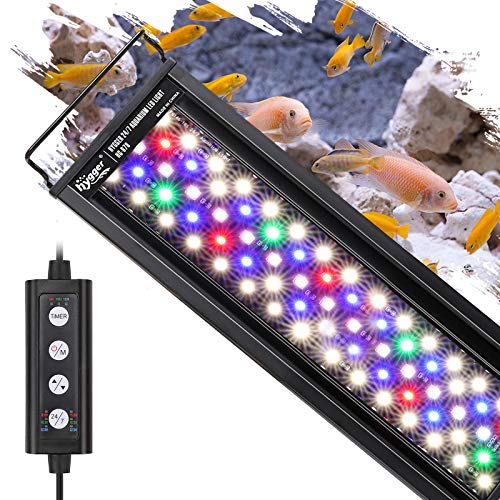
hygger 18W 24/7 Aquarium LED Light with Extendable Bracket

DaToo Mini Clip On Aquarium Light 7W Dimmable USB Lamp

FZONE 36W Full Spectrum Planted Tank Light with APP Control

SEAOURA 24/7 Planted LED Aquarium Light with Timer, 30-36 in

coospider-repta 18W UV Light for 100-1000 Gallon Ponds

SEAOURA WRGB Programmable Aquarium Light for 36-42in Tanks

Pawfly 6W Clip On LED Aquarium Light with Timer
More Details On Our Top Picks
The appeal here is simple: program it once and stop thinking about lighting forever. The default cycle mimics a natural day, easing through an orange sunrise, holding bright white through daylight hours, then fading to blue moonlight before shutting off overnight. For anyone juggling work, kids, and water changes, that automation removes one chore entirely.
The extendable bracket spans different rim widths, so it drops onto most standard rectangular tanks without drilling or hanging hardware. Seven color channels give you room to tune the look, and a DIY mode lets you set custom times, hues, and brightness levels when the preset schedule doesn’t match your routine.
Strong Points
- Automated sunrise-to-moonlight cycle means fish get a consistent rhythm even during busy weeks
- DIY mode lets you shift the whole schedule earlier or later to fit your household’s hours
- Extendable bracket fits multiple tank widths, useful if you upgrade tanks down the road
- Seven-color palette makes evening viewing more interesting than flat white light
Things To Consider
- Owners commonly report the programming menu takes a few sessions to memorize, so keep the manual handy
- At 18W, very demanding carpeting plants may want more intensity than this unit delivers
Key Specs
Who It Suits Best
Busy planted-tank keepers who want a believable day-night cycle they never have to touch again.
A Better Fit Elsewhere
Aquascapers chasing higher output and per-channel tuning will get more from the SEAOURA WRGB Programmable Aquarium Light.
Nano tanks are awkward to light because full-size fixtures dwarf them. DaToo built this clip-on specifically for that problem, sizing the head at roughly 2.7 inches to suit 1-to-3-gallon aquariums. The clamp grips a desk tank’s rim, and since power comes over USB, you can run it from a small adapter or even a power bank during a move.
Three modes cover white plus red, blue, and green LEDs, with ten brightness steps so you can dial output down for shy bettas or up for low-light plants. A timer and dimmer are built into the unit, which is rare at this size. Compared with the Pawfly below, it trades some spectrum breadth for a smaller physical footprint.
What We Like
- Genuinely tiny head suits desktop bowls where bigger bars would look absurd
- Ten dimming steps let you match light to skittish fish or slow-growing moss
- USB power adds placement freedom, no dedicated outlet required
Minor Gripes
- Clip mounting means repositioning after every water change unless you leave clearance
- Limited coverage, so anything beyond three gallons leaves dark corners
Right Fit For
Shrimp-keeper and betta owners working with nano cubes under three gallons who value a discreet setup.
Where A Sibling Pick Shines
Anyone wanting fuller-spectrum output in a similar clip format should look at the Pawfly 6W Clip On LED Aquarium Light instead.
This is the pick for people whose tanks are mostly garden. FZONE spreads six rows of LEDs across a wider four-inch emission surface, mixing RGB, white, and UV diodes to push growth and deepen plant coloration. The wider spread matters more than the wattage figure suggests: fewer hot spots directly under the bar means more uniform PAR reaching midground stems.
Control happens through a phone app, with timer scheduling and simulated sunrise and sunset ramps. That app approach beats button menus once you start layering seasonal changes, though it does mean another account and Bluetooth pairing to manage. Sized for 24-to-31-inch tanks, it sits between the hygger’s simplicity and the SEAOURA WRGB’s raw channel count.
Highlights
- Six-row layout with mixed RGB, white, and UV diodes supports vigorous plant growth and richer leaf color
- Wide four-inch light spread reduces shadowed patches across longer tanks
- App-based timer and dawn-dusk simulation make seasonal adjustments painless
- 36W output gives stem-heavy layouts the intensity they need
Trade Offs
- App dependency frustrates anyone who prefers physical controls or loses phone pairing regularly
- Higher output demands consistent fertilizing and CO2 attention, or algae will follow
At A Glance
Made For
Intermediate hobbyists running medium planted tanks who enjoy dialing in light schedules from their phone.
Consider Something Else When
Keepers of larger 36-to-42-inch aquascapes needing finer channel control should step up to the SEAOURA WRGB Programmable Aquarium Light.
Where the FZONE leans on an app, this SEAOURA keeps everything on the fixture itself: a touch controller with a clear LCD screen and a built-in clock. Six rows of LED chips, two 5054 and four 2835 types, deliver noticeably brighter, more even illumination than single-row budget bars, which shows immediately on a 30-to-36-inch planted tank.
The 24/7 programming handles the daily ramp automatically, so fish experience gradual transitions instead of a harsh snap-on at noon. In our view that consistency is the quiet benefit here; stable light cycles reduce stress behaviors in community stock. It occupies a sensible middle ground: more output than the hygger, simpler operation than the app-driven options.
Upsides
- Six-row chip arrangement produces strong, uniform coverage across mid-size tanks
- Onboard LCD controller means no phone, no pairing, no app updates
- Automatic 24/7 cycle eases fish through dawn and dusk transitions gently
- Built-in clock keeps schedules accurate through power interruptions
Points To Note
- Touch controls near a splash zone warrant careful hand placement during adjustments
- Color customization is narrower than true RGB-channel fixtures offer
Quick Facts
Who Will Love This
Planted-tank owners upgrading from basic bars who want real brightness without learning an app workflow.
Swap It Out When
Hobbyists wanting per-channel red-green-blue-white tuning on a similar footprint should consider the SEAOURA WRGB Programmable Aquarium Light from the same brand.
Everything else on this list lights a tank for viewing. This one works invisibly: an ultraviolet clarifier that sits inline with pond or spa plumbing and targets suspended algae, the culprit behind pea-green water. UV-C light disrupts free-floating algae cells as water passes through, letting your mechanical filter catch the remains. It doesn’t touch string algae on rocks, worth knowing before ordering.
The dual-tube design adds stability, and recent packaging upgrades address the fragile-bulb complaints common to this category. Rated for systems from 100 up to 1000 gallons, it covers koi ponds, large indoor tanks, swim spas, and cold plunges. Bulb replacement is the main ownership cost, typically an annual task depending on run hours.
Bright Spots
- Dual-tube construction runs steadier than single-tube clarifiers in this size class
- Wide 100-to-1000-gallon rating covers ponds, spas, and big display tanks alike
- Works continuously alongside existing filtration rather than replacing it
Small Caveats
- UV bulbs degrade over time and need periodic replacement, a recurring cost many first-timers overlook
- Ineffective against attached algae, so expect clearer water, not spotless rocks
- Requires inline plumbing integration, which complicates installation versus a clip-on fixture
Whose Shelf It Belongs On
Koi pond and spa owners fighting persistent green water who already run adequate mechanical filtration.
Not Your Match When
Indoor aquascapers seeking plant-growing illumination belong with the FZONE 36W Full Spectrum Planted Tank Light instead.
This is the serious tool in the lineup. One hundred eighty LED chips feed a four-channel WRGB system, meaning white, red, green, and blue output adjust independently. Two wavelengths do the heavy lifting for plants: 455nm blue and 660nm red sit squarely in the photosynthesis range that java ferns, anubias, and sword plants respond to. Published figures include a CRI of 93 and PAR of 140, numbers that put it well ahead of entry-level bars.
You get nine preset colors, a color-cycle mode, twenty brightness steps, and three timer modes, all on hardware sized for 36-to-42-inch tanks. Against its sibling, the SEAOURA 24/7 model above, the trade is straightforward: more control and output, more settings to learn. Aquascapers competing for form will appreciate the fine-tuning; casual keepers may find it excessive.
Reasons To Buy
- Four independent WRGB channels allow precise color ratios no fixed-spectrum bar can match
- High-PAR output supports demanding foreground carpets and red stem plants
- Twenty brightness levels make algae management far easier on nutrient-rich tanks
- 180-chip array delivers strong, even coverage across long 36-to-42-inch layouts
- Multiple timer modes handle weekday-versus-weekend schedules cleanly
Room For Improvement
- The depth of settings carries a learning curve that overwhelms some newcomers
- High output on unplanted or lightly stocked tanks invites algae without careful dialing back
Core Details
Who Should Grab It
Advanced aquascapers running high-tech planted tanks who treat lighting as part of the design process.
Reach For A Different Pick When
Keepers wanting automated simplicity over granular control will be happier with the hygger 18W 24/7 Aquarium LED Light.
Pawfly’s take on the nano clip-on covers slightly more ground than the DaToo, suiting tanks from 1 to 5 gallons. The spectrum splits across 6500K white, 450nm blue, 520nm green, and red diodes, giving small planted jars and shrimp cubes a genuinely full-spectrum option rather than a bare white strip. A built-in timer rounds out the package.
The standout detail is smart overload protection: the lamp flashes a warning when the power supply falls short, flagging the problem before flickering ruins your viewing. Pair it with a proper 5V/2A adapter, since weaker supplies trigger that warning repeatedly. Note the adapter ships separately, a small extra purchase to plan for.
Plus Points
- Full-spectrum diode mix supports low-light plants in small volumes
- Overload warning flashes before unstable power causes visible flicker
- Clip mount and USB power suit desks, shelves, and dorm setups
- Integrated timer automates daily on-off without extra hardware
Softer Spots
- No wall adapter included, so budget for a 5V/2A supply separately
- Underpowered USB sources cause flashing warnings until brightness is reduced
Feature Snapshot
Perfect Match For
First-time fishkeepers setting up a small desk tank who want automation and safety cues without complexity.
Another Choice May Suit
Anyone prioritizing the smallest possible footprint over spectrum width will prefer the DaToo Mini Clip On Aquarium Light.
What Matters Most Before Choosing Lights For Aquariums
Match Output To Your Plants, Not Your Budget
Light intensity needs scale with what you grow. Low-light species like anubias and java fern thrive under modest fixtures such as the hygger or Pawfly units, while carpeting plants and red stems demand the PAR levels only the SEAOURA WRGB or FZONE deliver. Overspending on intensity you don’t use just feeds algae.
Size And Mounting Decide Daily Convenience
Measure your tank’s rim and length before ordering. Extendable brackets and adjustable clips forgive variation, but a fixed-length bar on the wrong tank creates shadows or overhang. Clip-ons suit rimless and nano setups; full bars suit standard rectangular footprints.
Controls Shape Your Routine
Programmable cycles, timers, and dawn-dusk ramps matter more than most shoppers expect. Consistent light timing stabilizes fish behavior and limits algae windows. Decide early whether you prefer onboard buttons, an LCD panel, or phone-app control, because switching habits later rarely happens.
Clarifiers Are A Different Category
UV units like the coospider-repta don’t illuminate anything for viewing. They solve green-water problems in ponds and spas. Buying one expecting plant growth leads to disappointment, so confirm which job you’re hiring the product to do.
Key Considerations Across These Picks
Traps First Timers Fall Into
The classic error is buying raw wattage instead of matching spectrum and coverage to tank dimensions. A powerful bar over a shallow bowl cooks algae; a weak one over a deep planted tank starves stems. Second mistake: ignoring power requirements. USB fixtures like the Pawfly need a proper 5V/2A supply, and undersized adapters cause the flickering people blame on the light itself.
What Separates Premium From Basic
Higher-tier fixtures buy channel independence, higher chip counts, and precise wavelengths. Four-channel WRGB control lets you tune red output for plant coloration or dial blue back for evening viewing, something fixed-spectrum bars physically cannot do. That flexibility pays off most in densely planted, high-tech tanks where light is a growth variable you actively manage.
Frequently Asked Questions
How long should aquarium lights stay on each day?
Most planted tanks do well with 8 to 10 hours of consistent light. Programmable fixtures automate this schedule so it stays steady even on chaotic weeks.
Do LED aquarium lights cause algae?
Light alone doesn’t cause algae; excess light combined with excess nutrients does. Matching intensity to your plant load and keeping photoperiods consistent keeps growth in check.
Can I use a regular desk lamp for my fish tank?
Desk lamps lack the spectrum spread and even coverage aquatic plants need. Purpose-built fixtures distribute light across the full tank footprint and offer appropriate color temperatures.
What does a UV clarifier actually do?
It exposes passing water to UV-C light, which disrupts suspended algae cells so filters can remove them. It clears green water but won’t affect algae attached to surfaces.
Are clip-on lights strong enough for live plants?
For low-light species in tanks under 5 gallons, yes. Demanding plants need the higher-output bar fixtures covered earlier in this guide.
Closing Thoughts
The right choice comes down to honest self-assessment. Automated simplicity points to the hygger; maximum control points to the SEAOURA WRGB; nano tanks belong to the DaToo or Pawfly; green pond water belongs to the coospider-repta clarifier. Measure your tank, name your plants, and pick accordingly. Your fish won’t thank you out loud, but they’ll show it in color and behavior.
