

Plants need consistent light to photosynthesize, and a dim or flickering fixture is usually why an aquascape stalls out. The right fixture keeps your java ferns and carpeting plants growing while making fish colors pop at viewing time. This shortlist covers bracket-mounted bars, clip-on spotlights, and submersible strips across tank sizes from 16 to 43 inches, so you can match output to your setup instead of guessing.
The Shortlist At A Glance
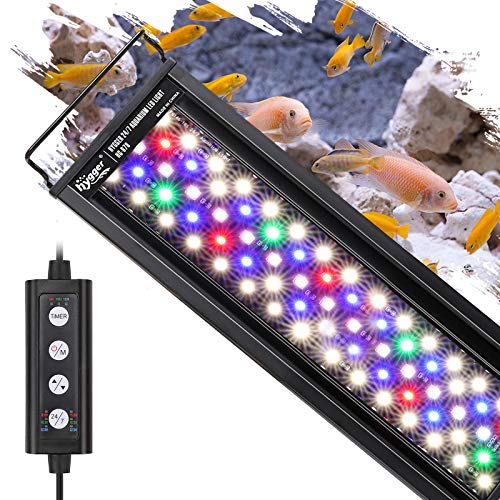
hygger 18W 24/7 Aquarium LED Light with Extendable Bracket

Lominie A20 Freshwater Planted Tank LED with Gooseneck

hygger 26W 24/7 Aquarium LED Light with Extendable Bracket
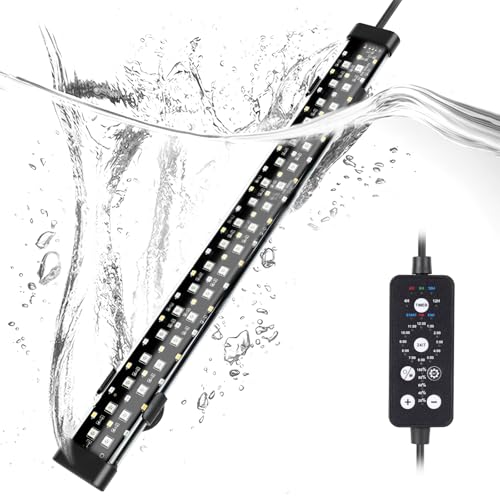
hygger Submersible LED Aquarium Light 14W 15in IP68

FZONE Light 90 60W Full Spectrum Aquarium Light

SEAOURA 24/7 Planted LED Aquarium Light 30-36 in

SEAOURA 24/7 LED Aquarium Light 18-24 Inch

SEAOURA WRGB Programmable Aquarium Light 36-42in
More Details On Our Top Picks
The appeal here is automation that actually works. Out of the box, this bar runs a natural rhythm: warm orange tones in the morning, full white through the day, then soft blue before shutting off overnight. You set it once and stop thinking about it.
The extendable bracket spans most standard rim widths, and seven color options plus a DIY mode let you override the schedule whenever you want a different look. For low-to-medium light plants like anubias and crypts, the 18W output is generally enough without pushing algae growth.
Strong Points
- Automated sunrise-to-moonlight cycle means no daily fiddling with switches
- DIY mode lets you program your own timing, colors, and brightness levels
- Extendable brackets fit a wide range of tank frames without extra hardware
- Gentle ramping between phases avoids startling skittish fish
Things To Consider
- Owners commonly report the default schedule needs shifting to match your own wake-up hours
- 18W may fall short for demanding carpeting plants in deeper tanks
Key Specs
Who It Suits Best
Beginners running a 10 to 20 gallon planted tank who want healthy plants without learning lighting curves first.
A Better Fit Elsewhere
Deeper 40-gallon scapes get more usable penetration from the hygger 26W model reviewed below.
Where the hygger bars sit across your rim, the Lominie A20 clamps on and aims. Its rustproof gooseneck rotates a full 360 degrees, so you can angle light exactly onto a feature rock or a patch of foreground moss instead of flooding the whole tank evenly.
Control comes three ways: remote, inline dimmer, or smart controller with timer functions. Four separate LED channels let you blend color and intensity to taste, which matters when you’re dialing in reds on alternanthera or keeping shrimp tanks looking neutral. One caution worth knowing: after setting the timer, avoid pressing other buttons, since owners report stray presses can clear the schedule.
Bright Spots
- 360-degree gooseneck gives precise aiming no bracket bar can match
- Four independent channels allow true custom color blending
- Clamp mount leaves open-top and rimless tanks looking clean
- 6500K output suits typical freshwater plant growth
Small Caveats
- Timer settings can be wiped by accidental button presses, per widely reported user feedback
- Single-point coverage suits nano tanks better than long rectangular layouts
Right Fit For
Hobbyists with 5 to 15 gallon nano aquascapes or refugiums who want spotlight-style control over one focal area.
Swap It Out When
Longer 30-inch-plus tanks spread light far more evenly with the SEAOURA 24/7 Planted LED covered later in this list.
This is the same platform as our top pick with roughly 44 percent more wattage behind it. That extra output translates into usable light reaching lower leaves in taller tanks, which is where stem plants like ludwigia tend to thin out under weaker fixtures.
You still get the automated sunrise, daylight, and moonlight progression, plus DIY scheduling for time, color, and brightness. In practice, mid-size planted tanks around 75 cm benefit most; the honest read is that an 18W bar often leaves the substrate level dimmer than plant roots would like. Same caveat applies here as its sibling: expect to nudge the default clock to fit your routine.
Upsides
- Higher wattage supports stem plants and denser planting schemes
- Full 24/7 automation handles the entire photoperiod unattended
- DIY mode covers custom timing, hue, and intensity combinations
- Extendable brackets adapt across common tank widths
Points To Note
- Default cycle timing typically needs adjusting to your household schedule
- More output means closer attention to algae management and CO2 balance
Made For
Intermediate hobbyists upgrading from basic fixtures on 20 to 40 gallon planted tanks with mixed stem and root-fed plants.
Consider Something Else When
Shallow 16 to 27 inch tanks don’t need the extra punch; the submersible hygger strip coming up next fits those better.
Submersible changes everything about how light lands in a tank. Because this strip sits inside the water column, illumination reaches plant surfaces directly with almost no reflection loss at the water line, and there’s no hood glare bouncing off your glass lid.
The build uses five rows of 2835 and 5050 LED chips rated for tens of thousands of hours, wrapped in an IP68 waterproof housing sized for 16 to 27 inch tanks. A 15-minute fade-in and fade-out prevents light shock, and nine colors plus adjustable brightness give you evening mood settings alongside the daytime spectrum. Suction cups hold it against the back wall, though algae will eventually film the housing, so plan on wiping it during water changes.
What We Like
- In-water placement delivers light straight to plant leaves with minimal loss
- Five rows of chips produce noticeably brighter, fuller coverage than single-row strips
- Slow 15-minute transitions protect fish from sudden light changes
- IP68 waterproofing removes worry about splashes and condensation
Room For Improvement
- The submerged housing collects algae film and needs periodic cleaning
- Suction cups can lose grip on textured or older silicone seams
Feature Snapshot
Who Will Love This
Keepers of shallow rimless or open-top tanks who dislike visible hoods and want discreet, even illumination.
Reach For A Different Pick When
Tanks beyond 27 inches need broader span; the FZONE Light 90 later in this list covers up to 43 inches properly.
This is the step up for anyone chasing dense growth. At 60W spanning 35 to 43 inch tanks, the Light 90 pushes serious output through six rows of LEDs combining RGB, white, and UV diodes, the latter supporting pigmentation and growth in ways standard white bars simply can’t.
The wider four-inch emission face spreads light more uniformly, reducing the hot spots and patchy “color spotting” cheaper multi-diode bars are known for. App control handles scheduling, timer, and sunrise-sunset fades from your phone, which beats walking over to a physical controller every time you tweak something. Fair warning: at this output level, CO2 injection and regular fertilizing stop being optional if you want clean glass.
Reasons To Buy
- 60W output sustains demanding carpeting plants and red species
- UV diodes support stronger coloration alongside RGB and white channels
- Wide emission face evens out distribution across long tanks
- App-based control makes schedule tweaks painless from anywhere in the house
Softer Spots
- High output demands CO2 and nutrient discipline to avoid algae outbreaks
- Oversized for anything smaller than a 35 inch footprint
At A Glance
Whose Shelf It Belongs On
Dedicated aquascapers running pressurized CO2 on 90 cm tanks who treat plants as the main event.
Not Your Match When
Low-tech 20 gallon setups will find the SEAOURA 18-24 inch model a calmer, simpler companion.
Compared to the hygger bars earlier in this list, the SEAOURA’s standout trait is its controller. A built-in clock pairs with an LCD touchscreen and six-button navigation, so programming happens on the unit itself rather than through a phone app or a maze of tiny buttons.
Underneath sits a six-row LED array mixing two rows of brighter 5054 chips with four rows of 2835s, delivering steady, flicker-free output across 30 to 36 inch tanks. Day and night modes offer twenty brightness levels, and the whole thing runs unattended once your 24-hour schedule is locked in. For a standard four-foot community planted tank, this hits a comfortable middle ground between price, output, and control sophistication.
Plus Points
- LCD touchscreen with real-time mode display simplifies programming
- Six-row LED array gives consistent, flicker-free illumination
- Twenty brightness levels allow fine tuning for algae control
- Built-in clock keeps schedules accurate through power blips
Minor Gripes
- On-unit controls mean walking to the tank for every adjustment
- Output suits medium-light plants more than demanding carpets
Quick Facts
Who Should Grab It
Owners of standard 30-36 inch community planted tanks who prefer physical controls over app dependency.
Another Choice May Suit
Smaller 18-24 inch tanks get identical features in a right-sized package from the SEAOURA model reviewed next.
First planted tanks live or die on simplicity, and this compact sibling of the 30-36 inch SEAOURA keeps the same friendly interface in a shorter body. The LCD touchscreen walks you through a 24-hour timer, and the display shows current mode and brightness at a glance, so there’s no guessing what the light is doing.
The six-row LED layout carries over too, pairing two rows of 5054 chips with four rows of 2835s for smooth, flicker-free output. DIY mode offers eight programmable segments, while day and night modes span twenty WRGB brightness levels. Anubias, java fern, and mosses thrive comfortably at these levels; demanding carpeting plants generally won’t.
Highlights
- Intuitive touchscreen makes first-time programming genuinely easy
- Eight-segment DIY mode allows a custom daily light curve
- Twenty-level brightness helps you find the algae-safe sweet spot
- Compact length suits 10-20 gallon tanks cleanly
Worth Noting
- Light output limits you to low and medium-light plant selections
- Touchscreens near splashed tank rims warrant careful hand placement
Best Suited To
Newcomers setting up their first 18-24 inch planted tank who want automation without a steep learning curve.
Look Elsewhere When
Once you add CO2 and root tabs, the FZONE Light 90’s higher output becomes the smarter long-term buy.
WRGB means each white, red, green, and blue channel adjusts independently, and that’s the whole point of this flagship SEAOURA. With 180 LED chips driving a high-PAR full spectrum, you can bias toward the 455nm blue and 660nm red wavelengths that fuel photosynthesis in sword plants and anubias, then rebalance for pure display color at viewing hours.
The published figures back the ambition: CRI of 93, PAR of 140, and 3721 lumens at 42W put it in genuine high-light territory for 36 to 42 inch tanks. Nine preset colors, a color-cycle mode, and twenty brightness levels round out the flexibility. Like the FZONE above, this much intensity assumes you’ve got CO2 and nutrients sorted; otherwise algae will happily take the surplus.
Standout Traits
- Four-channel WRGB tuning lets you shape spectrum per plant type
- PAR of 140 supports demanding species at depth
- CRI 93 renders fish and plant colors close to natural daylight
- 180-chip array spreads output evenly across long tanks
Honest Caveats
- High PAR output requires CO2 and fertilization to stay balanced
- Deep feature set takes some patience to learn fully
Core Details
The Right Fit
Experienced plant keepers running 36-42 inch high-tech tanks who want laboratory-grade spectral control without premium-brand pricing.
Where A Sibling Pick Shines
Simpler 30-36 inch setups save money and complexity with the SEAOURA 24/7 Planted LED reviewed earlier.
What Matters Most Before Choosing Lights For Planted Aquarium
Match Output To Your Plant List
Light intensity, measured as PAR (photosynthetically active radiation, the wavelengths plants actually use), should follow your ambitions. Low-light species like anubias and java fern do fine under 15-25W bars, while carpeting plants and red stems demand the 42-60W tier. Overlighting a low-tech tank invites algae faster than underwatering ever would.
Size And Mounting Style
Measure your tank’s inside width before ordering, since fixtures are rated for specific spans. Bracket bars suit standard framed tanks, clamp-on goosenecks excel on nano scapes, and submersible strips work best where hoods would ruin the look. The wrong mounting style frustrates daily use more than any spec shortfall.
Control And Automation
A reliable timer is the difference between thriving plants and a part-time hobby. Built-in clocks, LCD panels, and app control all accomplish the same goal; choose based on whether you’d rather tap a screen at the tank or adjust from your phone. Consistency matters more than the interface you pick.
Spectrum And Color Tuning
Full-spectrum fixtures with independent RGB channels let you separate growth lighting from display lighting. Fixed-spectrum bars handle most community tanks well, but dedicated aquascapers benefit from shifting blue and red ratios seasonally or per plant species.
Key Considerations Across These Picks
Traps First Timers Fall Into
The classic error is buying maximum wattage for a low-tech tank, then fighting algae for months. Another frequent misstep is ignoring tank length ratings; a 15-inch strip stretched over a 30-inch tank leaves dark zones where plants decline quietly. Match the fixture to your actual plant list first.
What Separates Premium From Basic
Higher-tier models spend their budget on diode density, wider emission faces, and finer control granularity. That buys even coverage, accurate color rendering, and tunable spectra rather than raw brightness alone. Paying up makes sense once you run CO2; until then, a solid programmable bar covers most needs.
Frequently Asked Questions
How many hours of light do planted aquariums need?
Most planted tanks thrive on 6 to 8 hours of consistent daily light. Longer photoperiors mainly feed algae rather than accelerate growth.
Can I use a regular LED shop light for my aquarium?
Shop lights lack the spectrum balance and waterproofing aquarium fixtures provide. They sometimes work temporarily but rarely support sustained plant health.
Do planted tank lights cause algae problems?
Excess intensity or duration contributes to algae, especially without CO2 and nutrient balance. Matching output to your plant load prevents most outbreaks.
Are submersible lights safe for fish?
IP68-rated fixtures are designed for full submersion and pose no electrical risk in normal use. Their sealed housings also resist condensation damage.
Is a timer really necessary for aquarium lights?
Yes, because inconsistent photoperiods stress both plants and fish. Automated schedules keep conditions stable even when your routine varies.
Closing Thoughts
Every tank on your stand deserves light matched to its plants, not just its dimensions. Start with your plant list, confirm the fixture span, and pick the control style you’ll actually use day to day. Any of these eight will grow a healthier aquascape than leaving your tank at the mercy of a window sill. Happy planting.
