

A long leash changes what a walk or training session looks like. Instead of a tight six-foot line, your dog gets space to sniff, wander, and practice recall while you keep a physical connection the whole time. That matters most for recall training, camping trips, and open yards where an unfenced boundary is a real concern.
The eight options below cover two distinct needs: true tie-out cables that anchor your dog in place, and long-line leads you hold or wear while working on obedience. Lengths run from 10 feet to 50 feet, materials range from coated steel cable to climbing rope and waterproof webbing, and handle designs vary from padded single grips to triple-handle control systems. Match the style to how you actually spend time outside with your dog, and the right choice becomes obvious fast.
The Shortlist At A Glance

WATFOON 50ft Tie Out Cable for Dogs Up to 300lbs

ZALER Long Dog Leash Training Lead (10FT, Black)
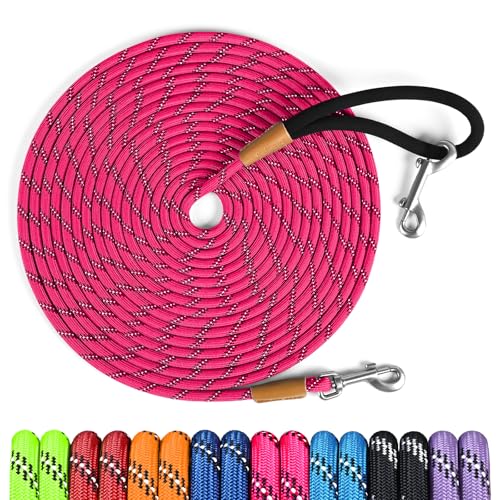
Lynxking Reflective Rope Training Lead Check Cord
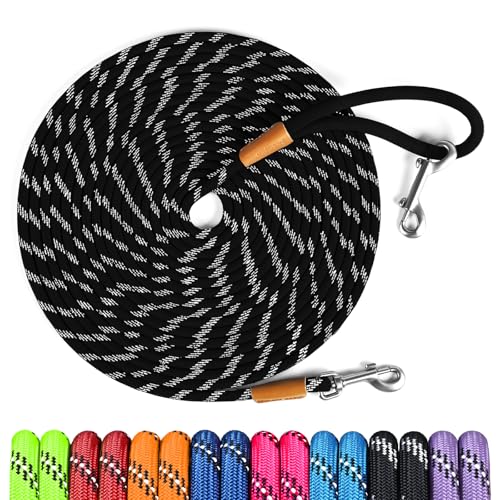
Lynxking Reflective Rope Training Lead Check Cord

Lynxking Reflective Rope Training Lead Check Cord

Tuff Pupper Heavy Duty 30 Foot Long Rope Leash

XiaZ Waterproof Long Leash for Dogs (30FT, Olive)
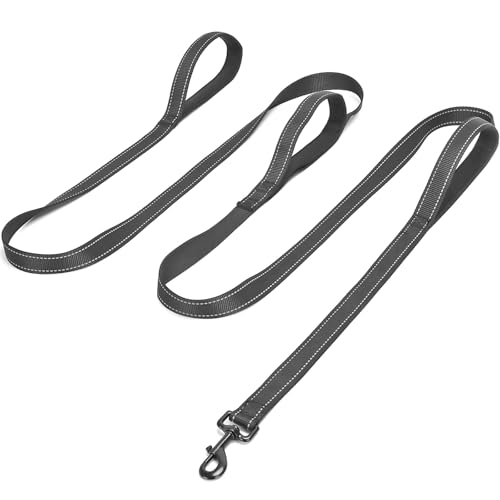
Mycicy 3 Handle Dog Leash 10FT
More Details On Our Top Picks
This is not a leash you hold. It’s a stationary tether built from 5mm stainless steel wire with a PVC jacket, rated for dogs up to 300 pounds and a 1000-pound break strength, which is the force the cable can withstand before failing. Fifty feet of reach gives a big dog real room to move around a stake point without feeling confined.
The double-crimped ends are where cheaper cables tend to give out first, so the reinforced fittings matter more than the raw length here. For unfenced yards, campsites, or garden time, it does one job and does it heavily.
Strong Points
- 1000-pound break strength handles powerful pullers and sudden lunges toward wildlife
- Stainless steel core with PVC coating shrugs off rain, dew, and corrosive coastal air
- Fifty feet of radius means a large dog can patrol a serious chunk of yard
- Chew-resistant construction survives dogs that destroy fabric leads in minutes
Things To Consider
- A taut steel cable near a play area can be a trip hazard, so route it away from walkways
- Owners commonly report coiling it loosely after use prevents kinks from forming over a season
Key Specs
Built With In Mind
Owners of extra-large or strong breeds who need a secure, fixed tether for unfenced outdoor spaces.
Swap It Out When
For active recall training where you stay attached, the ZALER Long Dog Leash gives you a handheld line instead of a fixed anchor.
Most long lines ship with a basic snap hook, and that’s usually the first failure point. The ZALER flips that script by including two screw-lock carabiners, the kind with a threaded gate you twist closed by hand so the gate can’t spring open on its own. Clip one end to the collar, the other to a tree, railing, or your belt, and the connection stays put.
The 10-foot length sits at the shorter end of the long-leash range, which makes it a smart bridge between a standard six-footer and a full check cord. It’s also handy for tying out at a campsite while you set up camp nearby.
What We Like
- Two screw-lock carabiners dramatically cut the risk of accidental gate release
- Nylon rope construction stays supple in cold weather rather than stiffening up
- Second carabiner doubles as a gear clip for bags, bottles, or keys on walks
- Reflective elements improve visibility on early morning and evening outings
Small Caveats
- The maker explicitly rules out climbing or hammock use, so respect those limits
- At 10 feet it’s short for wide-open field work compared to the Lynxking cords below
Who Should Grab It
Campers and backyard trainers who want a secure, lockable connection for medium-range control.
Where A Sibling Pick Shines
Recall drills across open ground call for the Tuff Pupper 30 Foot Rope Leash and its longer working radius.
A check cord is trainer shorthand for a long line used to reinforce recall, and this Lynxking version is built around comfort during exactly that kind of session. The braided nylon rope carries reflective straps along its whole length, so a dusk jog through the park doesn’t turn into a visibility problem. A padded handle keeps rope burn off your palm when your dog hits the end of the line at speed.
The rotating heavy-duty clip is the quiet hero here. Because it spins freely, the cord untwists itself instead of kinking into a stiff spiral after a few weeks of use, which is the complaint that kills most budget long lines early.
Highlights
- Full-length reflective strapping keeps you and your dog visible in low light
- Padded handle absorbs the shock of sudden stops without biting into your hand
- Rotating snap hook prevents the twist buildup that ruins lesser cords
- Thick braided rope balances strength with a weight that’s easy to carry all day
Points To Note
- Nylon absorbs water, so expect a damp, heavier line after swimming sessions until it dries
Made For
Joggers and everyday walkers running recall practice in parks before or after work hours.
Another Choice May Suit
Wet-weather owners will prefer the XiaZ Waterproof Long Leash, which rinses clean instead of soaking through.
This listing shares the same design DNA as the Lynxking cord above, which tells you something useful: the brand leans on one proven platform rather than scattering its effort. You get the same tough braided rope body, the same padded handle, and the same super-sturdy metal snap hook, offered here as a separate variant so you can match the exact length and colorway to your setup.
In practice, recall training rewards consistency more than novelty. Having a second identical cord, perhaps one left in the car and one at home, removes the excuse of “no lead, no session.” The tie-on simplicity also helps: clipping to a D-ring takes seconds even with cold fingers.
Upsides
- Identical proven build lets you standardize gear across home and travel kits
- Simple clip-and-go attachment works well for quick backyard sessions
- High-tensile rope holds up to repeated hard checks from enthusiastic dogs
Softer Spots
- With no locking gate on the snap hook, periodic inspection of the clasp is wise over time
- Single-handle design offers less grip flexibility than the Mycicy triple-handle leash
Right Fit For
Trainers building a repeatable routine who value matching equipment over extra features.
Reach For A Different Pick When
Hands-free hiking suits the Tuff Pupper better, since it supports waist-worn carrying.
Field trainers tend to care about two things in a check cord: light enough to coil and stuff in a vest pocket, strong enough to stop a dog mid-sprint. This third Lynxking variant answers both with high-strength thick rope that stays surprisingly lightweight, plus the familiar rotating clip and padded grip shared across the family.
The reflective strapping earns its keep during early-season hunting mornings when light arrives late. Compared with the WATFOON cable at number one, this is the mobile counterpart: you carry it, the dog drags it, and you step on it to deliver a check command. That drag-and-step technique is central to steadiness work, and a soft rope is far kinder underfoot than steel.
Bright Spots
- Lightweight enough to let a dog drag the line without fatigue during fieldwork
- Soft rope surface is comfortable to step on for check commands
- Reflective visibility supports pre-dawn training starts
Worth Noting
- Dragged rope picks up burrs and seeds, so a quick comb-through after field days keeps it tidy
Whose Shelf It Belongs On
Hunters and gundog handlers running drag-line steadiness drills in open fields.
Not Your Match When
Fixed-yard containment calls for the WATFOON tie-out cable instead of a handheld line.
Climbing rope is the material serious long-line makers gravitate toward, and Tuff Pupper builds this 30-footer entirely around it. High-tensile climbing rope stays flexible in a way stiff plastic-core leads never do, and it coils down small enough to wear on your waist or shoulder between sessions. That hand-or-waist versatility is rare at this price tier.
The nickel-plated 360-degree swivel clips at both ends are the detail worth pausing on. A swivel lets the line spin freely as your dog circles a tree or wraps around your legs, which means fewer mid-session untangling breaks. Thirty feet hits the sweet spot for recall work: long enough for real distance, short enough to reel in quickly.
Reasons To Buy
- Genuine climbing rope delivers flexibility cheap leads can’t match
- 360-degree swivel clips keep the line tangle-free as your dog circles
- Waist-worn option frees both hands for treats, whistles, or a coffee
- Doubles as a tie-down to trees, poles, or fences at camp or the beach
Trade Offs
- No dedicated traffic handle, so close-quarters control in crowds is limited
- Thirty feet may feel excessive in smaller suburban yards
Quick Facts
Who Will Love This
Hunting dog trainers and hikers who want pro-grade hardware and hands-free carrying in one lead.
Consider Something Else When
Urban walkers needing instant short-range grabs will get more from the Mycicy 3 Handle Leash.
Anyone whose dog treats every puddle as mandatory knows the smell problem: a soaked nylon lead that never quite dries in the car. The XiaZ solves it with a polyester core wrapped in a PVC outer layer, so water beads off instead of soaking in. Mud, lake water, and worse rinse away under a tap, and the line goes back into storage dry.
The PVC skin also handles temperature extremes without melting in summer heat or turning rigid in winter, a known weak spot for coated leads. The padded handle keeps grip comfortable across a 30-foot span, and the olive color hides dirt between washings. In our view, this is the low-maintenance choice of the entire list.
Plus Points
- Waterproof PVC shell means no damp-dog smell lingering in your vehicle
- Cleans with a simple rinse, no soap or scrubbing required
- Stays flexible across extreme hot and cold temperatures
- Padded handle keeps long sessions comfortable on your grip
Room For Improvement
- Coated surfaces can feel slightly slick with wet hands compared to braided rope
Details At A Glance
Best Suited To
Owners in rainy climates or with water-loving dogs who hate maintaining soggy gear.
Look Elsewhere When
Maximum strength for giant breeds points back to the WATFOON cable’s 1000-pound rating.
Three handles on one leash sounds like a gimmick until you’ve grabbed the wrong end of a standard lead in an emergency. The Mycicy places a short traffic handle about two feet from the collar for crowded sidewalks and instant control, a standard six-foot position for relaxed walking, and the full ten-foot grip for giving your dog slack outdoors. Each transition takes half a second.
The webbing itself is one inch wide and 2mm thick, a dense nylon weave aimed squarely at large pulling breeds. A heavy-duty metal clasp with a 360-degree swivel attaches to any collar or harness D-ring without twisting the tape. Reflective stitching adds a visibility layer for night routes.
Standout Traits
- Traffic handle delivers immediate close control near roads and crowds
- Wide, tightly woven nylon stands up to sustained pulling from big dogs
- Swiveling clasp prevents the leash from corkscrewing during walks
- Reflective threading improves safety on dim evening streets
Honest Caveats
- Extra handles add bulk, and some owners report the spare grips catching on doorframes indoors
- Ten feet is modest next to the 30-foot Tuff Pupper for open-field recall work
Core Details
The Right Fit
City dwellers with strong medium-to-large dogs who split time between busy streets and open park space.
Skip It When
Long-distance recall training needs the Lynxking check cord’s extended reach instead.
What Matters Most Before Choosing Long Leashes For Dogs
Length Should Match Your Training Stage
Shorter long lines, in the 10 to 15 foot range, suit dogs still learning boundaries and owners working in tighter spaces. Twenty to thirty feet is the recall-training sweet spot, far enough to test response at distance yet manageable to gather quickly. Fifty-foot options belong in genuinely open areas, and they demand more skill to handle without tangling.
Material Decides Maintenance
Braided nylon rope feels great and absorbs shock, but it soaks up water and dries slowly. Coated cable and PVC-jacketed webbing wipe clean and resist weather, at the cost of a stiffer feel in hand. Climbing rope splits the difference with flexibility and strength. Match the material to your climate and how much cleanup you’ll tolerate.
Hardware Is Where Cheap Leads Fail
The clip takes every lunge your dog delivers, so swivel action and solid metal construction matter more than almost anything else. Screw-lock carabiners add security for tie-out duty, while rotating snap hooks prevent twist buildup on handheld lines. Inspect clasps periodically regardless of brand.
Handle Design Shapes Daily Comfort
Padded grips prevent rope burn when a dog hits the end of the line at speed. Multiple handle positions, like the Mycicy’s three-grip layout, earn their keep in mixed urban environments. Waist-worn options free your hands for training tools.
Key Considerations Across These Picks
Traps First Timers Fall Into
The most common error is buying fifty feet for a small yard, then fighting constant tangles and trip hazards. Another frequent miss is pairing a thin cord with a powerful breed, which wears hardware prematurely. Skip leads without swivel clips if your dog circles you often, and always confirm the stated weight limit covers your dog with margin to spare.
When Paying More Pays Off
Higher-tier leads justify their cost through hardware and materials: climbing rope, nickel-plated swivels, screw-lock gates, and double-crimped ends all extend service life significantly. Budget options remain fine for calm, small dogs used occasionally. Strong pullers, daily users, and anyone training seriously will find the upgrade pays for itself in avoided replacements.
Frequently Asked Questions
How long should a dog training long line be?
Twenty to thirty feet suits most recall training because it tests distance while staying manageable. Go shorter for beginners and tighter spaces, longer only for open fields.
Can a long leash replace a fenced yard?
No. A long line requires your supervision and physical presence at all times. It supplements training and controlled outings, never replaces secure containment.
What’s the difference between a tie-out cable and a long leash?
A tie-out cable anchors your dog to a fixed point while you’re nearby. A long leash stays in your hand or on your waist, keeping you connected during active training.
Are reflective long leashes necessary?
They matter most for dawn, dusk, and night walking along roads. For purely daytime field training, reflectives are a nice bonus rather than essential.
How do I stop a long leash from tangling?
Choose leads with 360-degree swivel clips, coil the line loosely between uses, and avoid letting your dog circle trees or posts repeatedly during a session.
Closing Thoughts
The right long leash comes down to honest self-assessment about where you and your dog actually spend time. Fixed yard, open field, city sidewalk, or rainy trail, there’s a specific tool above built for that scenario. Start with your most common outing, match the length and material to it, and you’ll land on the right pick without second-guessing.
