

A planted tank lives or dies by its light. Too little and your java fern stalls out; too much or the wrong spectrum and you’re scraping algae off the glass every weekend. This roundup sorts through eight fixtures that cover nearly every setup, from a five-gallon desk nano to a four-foot aquascape, so you can match output to your plants instead of guessing.
The Lineup, Simplified
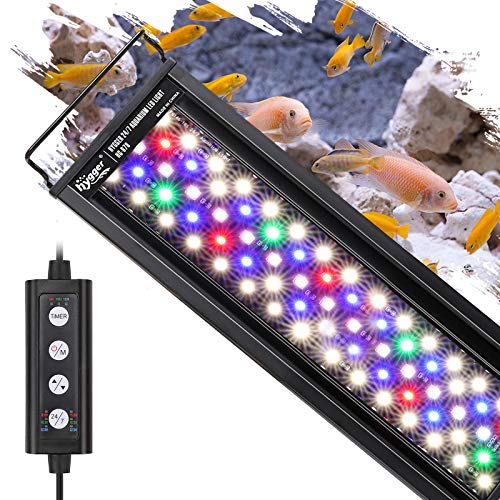
hygger 18W 24/7 Lighting Aquarium LED Light

Tetra LED 10 Gallon Complete Fish Tank Kit

Lominie A20 Freshwater Planted Tank Light

hygger 26W 24/7 Lighting Aquarium LED Light

FZONE Light 90 60W Aquarium Plant Light

SEAOURA 24/7 Planted LED Aquarium Light 30-36 in

SEAOURA WRGB Programmable Aquarium Light 36-42in

Pawfly 6W USB Clip-On Aquarium Light
The Details Behind The Selections
The appeal here is automation that actually mimics a day. Out of the box, this fixture runs an orange sunrise gradient in the early morning, holds white daylight through most of the day, then fades to blue moonlight before shutting off overnight. For anyone who leaves for work before dawn, that’s a full photoperiod handled without a single button press.
The extendable bracket spans standard tank rims, so installation is a two-minute job. An optional protection plan covering drops, spills, and post-warranty malfunctions is also available at purchase.
Strong Points
- Hands-off 24/7 cycle keeps plants on a consistent schedule, which matters for steady photosynthesis
- DIY mode lets you set custom time, color, and brightness instead of living with defaults
- Seven color options give moonlight and accent looks without buying separate night lighting
- Extendable bracket fits a range of tank widths with no drilling or clamping hardware
- Optional damage coverage adds peace of mind for a fixture that sits over open water
Things To Consider
- The default window starts around 6 am, so shifting the schedule requires digging into settings
- At 18W, very demanding carpeting plants may want more intensity than this delivers
Key Specs
Who It Suits Best
Busy keepers running low-tech planted tanks with anubias, ferns, and mosses who want a set-and-forget fixture.
Where A Sibling Pick Shines
Deeper tanks or heavier stem plant loads are better served by the hygger 26W version later in this list, which trades up raw output.
Unlike the standalone fixtures elsewhere on this list, Tetra’s kit is a whole starting point: a 10-gallon glass aquarium with a low-profile hinged hood, integrated LEDs, an internal filter with cartridge, water conditioner, food samples, and a setup guide. Nothing else to research before fish go in.
The energy-efficient LEDs cast a natural daylight look that suits easy plants like hornwort or banana lily. Filtration pairs mechanical debris capture with activated carbon to handle odors and discoloration, which keeps maintenance simple during those first chaotic months of cycling a new tank.
Everyday Perks
- Complete kit removes compatibility guesswork entirely
- Hinged hood makes feeding and partial water changes less fiddly
- Carbon filtration addresses smells and yellowed water common in new setups
A Few Limitations
- The stock hood light is built for viewing, not serious plant growth, so demanding species will stall
- Fixed output means no dimming or timer customization
- Growing hobbyists often replace the filter cartridge system within a year
Right Fit For
First-timers setting up a family or office tank who value one-box simplicity over tuning options.
Swap It Out When
Anyone prioritizing plant growth should skip ahead to the Lominie A20 clip-on, which mounts over an existing tank without replacing it.
Rimless tanks and odd-shaped nanos defeat bracket lights, and that’s exactly where this clip-on earns its keep. A rustproof 360-degree gooseneck lets you aim the head precisely, whether you’re spotlighting a single driftwood mound or washing light across a shallow planted cube.
Control comes three ways: remote, inline dimmer, or smart controller with timer functions. Four separate LED channels mean you can shift the white balance toward red or blue to flatter specific plant colors. One widely reported quirk worth knowing: after setting the timer, pressing other buttons can reset your programming, so finish adjustments deliberately.
Benefits That Matter
- 360-degree gooseneck solves mounting on tanks without rims or hoods
- Four adjustable channels let you tune spectrum per plant type
- Three control paths suit both casual users and tinkerers
Points To Note
- Timer settings are sensitive to accidental button presses, a commonly reported frustration
- The 6500K bias favors plant growth over dramatic fish coloration
Made For
Nano tank hobbyists and refugium builders who need precise aiming on rimless or unconventional glass.
Reach For A Different Pick When
Longer tanks need broad coverage rather than a focused beam, and the FZONE Light 90’s wide bar handles that far better.
This is the same platform as our opening pick with roughly forty percent more wattage behind it. That difference shows up in deeper tanks, where light falls off fast with distance, and with stem plants like ludwigia or rotala that need real intensity to color up. Everything else carries over: the automated sunrise-daylight-moonlight schedule, DIY programming for time, color, and brightness, seven colors, and the extendable bracket.
An optional protection plan is offered here too, with parts, labor, and shipping bundled into claims. In practice, owners of 20-gallon-long and similar footprints tend to gravitate to this size once their first low-light setup succeeds and ambitions grow.
Well-Handled Touches
- Extra wattage penetrates deeper water columns for mid-ground stems
- Identical 24/7 automation means zero learning curve if you’ve used the smaller model
- DIY scheduling supports split photoperiods to limit algae pressure
- Damage plan covers shipping costs on repairs, not just parts
Small Caveats
- Higher output raises algae risk unless you balance nutrients and CO2 accordingly
- Overkill for shallow tanks holding only slow growers like anubias
Feature Snapshot
Who Will Love This
Intermediate keepers stepping up from easy plants to stem-heavy layouts in standard 20-gallon-class tanks.
Not Your Match When
Four-foot scapes demand wider coverage than any bracket light provides, which is the FZONE Light 90’s territory.
Step up to a serious aquascape and the requirements change: you need width, spectrum control, and enough PAR (photosynthetically active radiation, the light plants actually use) to reach the substrate. The FZONE Light 90 answers all three with six rows of RGB, white, and UV LEDs across a broader four-inch emission area, designed to reduce the patchy “color spots” cheaper bars produce.
App control handles timers plus dedicated sunrise and sunset ramps, so livestock get gradual transitions instead of a jarring snap-on at noon. UV diodes support growth and coloration while the white rows deliver efficient everyday brightness. Compared to the SEAOURA WRGB further down, this leans toward raw spread and output over granular channel tweaking.
What Earns Its Place
- Wide emission area evens illumination across 35-43 inch tanks
- UV plus RGB plus white mix serves both growth and display goals
- App-based sunrise/sunset ramps reduce stress on fish and shrimp
- 60W output sustains demanding carpeting and red plants
Practical Considerations
- High output demands consistent fertilization and CO2 to avoid algae blooms
- Overkill for low-light tanks where half the capability goes unused
Core Details
The Right Fit
Dedicated aquascapers running high-tech planted tanks in the three-and-a-half-foot range who won’t compromise on spread.
Another Choice May Suit
Keepers wanting per-channel color experimentation on a tighter budget will find the SEAOURA WRGB more accommodating.
Standard 30 to 36 inch tanks are the most common size in home aquariums, and this fixture targets them directly. Six rows of quality LED chips, mixing two brighter 5054 rows with four 2835 rows, deliver consistent illumination that holds its own against pricier programmable bars. Colors stay vibrant day and night, which matters in a community tank viewed from across the room.
The touch controller with an LCD screen is the standout convenience here. A built-in clock drives the 24/7 schedule, so programming happens on the fixture itself rather than through an app. For households where multiple people feed the fish, a physical interface everyone can understand beats smartphone-only control.
Useful Strengths
- Six-row chip array produces bright, uniform coverage for the size class
- On-board LCD clock simplifies scheduling for the whole household
- Touch controls respond quickly and hold settings reliably
- Planted-tank tuning suits moderate light species without excess
Less Ideal Details
- No app remote access, so changes require walking to the tank
- Limited to 30-36 inch spans, leaving longer tanks underserved
Who Should Grab It
Owners of standard 30-36 inch community planted tanks who want dependable automation without app dependence.
Consider Something Else When
Smaller desktop setups under three feet pair better with the compact Pawfly clip-on reviewed last.
Where the previous SEAOURA keeps things simple, this 36-42 inch model hands you the full mixing board. WRGB stands for white-red-green-blue channels, and all four are independently adjustable, backed by 180 premium chips, nine preset colors, a color-cycle mode, and twenty brightness steps. Enhanced 455nm blue and 660nm red wavelengths drive photosynthesis in classics like java fern, anubias, and sword plants.
The published figures read well for the class: CRI of 93 for accurate color rendering, PAR of 140, 3721 lumens, and a 10000K rating at 42W. Three timer modes round out the package. Against the FZONE Light 90, you trade some raw spread for finer spectral control at a friendlier commitment level.
Strengths Worth Knowing
- Four-channel DIY tuning lets you dial ratios per plant palette
- High CRI renders fish and plant colors faithfully to the eye
- PAR of 140 supports demanding species in this tank range
- Nine presets plus color cycling simplify mood lighting
- Three timer modes cover varied daily routines
What To Weigh
- Deep menu structure means a learning curve before settings feel intuitive
- At 10000K the look runs cool and crisp, which not everyone prefers visually
Quick Facts
Whose Shelf It Belongs On
Advanced hobbyists running mixed plant palettes on longer tanks who enjoy fine-tuning their spectrum seasonally.
Look Elsewhere When
Simplicity seekers should stick with the SEAOURA 24/7 model above, whose LCD clock skips the menus entirely.
Betta bowls, shrimp cubes, and five-gallon desks don’t need sixty watts; they need something small, quiet, and dimmable. This USB-powered clip-on covers 1 to 5 gallon tanks with full-spectrum output spanning 6500K white plus blue, green, and red diodes, all dimmable, with a timer built in.
One detail deserves attention before checkout: the adapter isn’t included, and the unit wants a 5V/2A supply. Underpowered phone chargers trigger a flashing warning mode, and at 5V/1A you’ll need to drop brightness to stop flickering. Run it off a proper source and it’s a tidy little performer for moss balls and floating plants.
Positive Points
- USB power slots into existing desk outlets and power banks
- Clip mount suits tiny tanks where brackets won’t fit
- Four-color full spectrum with dimming covers nano plant needs
- Overload warning flashes alert you to insufficient power before problems start
Honest Caveats
- No adapter ships in the box, so budget for a proper 5V/2A plug
- Weak supplies cause flickering until brightness is reduced
- Clip positioning needs occasional nudging on curved glass
Essential Details
Perfect Match For
Dorm, office, and desktop keepers running betta or shrimp nanos with low-light plants like moss and floaters.
Skip It When
Anything beyond five gallons calls for the SEAOURA 24/7 model, whose six-row output fills a mid-size tank properly.
Matching Light To Your Tank Before You Buy
Start With Tank Size And Depth
Light intensity drops sharply as it travels through water, so depth dictates wattage more than floor space does. A 10-gallon tall tank often needs more punch than a 20-gallon long despite holding less volume. Measure your rim width too, since extendable brackets and clip-ons each have hard limits.
Match Spectrum To Your Plants
Spectrum describes which wavelengths a fixture emits. Slow growers like anubias thrive under basic white light, while red plants lean on deep red and blue channels to develop color. Fixtures with independent RGB channels reward experimentation; fixed-output hoods do not.
Decide Between Automation And Control
The 24/7 cycle fixtures remove daily decisions entirely, which suits busy households and prevents forgotten photoperiods that trigger algae. App-controlled and multi-mode units cost more but let you run siesta schedules or seasonal shifts. Honest self-assessment matters more than feature counts here.
Factor In Algae Management
Every watt you add feeds plants and algae alike. Higher-output fixtures assume you’ll balance fertilizers, CO2, and photo periods together. Running strong light over a lightly stocked, unfertilized tank is the fastest route to green water.
Key Considerations Across These Picks
Traps First Timers Fall Into
The classic error is buying on tank length alone and ignoring depth, then wondering why carpeting plants melt. Another frequent stumble is pairing high-output fixtures with nutrient-starved tanks. Read your plants’ actual requirements first, then size the light second.
What The Higher Tier Buys
Spending up generally buys channel independence, wider even coverage, and app-level scheduling. Those features matter once you chase red plants or run CO2 injection. For low-light tanks, the budget end of this list already covers everything you’ll ever need.
Frequently Asked Questions
How many hours of light do planted tanks need daily?
Most planted tanks do well with 6 to 8 hours of consistent light. Longer photoperiods mainly benefit algae, not plants.
Can I use a regular household LED bulb over my aquarium?
Household bulbs lack the spectrum spread and waterproof design aquarium fixtures provide. Dedicated units distribute light evenly and resist humidity.
Do planted tank lights cause algae problems?
Light alone doesn’t cause algae; imbalance between light, nutrients, and CO2 does. Consistent photoperiods with matched fertilization keep growth on your terms.
Are programmable lights worth the extra cost?
For low-light setups with easy plants, probably not. Hobbyists chasing coloration, carpets, or CO2-injected scapes get clear value from channel control.
How often should I clean my aquarium light?
Wipe the housing and lens monthly with a damp cloth to remove mineral film and dust. Salt creep and hard-water spots cut output noticeably over time.
Closing Remarks
Your tank tells you what it needs faster than any spec sheet. Start with the smallest fixture that meets your plants’ stated requirements, automate the photoperiod, and upgrade only when growth plateaus. Every option here has a clear owner waiting for it; the rest is patience and a good fertilizer routine.
