

Indoor cats burn energy in short bursts, and a toy that responds to your hand keeps those bursts coming. A remote control cat toy lets you steer the action from the couch, which matters when your cat is bored at 9 p.m. and you are not interested in crawling around the living room waving a wand. The eight options below cover everything from a simple battery-powered mouse to sensor-driven smart toys that navigate furniture on their own. Each one earns its spot through specific design choices, not marketing copy.
The Lineup, Simplified

SmartyKat Electronic Motion Cat Toy

FurSo Remote Control Flapping Bird Toy

Tchernt Speed 2.0 Tail Interactive Cat Toy Ball

Tchernt Speed 2.0 Tail Interactive Cat Toy Ball
Tchernt Speed 2.0 Tail Interactive Cat Toy Ball

AsFrost Upgraded Interactive Cat Toy (SkyBlue)

PAKESI Remote Control Smart Cat Toy

PAKESI Remote Control Smart Cat Toy
Inside Each Recommended Option
The SmartyKat Race ‘N Chase is the simplest entry here: a battery-powered mouse you steer forward and backward from a handheld remote. That two-button control scheme means no learning curve, which makes it a natural first remote toy for a household that has never tried one.
In practice, the appeal is unpredictability. Because you control the direction, the mouse can dart, stall, and reverse in ways an automated toy never will, and cats that ignore motorized toys often respond to that erratic rhythm. It runs on replaceable batteries rather than a charging cable, so there is nothing to plug in between sessions.
Positive Points
- Two-button remote keeps operation effortless for any household member
- Prey-like motion and texture tap into natural chasing instincts
- Battery power means no charging downtime before play sessions
- Encourages sedentary cats to run and pounce instead of watching
Things To Consider
- Disposable batteries add ongoing cost compared with USB-rechargeable rivals like the FurSo bird
- Forward-and-backward control only, so steering is less precise than wheeled smart toys
Who Will Love This
A first-time owner with a kitten or a hesitant cat who needs low-pressure introduction to interactive play.
Where A Sibling Pick Shines
The FurSo flapping bird suits owners who want chirping sounds, motion-sensor activation, and rechargeable convenience in one unit.
Where the SmartyKat mouse keeps things bare-bones, the FurSo Pounce Bird layers on nearly every feature this category offers. It is a plush ground bird, not a flyer, that flaps and chirps like a sandpiper or sparrow, and a built-in motion sensor wakes it the instant your cat touches it.
The remote works up to roughly ten feet with clear line of sight, letting you start, stop, switch movement modes, and adjust chirp volume without leaving your seat. Charging takes about 40 to 60 minutes over the included Type C-USB cable, though the manufacturer specifies a 5V/1A charger only. An idle dormant mode conserves charge between sessions, so the toy tends to be ready when your cat decides it is time to hunt.
The Good Stuff
- Motion sensor triggers instant flapping and sound on contact
- Type C-USB recharging eliminates disposable battery spending
- Remote adjusts volume, useful in apartments or during calls
- Dormant mode preserves battery between spontaneous play bursts
- Lifelike bird movement and chirping hold attention longer than wheels alone
Worth Noting
- Plush fabric collects fur and dust, so occasional cleaning keeps it hygienic
- Charger restriction to 5V/1A adapters may frustrate faster-charging setups
Feature Snapshot
Made For
Cat owners whose pets fixate on birds at windows and want sound-rich, hands-off stimulation indoors.
Consider Something Else When
Owners of carpet-heavy homes chasing pure running exercise may prefer the Tchernt Speed 2.0 Tail ball, built to roll on carpet.
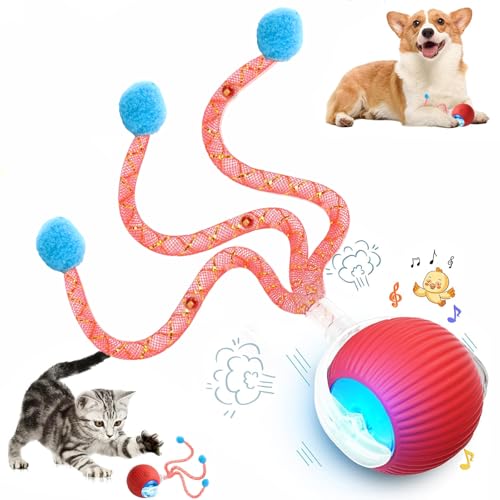
This rolling ball trades a handheld remote for onboard intelligence. An elastic tail accessory whips around as the ball moves, paired with lifelike bird calls, and the combination drives most cats into full stalking mode within seconds of activation.
Mode selection happens through light colors: purple signals slow movement suited to timid kittens, yellow marks an interactive setting for curious cats, and blue indicates fast mode for energetic adults, which the manufacturer notes can roll on carpet. A single button press cycles modes, and holding it for two seconds jumps straight to fast. The 300mAh battery reaches a full charge in roughly 30 minutes using a 5V/1A adapter.
What Earns Its Place
- Three distinct speeds match different feline temperaments
- Elastic tail plus bird calls create convincing prey behavior
- Fast mode rolls on carpet where many toys stall
- Half-hour recharge minimizes downtime between sessions
Small Caveats
- No remote control, unlike the AsFrost or PAKESI options later in this list
- Only compatible with 5V/1A adapters per the manufacturer
At A Glance
Right Fit For
Households wanting set-and-forget motion play without managing another remote on the coffee table.
Another Choice May Suit
Anyone wanting directional command should look at the AsFrost upgraded toy, whose controller adjusts speed and chase direction directly.
This listing carries the same Tchernt Speed 2.0 platform as the previous entry, and that repetition is actually useful information. Buying a second unit gives multi-cat homes two independent balls, so a dominant cat cannot monopolize the only moving toy in the room.
You get the identical feature set: three color-coded speed modes, an elastic tail accessory, synthesized bird calls, and a 300mAh cell that charges fully in about half an hour. Owners commonly report the tail attachment as the first wear point, which is why the included spare matters more than it first appears.
Points In Its Favor
- Duplicate-unit strategy prevents toy guarding in multi-cat homes
- Spare tail accessory doubles effective lifespan
- Erratic movement patterns keep hunting instincts engaged
Details To Watch
- Elastic tail is a consumable part; expect eventual replacement needs
- Identical appearance to its sibling listing, so label chargers to avoid mix-ups
- Sound effects may annoy light sleepers during late-night zoomies
Who Should Grab It
Two-cat households that want affordable redundancy rather than a single premium smart toy.
Swap It Out When
Quiet operation matters more than quantity, the PAKESI smart mouse’s silent silicone body is the better call.
The third Tchernt variant rounds out the trio, and it earns its badge through sheer usability. This is the ball you reach for every evening because starting it takes one press and putting it away takes none; it simply gets switched off and dropped back in the basket.
For first-time use with a kitten, the manufacturer recommends beginning in slow mode, marked by the purple indicator, then graduating to yellow and blue as confidence grows. That progression matters: a ball screaming across hardwood on day one can scare a young cat off electronic toys permanently. Fast mode handles carpeted rooms, which broadens where this thing is genuinely useful.
Key Advantages
- One-button operation suits daily, low-effort routines
- Graduated speed modes ease kittens into electronic play
- Carpet-capable fast mode expands usable floor space
- 30-minute charge cycle supports multiple sessions per day
Honest Caveats
- Bird-call audio repeats, and some cats habituate to it over weeks
- Hard floors amplify the noise level noticeably
Whose Shelf It Belongs On
Busy owners who want reliable nightly exercise for one cat without app pairing, remotes, or setup rituals.
Look Elsewhere When
Steering precision is the goal, the PAKESI smart mouse with obstacle avoidance navigates cluttered rooms far better.
The AsFrost sits a tier above the Tchernt balls in control granularity. Its remote offers both automatic and manual modes, adjustable speed spanning 1500 to 3000 rpm, and clockwise or counterclockwise chase direction, giving you genuine directorial control over the game.
That adjustability has a practical purpose beyond novelty. A senior cat may only engage at lower speeds, while a young Bengal wants the top end, and being able to dial between them from the couch means one toy serves a changing household. Simulated mouse sounds layer onto the motion to sharpen the prey response further. Compared with the fixed three-mode Tchernt, this is the choice for owners who treat play sessions as deliberate exercise programming.
Reasons It Performs
- Wide 1500–3000 rpm speed range fits kittens through athletes
- Directional control creates varied, repeatable chase patterns
- Auto and manual modes suit solo and supervised play alike
- Mouse audio deepens the predatory trigger response
Practical Considerations
- More settings mean a longer learning curve than one-button rivals
- Remote-dependent operation requires keeping track of a second device
Core Details
Best Suited To
Engaged owners of high-drive breeds who want tunable intensity rather than a fixed-speed toy.
Not Your Match When
Minimalists who resent extra gadgets will find the Tchernt Speed 2.0 ball’s button-only design far simpler to live with.
This PAKESI mouse-shaped rover solves the most common complaint about motorized toys: getting stuck under the sofa. Built-in sensors detect obstacles and narrow gaps, prompting the unit to reverse and reroute instead of grinding against the baseboard until someone rescues it.
The silicone shell absorbs impact, so repeated collisions with chair legs do not crack the housing the way rigid plastic eventually does. Operation stays quiet enough for apartment walls and nap schedules, and the surface compatibility list covers wood, tile, hardwood, and thin carpet. Remote control adjusts speed between fast and slow settings, while a smart interactive mode lets the toy move, shake, and bounce autonomously.
Features That Help
- Obstacle avoidance prevents under-furniture rescue missions
- Silicone body withstands years of bumps and drops
- Near-silent running respects neighbors and sleeping humans
- Works across wood, tile, hardwood, and thin carpet
- Dual autonomous and remote-driven modes add variety
Softer Spots
- Thick high-pile carpet falls outside the stated surface range
- Sensor navigation occasionally takes conservative, slower routes
Key Specs
The Right Fit
Owners of cluttered living rooms who are tired of fishing dead toys out from beneath sectionals.
Reach For A Different Pick When
Budget-conscious shoppers happy with basic motion will find the Tchernt Speed 2.0 ball covers essentials at a friendlier figure.
This second PAKESI listing shares the platform’s core strengths, and its badge reflects where those strengths land hardest: shared-wall living. Silent operation combined with soft silicone construction means a 2 a.m. play session produces neither motor whine nor hard plastic clattering across laminate flooring.
The remote toggles between fast and slow speeds to match your cat’s mood, and the smart interactive mode handles autonomous movement, shaking, and bouncing when you would rather watch than steer. Surface flexibility spans wood, tile, hardwood, and thin carpet, covering the flooring mix found in most rentals. Compared with the louder Tchernt balls earlier in this list, this is the considerate-housemate option.
What Works In Its Favor
- Silent running keeps downstairs neighbors unaware
- Shock-absorbing silicone shrugs off furniture impacts
- Remote speed adjustment suits lazy evenings and energetic mornings
- Autonomous mode entertains cats without constant input
Factors To Consider
- Deep-pile rugs exceed the recommended surface types
- Mouse shape appeals less to ball-chasing cats than the Tchernt design
Who It Suits Best
Apartment dwellers and night-shift workers whose cats play while the household sleeps.
Skip It When
Your cat prefers chirping plush prey, the FurSo flapping bird delivers sound-rich interaction this silent unit deliberately avoids.
What Matters Most Before Choosing Remote Control Cat Toys
Match the Toy to Your Cat’s Temperament
Timid cats shut down when a toy screams across the floor at full speed. Look for graduated speed settings, like the Tchernt’s purple slow mode, and start gentle. Confident hunters respond better to erratic, unpredictable movement than to smooth predictable loops.
Flooring Determines What Actually Works
Wheeled and rolling toys behave very differently on hardwood versus carpet. The Tchernt ball explicitly supports carpet in fast mode, while the PAKESI units cap out at thin carpet. Check the stated surface list against your own floors before committing.
Power Style Shapes Daily Ownership
Disposable batteries mean recurring cost and mid-play dead stops. Rechargeable Type C-USB designs such as the FurSo cost nothing to run after purchase, though many specify 5V/1A adapters only, so confirm your existing chargers comply.
Noise Tolerance Is a Real Constraint
Bird calls, mouse squeaks, and motor hum all carry. Apartments and shared walls favor silent builds like the PAKESI silicone mouse, while detached homes can embrace sound-rich toys that trigger stronger prey responses.
Key Considerations Across These Picks
Traps First Timers Fall Into
The most common mistake is buying for yourself instead of your cat. A feature-loaded unit with ten settings means nothing to a cat that freezes at loud noises. Start with your pet’s personality, then filter features. Second trap: ignoring floor type, which quietly kills half the toys in this category on day one.
Where The Extra Money Goes
Higher-tier models spend their budget on sensors, silicone shells, and rechargeable cells. Obstacle avoidance alone saves daily frustration in furnished rooms, and USB recharging pays for itself within months. Pay up when your home is cluttered or your usage is daily; stay basic for occasional supervised play.
Frequently Asked Questions
Are remote control cat toys safe to leave unsupervised?
Most are designed for supervised play, and sensor-equipped models handle obstacles better. Stay nearby during early sessions to learn how your cat interacts with the toy.
Do these toys work on carpet?
It depends entirely on the model. The Tchernt ball’s fast mode rolls on carpet, while the PAKESI units specify thin carpet at most.
How long do batteries typically last?
Rechargeable models like the FurSo charge in 40 to 60 minutes, and the Tchernt in about 30. Runtime varies with mode and usage frequency.
Will my cat lose interest quickly?
Rotation helps enormously. Alternate between two toys, store one out of sight, and swap weekly to keep novelty alive.
Are chirping sounds necessary?
No, but they strengthen prey drive for many cats. Sound-sensitive homes should prioritize silent models like the PAKESI instead.
Closing Thoughts
The right choice comes down to your floors, your walls, and your cat’s nerve. Sound-loving hunters get the most from the FurSo bird, tunable chasers suit the AsFrost, and quiet apartments belong to the PAKESI pair. Whatever you choose, start slow, supervise the first few sessions, and let your cat set the pace.
