

A shredded sofa arm is the price most cat owners pay for ignoring one simple instinct. Cats need to scratch daily, and a well-placed scratch pad redirects that energy away from your furniture and onto something built to take the abuse. The eight options below cover every setup, from budget cardboard refills to sisal ramps that double as climbing toys, so you can match the pad to your cat’s habits and your floor plan.
Your Options, Compared

Catinarla 5-Pack Reversible Scratch Pad with Box

RUBMEOW Cardboard Scratch Pad 5-Piece Set

miwoowim 3-Piece Oval Bowl Scratcher Set
PatiencET 3-Pack Corrugated Scratch Pad

SmartyKat Super Scratcher Chaise (Brown)

CHEERHOME PETS Sisal L-Shape Scratcher Ramp
Markarbarka 23.6 Inch L-Shaped Scratcher 2-Pack

Markarbarka Reversible Scratching Board 3-Pack
A Deeper Look At The Lineup
This set solves the refill problem in one purchase: five reversible corrugated pads slide into a 13-inch box, so when one side wears down you flip it, and when both sides go you swap in a fresh insert. The box itself measures roughly 13 by 9.4 inches with a 5-inch depth, which gives cats a low-walled container to paw at from any angle.
The pads are made from recycled corrugated cardboard bonded with non-toxic glue, and five packets of catnip come included to speed up first contact. In a busy living room, having spares on hand means your cat never faces an empty scratcher.
The Practical Payoff
- Five inserts mean months of coverage before you shop again.
- Reversible construction doubles the working life of each pad.
- Included catnip helps hesitant cats adopt the new spot quickly.
- Recycled material with non-toxic adhesive suits cautious owners.
Small Caveats
- Cardboard sheds crumbs over time, so expect light sweeping around the box.
- The compact footprint may feel tight for larger breeds.
Key Specs
Who It Suits Best
Budget-conscious owners of one or two small-to-medium cats who want a season of scratchers sorted in a single order.
A Better Fit Elsewhere
Maine Coon or Ragdoll owners will find more room in the RUBMEOW five-piece set, whose pads run up to 17 inches long.
Where the Catinarla set keeps things compact, RUBMEOW stretches out. The box spans about 17.5 by 11 inches, and the five inserts include two thicker wave-shaped boards alongside three flat ones, giving your cat a choice of texture and angle in one station. That extra length matters more than it sounds: bigger cats need room to fully extend their front legs, and cramped scratchers often get ignored.
The outer box uses USA-made paper card, and the boards themselves are recyclable corrugated paper with no added treatments. Owners of long-bodied cats commonly report this style of wide box gets daily traffic where narrower pads sat untouched.
Reasons It Performs
- 17-inch pads give large cats a full stretch.
- Mixed wave and flat inserts add variety.
- Five pieces extend replacement intervals considerably.
- Simple cardboard wipes clean with a quick shake-out.
Things To Consider
- The wider box claims noticeable floor space in tight rooms.
- No catnip is mentioned, so you may want to supply your own.
Right Fit For
Homes with medium or large indoor cats that outgrow standard 13-inch scratchers within weeks.
Skip It When
Apartment dwellers short on floor area should look at the miwoowim oval set instead, which stacks function into a smaller footprint.
This set blurs the line between scratcher and bed. You get two 17-inch oval bowl nests plus one boxed cardboard scratcher, sized for kittens and medium-sized cats. The bowl shape cradles a lounging cat while leaving the curved rim exposed for claw work, which means one piece of furniture handles two jobs.
For studio apartments or shared living rooms, that dual role earns its keep. Instead of dedicating separate floor space to a scratcher and a nap spot, the miwoowim arrangement consolidates both, and the three-piece layout lets you spread stations across rooms so scratching happens wherever your cat already hangs out.
Bright Spots
- Oval bowls double as beds, cutting clutter.
- Three pieces allow multi-room placement.
- Compact design fits apartments and dorms.
- Kitten-friendly sizing encourages early habits.
Points To Note
- Curved surfaces wear unevenly compared with flat pads.
- Larger adult cats may find the bowls snug.
Product Snapshot
Made For
Small-space owners raising kittens or housing one medium cat who naps as much as they scratch.
Another Choice May Suit
Heavy-duty scratchers that flatten cardboard fast are better served by the CHEERHOME PETS sisal ramp later in this list.
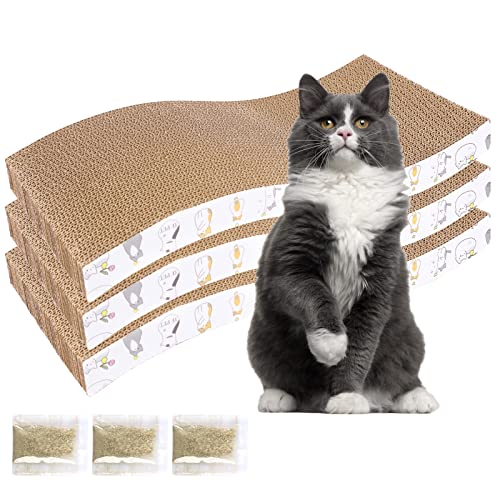
Some cats treat scratching as a full-body stretch routine rather than a quick claw trim. The PatiencET pack leans into that: one L-shaped lounger plus two flat pads, all shaped from denser-than-average recycled corrugated board assembled by hand. The curved profile invites climbing, rubbing, and rolling along with straight scratching.
Denser flute construction generally lasts longer than bargain-bin board, which offsets the fact that these pads lack a containing box. Scatter them near the couch or bed, wherever your cat already lounges, and the shapes do the persuading.
A Favorable Mix
- L-shaped lounger supports stretch-and-scratch posture.
- Upgraded dense cardboard resists rapid shredding.
- Handmade assembly shows consistent glue lines.
- Flat pads tuck under furniture edges neatly.
Less Ideal Details
- No box means loose cardboard bits collect nearby.
- Curved sections can’t be flipped like flat reversible pads.
- Only two flat refills against one shaped piece.
Who Will Love This
Owners of cats that combine napping, stretching, and scratching in one session, especially near sofas.
Consider Something Else When
Cats motivated mainly by scent respond faster to the SmartyKat chaise below, whose catnip infusion does the recruiting.
SmartyKat takes a different route to attracting reluctant scratchers: concentrated catnip is infused between each layer of cardboard during manufacturing, so every scratch releases a fresh burst of scent. That patent-pending process beats sprinkling dried nip on top, which fades in days. The chaise shape also cradles your cat, turning the pad into a designated hangout.
For cats that ignore plain cardboard, scent is usually the missing trigger. This single-pad buy costs more per unit than multipacks, but it’s the option most likely to convert a sofa-scratcher on the first week.
Positive Takeaways
- Layer-infused catnip renews with every scratch session.
- Chaise contour doubles as a cozy rest spot.
- Single focused design targets stubborn non-scratchers.
What To Weigh
- One pad only, so heavy households burn through it fastest.
- Catnip response varies; some cats stay indifferent.
Quick Facts
Best Suited To
Owners of picky or senior cats who need extra motivation to abandon the couch corner.
Swap It Out When
Multi-cat homes needing volume should choose the Markarbarka three-pack instead of paying per single pad.
Every other entry here relies on cardboard, which works well but wears out. The CHEERHOME PETS ramp switches to natural sisal fiber wrapped over a solid wood frame, the same rope material used on quality cat trees. Sisal stands up to claws far longer than corrugated board, making this the durability play of the lineup.
Versatility seals the deal. Prop it at its built-in 120-degree angle against a wall or sofa for vertical stretching, or lay it flat as a ramp; the hollow center even gives curious cats a tunnel to investigate. Two units arrive per pack, enough to cover two rooms.
A Few Highlights
- Sisal fiber outlasts cardboard many times over.
- 120-degree angle supports a full vertical stretch.
- Hollow center adds crawl-through play value.
- Two-pack covers multiple locations.
Factors To Consider
- Higher upfront cost than cardboard alternatives.
- Wood frame needs occasional tightening of fittings.
- Heavier to reposition than flat pads.
Core Details
The Right Fit
Owners of aggressive scratchers tired of replacing cardboard monthly, willing to invest once.
Reach For A Different Pick When
Tight budgets fit better with the Catinarla five-pack, which trades longevity for sheer quantity.
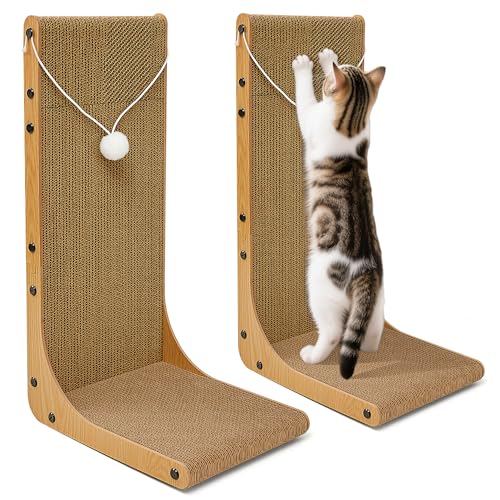
At nearly two feet long, this L-shaped board gives cats the tallest vertical scratch surface in the roundup. Each unit works standing against a wall or lying flat, and pre-punched holes at the top and base make assembly a minutes-long job. Toy balls attach to keep playful cats engaged between scratch sessions.
The two-pack configuration targets multi-cat homes directly: one unit beside the couch, another near the bedroom door, and territorial disputes over scratch rights mostly disappear. Wall-mountable hardware adds flexibility for renters who’d rather protect baseboards than drill.
The Good Stuff
- 23.6-inch height suits full-body vertical stretches.
- Dual orientation adapts to any room layout.
- Pre-drilled holes speed up setup.
- Attached balls entertain between scratches.
Points To Keep In Mind
- Assembly required, unlike ready-to-use flat pads.
- Tall profile draws the eye in small rooms.
Whose Shelf It Belongs On
Multi-cat families wanting dedicated vertical stations in high-traffic zones without buying a full cat tree.
Not Your Match When
Anyone seeking zero-setup simplicity will prefer the reversible flat boards in the Markarbarka three-pack reviewed next.
Markarbarka’s second entry goes wide instead of tall. These boxed pads use BC-flute high-density corrugated board, a thicker wave profile than standard scratchers, with a bark-like texture that taps directly into feline instinct. Each pad flips for double-sided use, effectively doubling service life before the next insert rotates in.
Three wide boxes arrive per pack, each with a bell ball for added play appeal. Compared with the brand’s L-shaped model above, this set skips assembly entirely and suits horizontal scratchers, the majority preference among house cats.
Practical Advantages
- High-density BC-flute board resists fast shredding.
- Reversible design extends each pad’s lifespan.
- Wide surface accommodates larger cats comfortably.
- Bell ball adds independent entertainment.
Details To Watch
- Horizontal-only orientation won’t satisfy dedicated climbers.
- Wide boxes occupy more floor area than slim pads.
Feature Rundown
Who Should Grab It
Households running two or more enthusiastic horizontal scratchers who want durable refills staged and ready.
Where A Sibling Pick Shines
Cats that insist on scratching upright belong with the Markarbarka L-shaped 2-pack, whose vertical panel matches that habit.
What Matters Most Before Choosing Scratch Pads For Cats
Match The Orientation To Your Cat’s Habit
Watch how your cat scratches before spending anything. Horizontal scratchers want flat or bowl-shaped pads like the miwoowim set, while vertical scratchers need the height of an L-shaped board or sisal ramp. Buying the wrong orientation is the most common reason a scratcher sits ignored next to a chewed armrest.
Size And Density Drive Longevity
A pad should let your cat fully extend their front legs, so measure your cat’s stretched reach and compare it to product dimensions. Denser flute grades, such as the BC-flute board in the Markarbarka three-pack, resist shredding noticeably longer than thin economy board, which matters in multi-cat homes.
Material Trade-Offs
Corrugated cardboard is affordable, replaceable, and most cats accept it immediately, but it sheds and needs rotation. Sisal wrapped over wood, as on the CHEERHOME PETS ramp, costs more upfront yet survives months of aggressive use. Renters and frequent movers often prefer lightweight cardboard for exactly that reason.
Placement Beats Everything
Even the best pad fails in the wrong spot. Put scratchers beside the furniture your cat currently targets, near sleeping areas, and along regular walking routes. Multiple cheap stations outperform one premium station in the wrong corner.
Key Considerations Across These Picks
Traps First Timers Fall Into
The classic error is buying one pad and expecting instant adoption. Cats need scent and repetition, so sprinkle catnip, place the pad where damage already happens, and reward use. Another slip is choosing the smallest, cheapest option for a large cat; undersized boards get abandoned within days.
What Separates Premium From Basic
Higher-priced options earn their cost through materials and engineering. Layer-infused catnip, solid wood frames, and high-density flutes all extend usable life, meaning fewer replacements per year. Paying up makes sense for heavy scratchers; casual kitties do fine on value multipacks.
Frequently Asked Questions
How often should a cardboard scratch pad be replaced?
Most pads last four to eight weeks under daily use by one cat. Flip reversible models first, then swap in a fresh insert once both sides fray.
Where should I place my cat’s scratch pad?
Position it next to the furniture your cat already scratches and near favorite napping spots. Visibility and convenience drive usage more than anything else.
Do all cats respond to catnip?
No, sensitivity is genetic and roughly a third of cats show little interest. Texture and placement still matter for those cats.
Can a scratch pad really protect my sofa?
It redirects the behavior rather than removing the instinct. Consistent placement plus rewarding pad use shifts most cats away from upholstery within weeks.
Are sisal scratchers better than cardboard?
Sisal lasts significantly longer but costs more upfront. Cardboard wins on price and easy replacement, sisal wins on durability.
Closing Thoughts
Your cat’s scratching habit isn’t going anywhere, so the goal is simply giving it a better outlet. Start by matching orientation to your cat’s style, then pick from the eight options above based on space, budget, and how hard your cat scratches. A well-placed pad pays for itself the first time your sofa survives a month untouched.
